
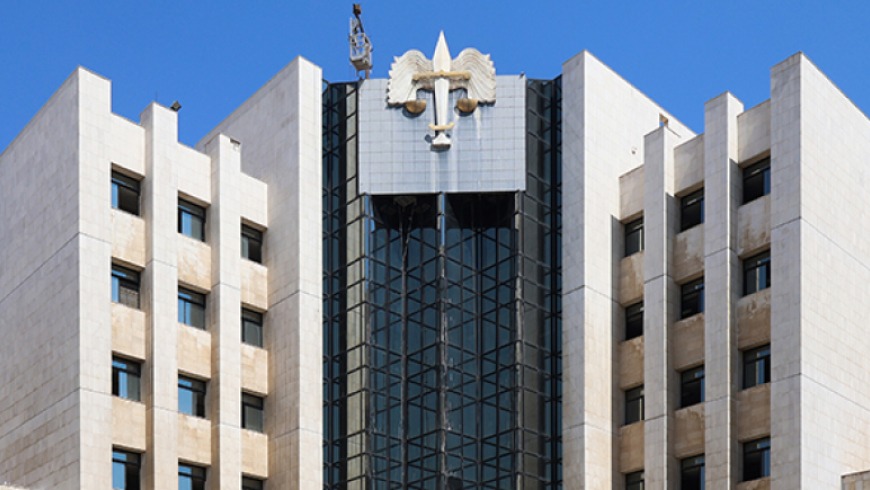
The Syrian Ministry of Justice has referred six judges from Suweida, associated with the so-called “Supreme Legal Committee,” to the Inspection Department for investigation, citing violations of judicial duties under the Judicial Authority Law. The judges, identified as Muhannad Abu Faur, Ayman Harfoush, Mufid Amasha, Issam Araoui, Shadi Murshid, and Mu’taz Sayegh, are accused of engaging in political activities and administrative roles that contravene judicial regulations.
According to a statement reported by the Syrian Arab News Agency (SANA), the ministry highlighted that the judges’ involvement in the committee, established in July 2025 by the spiritual leadership of the Druze community, violates Articles 78 and subsequent provisions of the Judicial Authority Law. These regulations prohibit judges from holding secondary roles, engaging in political activities, or expressing political opinions. The ministry described the committee’s work as “purely political” and contrary to national interests, accusing it of promoting division and separatism.
Tom Barrack: Proud of U.S. Role in Suweida Resolution, Urges Calm in Manbij
The Supreme Legal Committee, comprising nine members—including six judges and three lawyers—has been described as an attempt to establish a parallel local authority in Suweida amid escalating political and security tensions in southern Syria. The committee announced plans to form a temporary executive office to manage administrative, security, and service-related affairs in the province, citing “emergency circumstances.” Its stated objectives include safeguarding public and private institutions, combating corruption, addressing citizen grievances, and supporting families of martyrs, the wounded, and the forcibly disappeared. The committee also aims to oversee relief efforts, fact-finding missions, and the distribution of donations, while ensuring the operation of banks, economic facilities, and hospitals.
The ministry’s statement also noted unconfirmed reports of additional judges, Iklas Darwish and Khuzama Masoud, potentially participating in similar activities. All named judges have been referred for investigation to determine their involvement and face appropriate measures if found guilty.
The formation of the Supreme Legal Committee has sparked concerns about the emergence of parallel governance structures in Suweida, further complicating efforts to stabilize Syria’s southern regions. The committee’s actions, including appointing a former regime officer as a security chief, have intensified debates about its role and legitimacy in the context of Syria’s fragile post-conflict landscape.
This article was translated and edited by The Syrian Observer. The Syrian Observer has not verified the content of this story. Responsibility for the information and views set out in this article lies entirely with the author.