
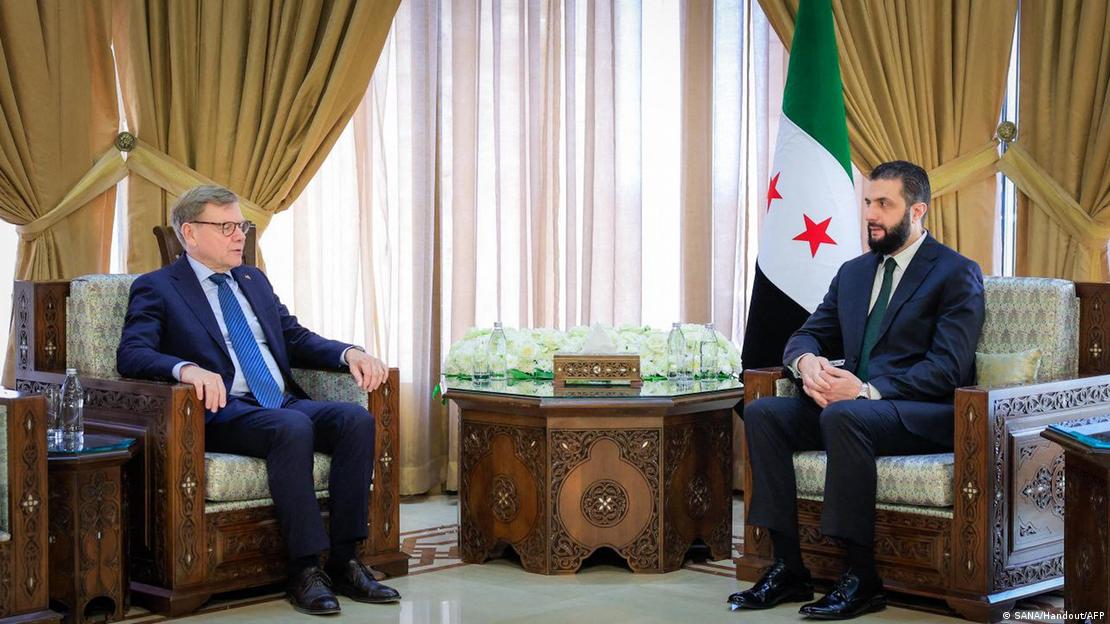
Syria is preparing for an anticipated presidential visit to Berlin, where President Ahmad al-Sharaa is expected to hold talks with German leaders on Syria’s relations with Europe and the refugee file—at an exceptionally sensitive political and security moment.
The outreach comes as Germany debates asylum policy with renewed intensity, and as several European capitals cautiously test a reopening toward Damascus after years of political estrangement.
Against this backdrop, the European Council announced that its president, António Costa, accompanied by European Commission President Ursula von der Leyen, will travel to Damascus on 9 January to meet President Al-Sharaa.
European Outreach and Key Negotiation Themes
Diplomatic sources told The Independent Arabic that President Al-Sharaa is preparing to visit Germany following an official invitation from Chancellor Friedrich Merz.
According to the sources, the talks will examine avenues for strengthening Syrian–European relations, alongside potential economic cooperation between Damascus and the European Union. Germany’s role is expected to feature prominently, with the Syrian refugee issue placed at the centre of the agenda. The sources suggested the Berlin visit may form part of a broader European tour.
The anticipated trip follows earlier comments by Chancellor Merz in November, when he confirmed that he had invited President Al-Sharaa to discuss the return of Syrian refugees—particularly those with criminal records.
Refugees at the Heart of Germany’s Domestic Debate
At the time, Merz said Germany “will of course continue deporting criminals to Syria” and intends to do so “in a concrete manner.” He also expressed Berlin’s interest in supporting Syria’s stabilisation, describing dialogue with Damascus as “the path toward jointly resolving the problem.”
Merz has repeatedly argued that “the war is over and there is no longer any justification for asylum claims,” calling for returns to begin—either voluntarily, or through enforced deportations for those who refuse to go back. During a recent visit to the northern city of Husum, he reiterated that asylum requests can no longer be justified after 13 years of war, adding that those who decline to return “can be deported.”
CDU Divisions and a Shifting Political Landscape
German Foreign Minister Johann Wadephul struck a more cautious tone during his own visit to Damascus, warning that returns remain “extremely limited” due to the widespread destruction of infrastructure—an assessment that drew criticism within the Christian Democratic Union (CDU), the party to which both Merz and Wadephul belong.
The debate has re-emerged a decade after former Chancellor Angela Merkel’s “open-door” policy, under which Germany received nearly one million refugees, a significant proportion of them Syrians. Since then, the far right has gained ground, intensifying pressure on the ruling camp to adopt tougher migration and border measures.
President Sharaa’s potential visit to Berlin thus reflects a mutual attempt—by Damascus and key European capitals—to test the boundaries of political re-engagement, even as the refugee file remains among the most sensitive and complex issues on the table.
This article was translated and edited by The Syrian Observer. The Syrian Observer has not verified the content of this story. Responsibility for the information and views set out in this article lies entirely with the author.