
As the confrontation involving the United States, Israel, and Iran moves deeper into its second month, the continued disruption of international trade through the Strait of Hormuz has sent tremors across the global economy. This narrow maritime passage carries a significant share of the world’s commercial traffic, including a substantial portion of global oil and gas flows and a considerable volume of liquefied natural gas.
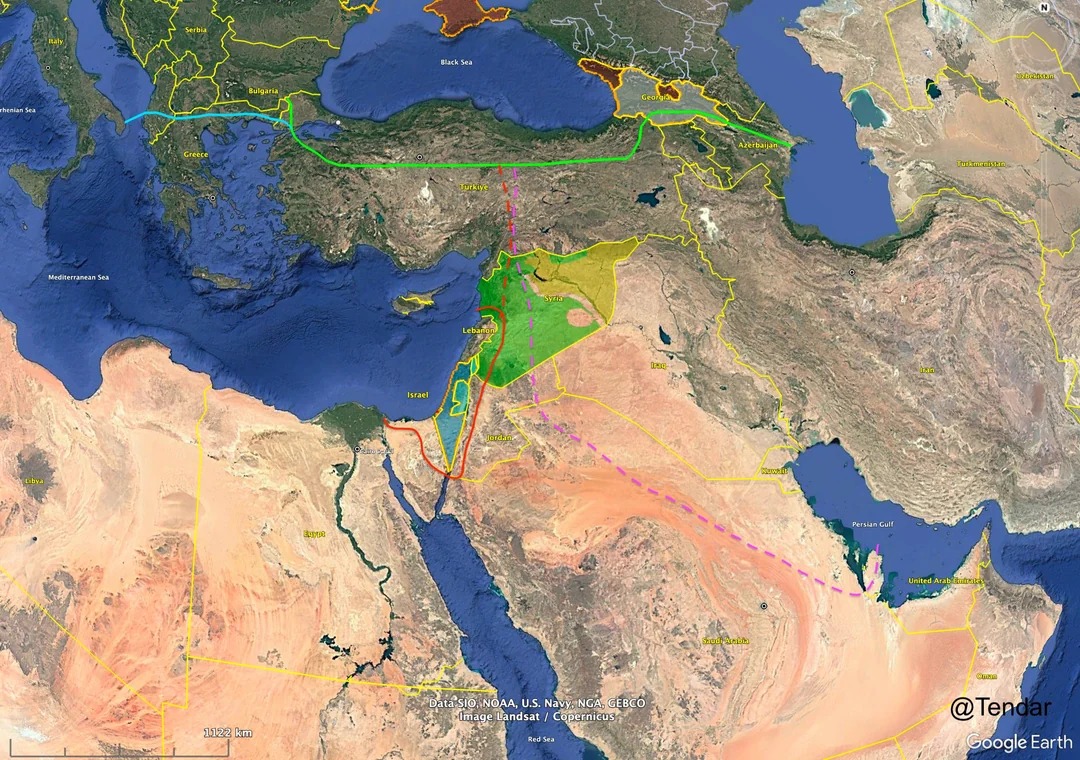
With no clear resolution on the horizon and mounting fears of strikes on regional energy infrastructure, European nations are preparing for a severe energy shock. In this climate of uncertainty, Syria is emerging as a strategic alternative capable of reducing dependence on the Strait of Hormuz, strengthening Arab energy security, and stabilizing global supply chains.
During the Syrian-German Business Forum in Berlin, President Ahmad al-Sharaa underscored that Syria’s Mediterranean coastline and its position between East and West offer a secure refuge for trade. He warned that prolonged instability in the Red Sea or the Strait of Hormuz elevates the importance of the Syrian route for ensuring the continuity of supplies to Europe.
This view was echoed by the United States Envoy to Syria, Thomas Barrack, who recently called for reliable maritime alternatives and noted that Syria could assume a pivotal role by transporting Gulf oil through pipelines that reach the Mediterranean directly.
Prospective Strategic Projects
Economic specialists argue that Syria’s geography, linking three continents, places it at the forefront of potential East-West transit routes. Dr. Osama Kadi, an economic consultant, outlined several major projects currently under consideration.
One proposal envisions a high-speed rail line connecting Saudi Arabia to Syria through Jordan, capable of carrying passengers and goods at modern velocities. Another project involves the revitalization of the historic Trans-Arabian Pipeline, redirecting oil from northeastern Saudi Arabia toward the Syrian ports of Baniyas or Lattakia. A separate initiative explores the extension of Qatari gas pipelines through Syrian territory toward Turkey and onward to Europe, which would require the development of advanced liquefaction and storage facilities along the Syrian coast. There is also renewed interest in rehabilitating the Kirkuk-Baniyas pipeline linking Iraq and Syria, with plans to expand its capacity through contemporary engineering methods.
The “Food Corridor” and Regional Integration
Beyond energy, Dr. Kadi introduced the concept of a “Food Corridor” between Saudi Arabia and Syria. This initiative envisions a rapid rail link originating in the Saudi city of Arar, designed to transport fresh agricultural products and essential goods to Syrian markets within a matter of hours.
“The Food Corridor aims to address the inherent fragility of supply chains that rely excessively on maritime transit through the Strait of Hormuz,” Dr. Kadi explained.
By capitalizing on Syria’s diverse climate and agricultural output, the country could evolve into a primary food supply base for the Gulf. The corridor is also intended to integrate with the India-Middle East-Europe Economic Corridor, restoring Syria’s historical role as a central artery of the Silk Road.
The Architecture of Success
Economic researcher Abdel Azim al-Mugharbel believes that Syria’s geographic promise can only be realized through a set of essential conditions.
The first requirement is the rehabilitation of infrastructure, including ports, highways, and border crossings. The second is the establishment of sustained stability to guarantee the uninterrupted movement of goods. The third is an institutional transformation that shifts Syria from the status of a geopolitical burden, which characterized the former era, into a dynamic economic force.
According to al-Mugharbel, turning Syria into a hub for transport, storage, and re-export will accelerate national recovery and reconstruction. This transformation is expected to generate broader prosperity and raise the annual income of the Syrian people.
This article was translated and edited by The Syrian Observer. The Syrian Observer has not verified the content of this story. Responsibility for the information and views set out in this article lies entirely with the author.