
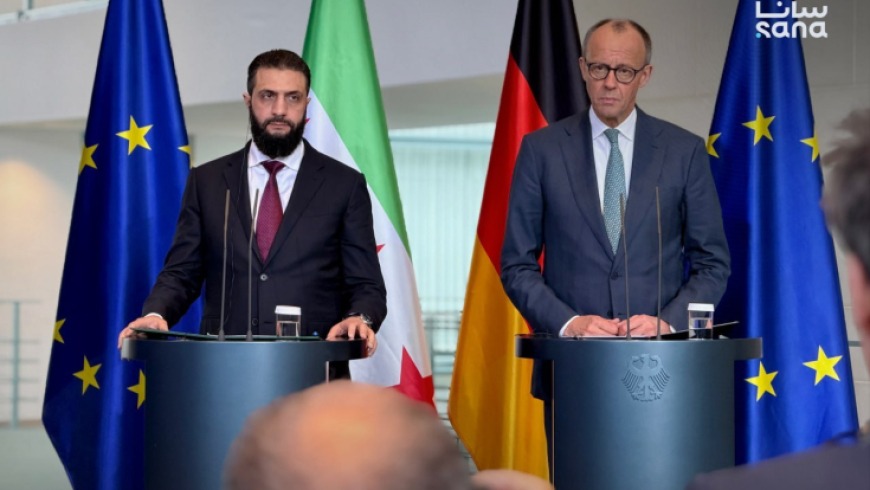
Syrian President Ahmad al‑Sharaa arrived in Berlin this week for a high‑profile diplomatic and economic visit that Syrian and German officials say marks a new phase in Syria’s postwar reintegration. The trip, made at the invitation of German Chancellor Friedrich Merz, comes one year after the fall of the previous Syrian regime and at a moment when Damascus is seeking to convert political transition into economic revival.
Sharaa’s message in Berlin was clear: Syria is open for business, and it intends to rebuild through investment rather than aid. Speaking at the Syrian‑German Business Forum, he announced that the country had secured roughly $59 billion in investment commitments over the past year, crediting sweeping amendments to investment laws for creating what he described as a more predictable and competitive environment.
“We do not see the destruction of the past fifteen years as an ending,” he told the audience of German executives and policymakers. “It is the threshold of a new phase of reconstruction.”
A Bid to Position Syria as an Energy Corridor
Sharaa used the forum to promote a strategic vision that places Syria at the center of regional energy flows. He argued that the country’s geography qualifies it to serve as a “safe and reliable hub” for supply chains linking the Gulf and Eastern Mediterranean to European markets. The pitch aligns with ongoing efforts to rehabilitate Syria’s energy infrastructure and to attract foreign partners to long‑delayed pipeline and electricity‑grid projects.
The visit included a formal meeting at the Federal Chancellery, where al‑Sharaa and Chancellor Merz announced the creation of a joint task force to coordinate reconstruction and economic stabilization. Merz described Syria’s political transition as “a moment that moved the world,” recalling the images of detainees emerging from former torture centers after the regime’s collapse.
A major focus of the talks was the 1.3 million Syrians living in Germany, many of whom arrived during the height of the war. Both leaders unveiled a “circular migration” initiative intended to allow skilled Syrian professionals—among them more than 6,000 Syrian doctors working in German hospitals—to contribute to rebuilding their homeland without severing their lives in Europe.
German officials framed the program as a model for balancing humanitarian responsibility with long‑term development, while Syrian officials described it as a way to reconnect the diaspora with national recovery.
Security, sovereignty, and Regional Tensions
In Berlin, Sharaa also outlined the principles of what he calls the “New Syria” policy. He stressed that the state must exercise full sovereignty over all Syrian territory and that no armed groups or autonomous enclaves would be permitted to operate outside national institutions. This includes the ongoing integration of Kurdish forces into the national military structure.
He condemned Iranian interference in the Gulf and criticized Israeli violations of the 1974 Disengagement Agreement, framing both as destabilizing forces. He also identified the fight against cross‑border Captagon smuggling as a central priority for his administration.
Economic Realities at Home
While the president promoted long‑term investment opportunities abroad, humanitarian assessments at home painted a more sobering picture. A recent report by the UN Office for the Coordination of Humanitarian Affairs (OCHA) found that the cost of living rose sharply in February due to structural inflation and high transport costs. The average price of a basic food basket reached $169, underscoring the gap between macro‑economic ambitions and the daily struggles of ordinary Syrians.
Markets remain functional but under strain, particularly in Suwayda and parts of the Northeast where supply bottlenecks persist.
The government’s reform agenda also extended to social justice. At Damascus University, the National Authority for Transitional Justice hosted a conference on the gaps in Syria’s 1969 Nationality Law, which prevents Syrian mothers from passing citizenship to their children. Legal experts and UN representatives argued that amending the law is essential for protecting children’s rights and aligning Syria’s legal framework with international human rights standards.
Abdul Basit Abdul Latif, head of the Authority, said the reform is “a foundational step toward a more just and inclusive Syria.”
A Trip Framed as a Turning Point
For Damascus, the Berlin visit was designed to signal that Syria is re‑entering the international arena with a plan for reconstruction, a message of sovereignty, and a bid to position itself as a future energy corridor. For Germany, it was an opportunity to shape the early stages of Syria’s recovery while addressing the long‑term future of its Syrian diaspora.
Whether the promises made in Berlin translate into tangible change at home remains an open question. But the visit marked one of the most visible steps yet in Syria’s attempt to move from political transition to economic revival.
This article was translated and edited by The Syrian Observer. The Syrian Observer has not verified the content of this story. Responsibility for the information and views set out in this article lies entirely with the author.