
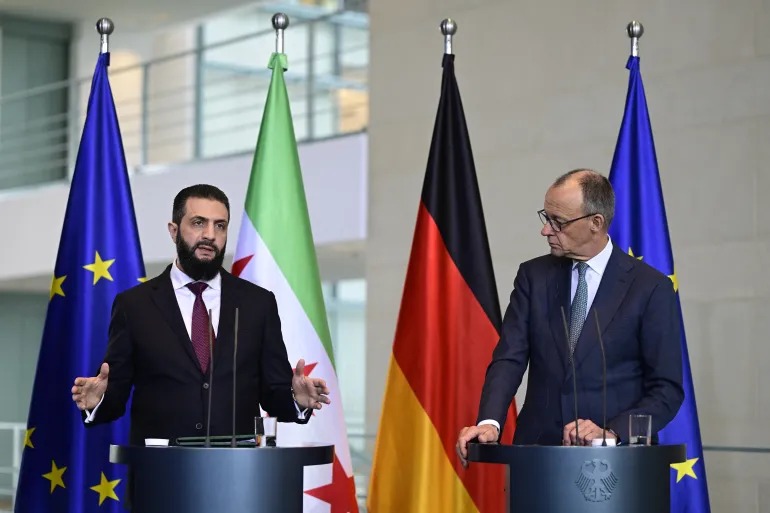
The official visit of Syria’s interim president, Ahmad al-Sharaa, to the German capital has ignited a storm of political and media controversy. While the state extended full ceremonial honors at Bellevue Palace, the streets of Berlin revealed a far more fractured landscape, where fervent displays of support collided with sharp denunciations from human rights advocates.
Echoes of “Allahu Akbar” at the Ritz-Carlton
The Bild newspaper spotlighted a striking scene outside the Ritz-Carlton Berlin, where a dense crowd from the Syrian diaspora gathered to greet the president. Chants of “Allahu Akbar” rose in waves as supporters applauded the man once known as Abu Mohammad al-Julani.
German media seized on the moment, portraying it as a revealing glimpse into the complex composition of Sharaa’s support base. To his critics, the religious fervor surrounding a figure long associated with jihadist movements serves as a stark reminder of his ideological past. Sharaa, for his part, used a meeting with the diaspora to praise their “national identity,” a gesture widely interpreted as part of a broader effort to recast his administration’s image on the international stage.
Public Celebration and Political Outrage
Across Berlin, the atmosphere at times resembled a cultural festival. At Potsdamer Platz and the Victory Column, Syrian supporters celebrated openly, some decorating their vehicles with national symbols in a display of exuberant pride.
Yet this public jubilation stood in sharp contrast to the warnings issued by human rights organizations and several political factions. While President Frank-Walter Steinmeier and Chancellor Friedrich Merz engaged in formal diplomacy, Germany’s Left and Green parties condemned the visit as an act of “moral bankruptcy.” Critics pointed to a widening gap between Sharaa’s rhetoric of unity and persistent reports of abuses against Druze, Kurdish, and Christian communities.
This article was translated and edited by The Syrian Observer. The Syrian Observer has not verified the content of this story. Responsibility for the information and views set out in this article lies entirely with the author.