
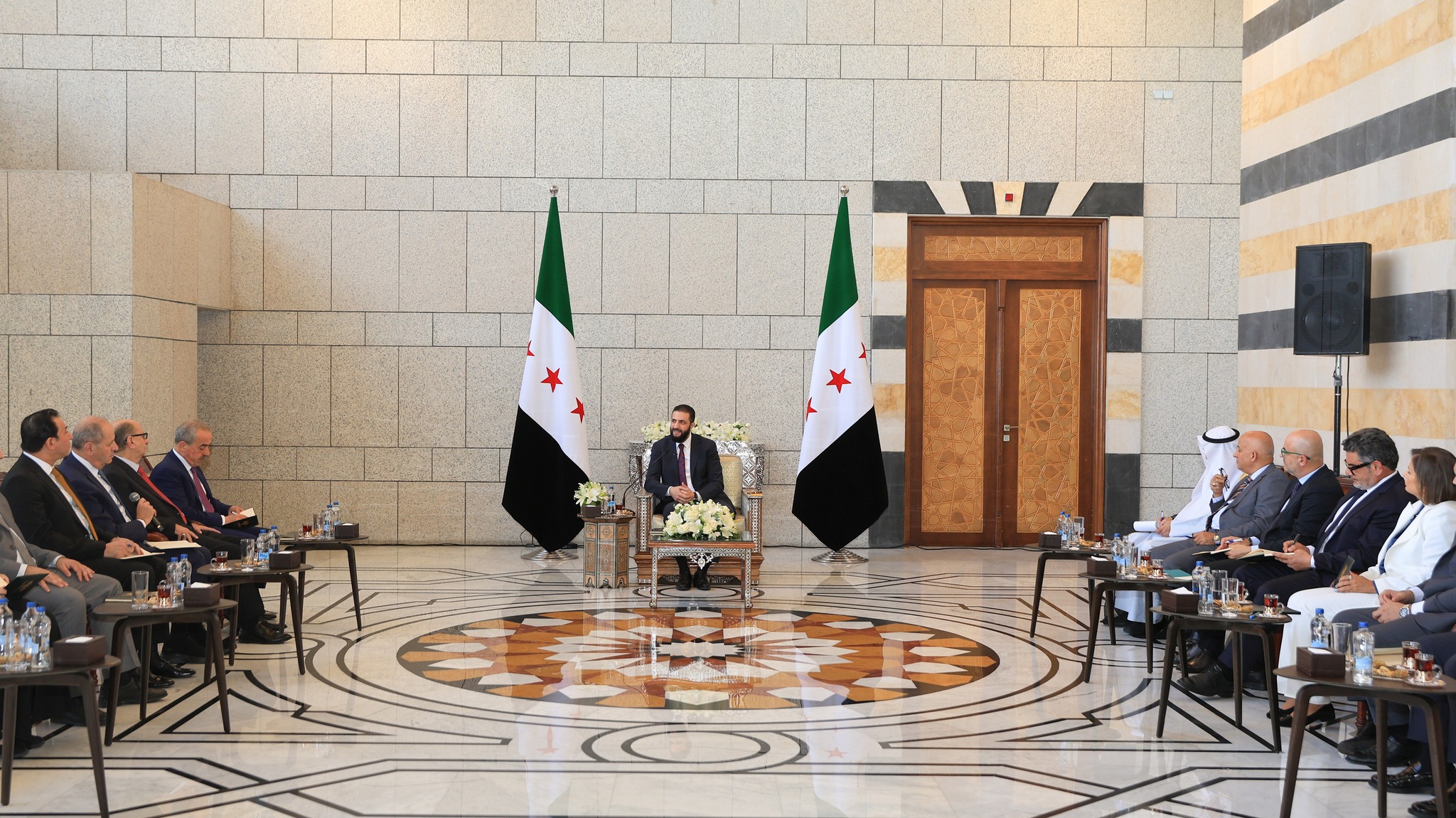
Ahmad al-Sharaa, head of Syria’s transitional government, has triggered widespread controversy and signaled a potentially historic shift in foreign policy by distancing himself from the Arab Spring and revealing that advanced negotiations are underway for a US-brokered security agreement with Israel.
The comments, made during a Sunday meeting with a senior Arab media delegation, have drawn swift and fierce reactions from Syrians online, while outlining what Sharaa described as a pragmatic new vision for the country’s future.
Rejecting the Legacy of the Arab Spring
President Sharaa sought to define his political identity in sharp contrast to the dominant forces that have shaped regional upheaval over the past decade. He made clear that he is not aligned with Islamic movements such as the Muslim Brotherhood or jihadist factions, nor does he consider his political project to be a continuation of the 2011 Arab Spring.
The statement sparked immediate backlash on Syrian social media. Noted novelist Somer Shihada responded with a sardonic Facebook post, suggesting that the only remaining identities for Sharaa were being “ahead of his time, a hidden Imam who has now emerged, or an extension of Bashar al-Assad”. Journalist Ryan Ma’rouf lampooned the remarks, writing: “Yes, gentlemen, I am an extension of repressive dictatorial regimes.”
Towards a Landmark Security Accord with Israel
Perhaps most consequential was -Sharaa’s disclosure of progress in high-level talks over a security arrangement with Israel, as reported by Nadeem Qateesh, Director General of Sky News Arabia. The proposed agreement, reportedly backed by the United States and Gulf states, could be finalised as early as September.
According to informed sources, the preliminary framework includes:
- The demilitarization of the Syrian Golan Heights and southern border regions to neutralize threats to Israel;
- A ban on the deployment of strategic weapons, including missiles and advanced air defense systems, within Syrian territory;
- Provisions preventing Turkish involvement in rebuilding the Syrian military;
- The creation of a humanitarian corridor from Israel to the Druze-majority province of Suwayda.
In return, the transitional government would receive commitments of substantial US and Gulf funding for reconstruction, alongside broader strategic support aimed at curbing Iranian influence and reintegrating Syria into the regional diplomatic fold.
While Sharaa acknowledged that conditions for a full peace treaty with Israel are not yet in place, he stated he would not hesitate to pursue such an accord openly if it aligned with Syrian and regional interests.
Domestic Priorities: Unity and Constitutional Reform
On the domestic front, Sharaa reaffirmed his administration’s red lines—chief among them, preserving Syria’s territorial unity and ensuring that the state retains exclusive control over armed forces. He also expressed openness to amending Article 107 of the constitution to address concerns raised by minority communities.
Sharaa cited a March agreement with Mazloum Abdi, leader of the Syrian Democratic Forces (SDF), as a potential blueprint for future negotiations. He underscored the strategic importance of the SDF-held northeast, rich in oil and agriculture, and pledged to fully integrate the Kurdish population into the national framework.
Together, Sharaa’s remarks paint a portrait of a transitional leader attempting to chart a new course for Syria—one distinct from both the legacy of the revolution and the Assad regime—while courting bold diplomatic breakthroughs to secure legitimacy and fund the monumental task of reconstruction.
This article was translated and edited by The Syrian Observer. The Syrian Observer has not verified the content of this story. Responsibility for the information and views set out in this article lies entirely with the author.