
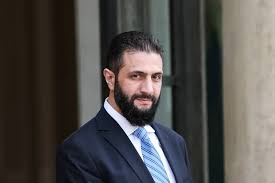
From its earliest days, the Damascus authority sought to reassure the international community about its new direction and political orientation, attempting to convey that the rule of Hay’at Tahrir al-Sham in the capital marked a fundamental departure from its governance in Idlib. The first signals were directed at Arab states, followed by messages to the wider international community, delivered through official statements and a series of meetings with regional and global leaders. Among the most prominent of these came from the then military operations commander, Ahmed al-Sharaa, who declared: “The revolution ended with the fall of the regime, and Syria will not be a platform for attacking other countries.” He stressed that the new authority would not export revolution, would refrain from supporting Islamist movements, and would base its foreign relations on pragmatism rather than ideology.
The objective was to secure Arab and international support in order to consolidate the foundations of the new authority and gain external legitimacy—at a time when domestic matters remained suspended and unresolved. It was a bold gamble for a fledgling government, for internal trust is the bedrock of any genuine legitimacy.
Arab and Western Support
Today, after securing notable international recognition—bolstered by strong Arab support from Saudi Arabia, Qatar and the UAE, and Western backing exemplified by a joint visit from the German and French foreign ministers—circumstances have shifted. These developments were followed by al-Sharaa’s trip to Paris, exceptional meetings with Russia, and generous support from the administration of former US President Donald Trump. This momentum began with an initial meeting in Riyadh last May, where Trump praised al-Sharaa and pledged to lift sanctions with Saudi mediation. It continued through subsequent meetings in New York and Washington, culminating in a visit to the White House in November, where Syria’s accession to the international coalition against ISIS was formalised. The process was crowned by the gradual easing of sanctions, including the freezing and eventual removal of provisions within the Caesar Act.
Neglecting the Domestic Front
While courting external support is crucial to ending Syria’s isolation, reintegrating it into the international order, and attracting loans, aid and investment for reconstruction, this strategy has come at the expense of domestic affairs—issues that have been noticeably neglected over the past year. In many cases, the authorities resorted to excessive force in addressing security incidents, a stark contrast to the conciliatory diplomacy pursued abroad. This contradiction was evident in Jaramana, then Sahnaya and Ashrafiyat Sahnaya, along the coast, and later in Sweida, where sectarian tensions erupted into violent clashes. These developments were accompanied by a rise in sectarian incitement, kidnappings and random killings in minority areas.
Regrettably, this approach coincided with the postponement of key national priorities: the fate of detainees and the disappeared following the regime’s collapse; the reinstatement of dismissed public employees; the establishment of transitional justice mechanisms; and the political settlement required for the return of territories outside Damascus’s control, such as Sweida and the SDF-held areas east of the Euphrates. Delays have also plagued efforts at economic and administrative reform. What little reform occurred was mostly limited to the mass dismissal of public-sector workers, with many skilled professionals replaced by inexperienced loyalists.
A Transitional Authority
It is difficult to believe the leadership is unaware that neglecting the domestic sphere undermines its credibility with the international community—particularly since it is viewed not as a permanent government, but as a transitional authority entrusted with a defined set of tasks. American conditions, reviewed periodically to extend the suspension of Caesar Act sanctions, serve as a barometer for assessing the authority’s conduct. Meanwhile, the broader political settlement—considered the cornerstone of the transition, a guarantor of inclusive representation, and the basis for transparent governance—has yet to begin, more than a year after the regime’s fall.
There is also no clear vision for the transitional period, nor clarity on the shape of Syria’s future political and economic system. Will the country embrace a free-market economy or continue down the path of state capitalism? The lack of concrete policies and reforms to incentivize private sector growth and attract investment suggests a drift towards the latter. In this context, there is growing concern that the economy may devolve into a crony system dominated by insiders and an expanding bureaucracy.
The Dissipation of International Legitimacy
This phase is characterized by intense internal activity, yet without tangible progress. Parliament remains paralyzed, with its membership incomplete due to the failure to appoint the remaining third of its members. This legislative vacuum undermines the validity of its laws and agreements, reducing the institution to a symbolic shell. The absence of popular representation has raised fears of a return to authoritarianism, particularly amid the rejection of calls for decentralization, and growing indications that the old centralized model is being reimposed.
Should these policies lead to stagnation and economic decline, legislative work will falter, political stability will erode, and international donors and investors—already conditioned by the promise of reform—will withdraw. At that point, the fragile structure of international legitimacy will begin to collapse, replaced by an image of an authority reduced to managing crises rather than leading meaningful reconstruction or reform. Without a clear vision or forward momentum, temporary security measures will take precedence, and the country may slide back into isolation—the very condition that contributed to Assad’s downfall.
This article was translated and edited by The Syrian Observer. The Syrian Observer has not verified the content of this story. Responsibility for the information and views set out in this article lies entirely with the author.