
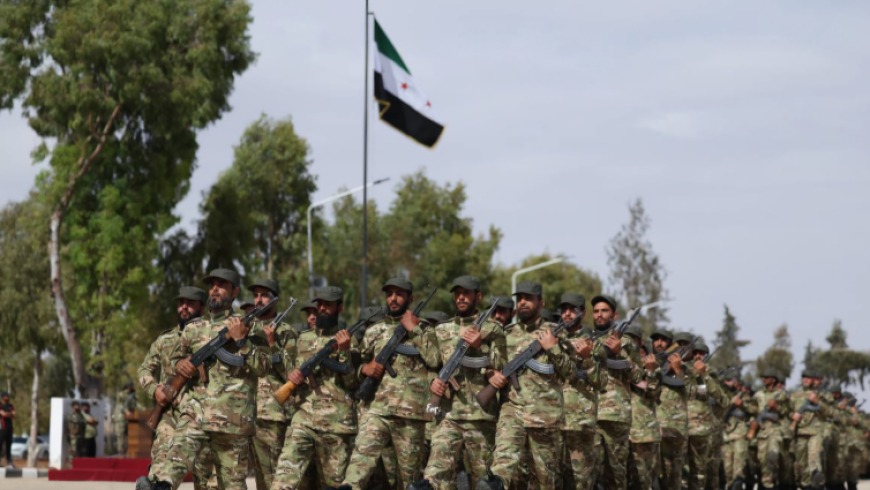
Reports of a potential Syrian military offensive in the northeastern provinces of Raqqa and Deir ez-Zor are gathering pace, as government forces mass near Palmyra, fuelling fears of renewed clashes with the Kurdish-led Syrian Democratic Forces (SDF), which currently control much of the region.
According to a recent report by The National, the Syrian army is preparing a large-scale operation to retake the two provinces—a move that could alter the balance of power in Syria’s northeast. The strategy appears influenced by shifting regional dynamics, particularly the stance of the United States, which could either permit or block the offensive, as well as efforts to avoid drawing Israel into the conflict.
Military deployments have been observed across the Syrian desert, with sources estimating that approximately 50,000 fighters have assembled near Palmyra, ready to move towards Raqqa and Deir ez-Zor. These forces are reportedly supported by local Arab tribes, potentially strengthening Damascus’s position in a region where ethnic Arabs make up a substantial proportion of the population and the SDF’s ranks.
On the political front, tensions have escalated due to stalled US- and French-sponsored negotiations between Damascus and the SDF. The Kurdish-led group has been reluctant to relinquish control over key sovereign assets, such as dams, border crossings, and oil fields—raising the risk of military escalation should no agreement be reached.
Nonetheless, opportunities for de-escalation remain. The SDF has been granted a grace period to implement the terms of a 10 March agreement, which outlines its gradual integration into the Syrian state’s institutional structure. Leaked information suggests that international support for the SDF may diminish if progress on the deal falters.
Analysts Warn of Imminent Clashes
Political analyst Dr Hamza Al-Mohammed, speaking to Syria TV, confirmed preparations for a significant military campaign, despite describing The National‘s report as containing a mix of accurate and misleading elements. He cited a recent tripartite meeting in Ankara between US, Turkish, and Syrian officials, during which groups affiliated with the PKK and PYD were reportedly given a 30-day ultimatum—now reduced to 11 days—to hand over the region to government forces.
“The United States urged Turkey to delay its actions, but Ankara insisted on honouring Damascus’s demands,” Al-Mohammed stated. He highlighted extensive troop mobilisations and noted that Raqqa remains under PKK/PYD control, while Deir ez-Zor is divided—the eastern bank of the Euphrates River remains under SDF influence. Crucially, he estimated that Arabs constitute 60 per cent of SDF fighters in these areas, predicting swift government gains in the event of confrontation due to potential defections.
Al-Mohammed also underscored internal divisions within the SDF, with some Kurdish factions opposing the handover. He cited unresolved issues such as prisons, refugee camps, and oil resources as obstacles to the implementation of the 10 March agreement, which he estimated could take between one and one-and-a-half years to fully realise.
Tensions have intensified following a controversial conference in Hasaka, organised by SDF commander Mazloum Abdi. Al-Mohammed criticised the event, describing it as a setback that hardened positions on all sides.
Military strategist Brigadier Ismail Ayoub echoed these concerns, noting that the northeastern front has remained volatile for years. He pointed to a 500-kilometre-long contact line along the Euphrates, reinforced recently by Syrian units, including former National Army fighters integrated into government ranks.
“If a full-scale war breaks out, the Syrian army holds both qualitative and numerical superiority,” Ayoub told Syria TV. He warned that the SDF’s dependence on US protection could be a strategic vulnerability, especially if that support is withdrawn, prompting large-scale defections among Arab fighters.
He also referenced recent skirmishes in areas such as Deir Hafer and Manbij in eastern Aleppo as evidence of the region’s fragility. Ayoub criticised the SDF’s pursuit of a federalist model, arguing it is unrepresentative, given the group’s minority status—even in Hasaka.
As the deadline looms, the situation remains delicately poised between the potential for diplomatic breakthrough and the risk of renewed warfare in Syria’s resource-rich northeast.
Damascus Cancels Paris Talks with SDF
In a relevant development, the Syrian government has cancelled scheduled negotiations with the Syrian Democratic Forces (SDF) in Paris, citing fallout from a recent conference in Hasaka. However, officials say direct talks are continuing within Syria to advance implementation of the 10 March integration agreement.
Qutayba Idlibi, the Foreign Ministry official overseeing US affairs, announced the withdrawal in an interview with Rudaw TV, while reaffirming Damascus’s commitment to dialogue. “Meetings will continue in Damascus and northeastern Syria,” he said. “Technical committees are already undertaking practical steps on the ground to operationalise the 10 March agreement.”
Signed by Syrian President Ahmed al-Sharaa and SDF commander Mazloum Abdi, the agreement seeks to incorporate SDF forces into the national military structure, following a model applied to other formerly autonomous factions. Idlibi stressed the objective of consolidating combat experience to serve national defence priorities, under the principle of “one army, one state.”
He added that Damascus rejects any “state within a state” arrangement, likening such a model to Lebanon’s fractured governance. He argued that genuine stability requires a unified army and government that includes all Syrians under the umbrella of state sovereignty.
Shift Towards Syrian-Led Dialogue
The decision to boycott the Paris round of talks came in response to the SDF-hosted Hasaka conference, which Idlibi described as flawed in its design. He criticised the inclusion of figures linked to the former Assad regime and the event’s focus on sectarian, religious, and ethnic narratives—elements seen by Damascus as undermining national unity.
Direct communication lines between President al-Sharaa and Commander Abdi have reportedly opened new avenues for internal resolution. “This Syrian-led dialogue demonstrates that durable solutions can emerge from within, rather than through externally sponsored processes,” Idlibi said.
The cancellation was initially reported by the Syrian Arab News Agency (SANA), quoting a source who described the Hasaka meeting as a “blow to ongoing negotiations.” Damascus reiterated its refusal to engage with actors perceived to be reviving the former regime under new guises.
In response, the government called on the SDF to engage seriously with the 10 March deal and urged international mediators to relocate all discussions to Damascus, which it maintains is the sole legitimate forum for inter-Syrian dialogue.
While affirming the right of Syrians to peaceful assembly and constructive discussion—whether at local or national level—the source insisted that such activity must support Syria’s overarching national project and safeguard its sovereignty, unity, and territorial integrity.
This pivot towards domestic negotiation reflects a broader push by Damascus to assert self-reliant solutions, amid regional pressures and the SDF’s continuing control over large swathes of the northeast.
This article was translated and edited by The Syrian Observer. The Syrian Observer has not verified the content of this story. Responsibility for the information and views set out in this article lies entirely with the author.