
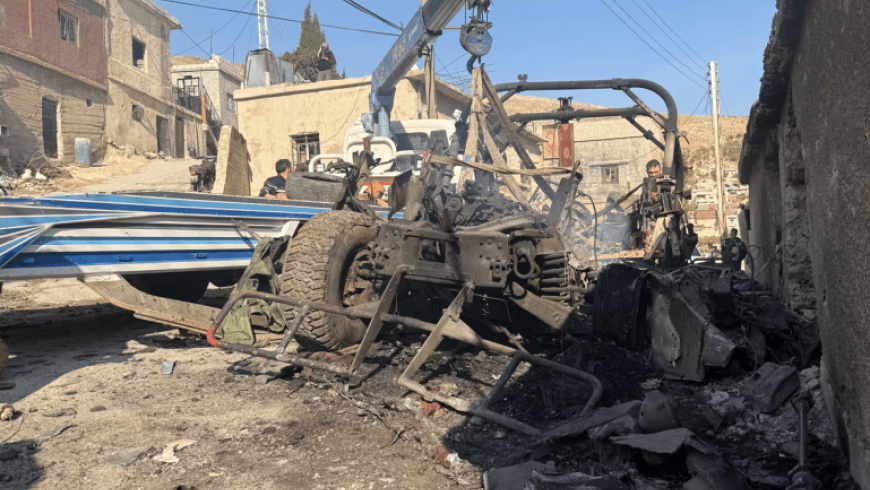
The Israeli assault on the town of Beit Jinn in late November 2025 was more than a further chapter in Tel Aviv’s expanding military campaign across southern Syria. It was a moment dense with implications—some deliberately conveyed by Israel, others revealed inadvertently—and a stark illustration of the strategic, political and social fissures shaping the post-Assad landscape.
Beit Jinn exposed, with unusual clarity, the contradictions within Israel’s security calculus, the fragility of Syria’s transitional phase, and the dangerous vacuum left by the co-existence of an occupying army and newly emerging armed actors operating outside the state. The raid underscored how swiftly southern Syria could become the most volatile front in this new era—and how high the stakes now stand for all involved parties.
Israel’s Expanding Ambition—And Its Deepening Anxiety
The timing of the raid was telling. On the eve of Syria’s commemoration of liberation from the Assad regime, Israel appeared determined to remind Syrians that military domination did not depart with the fall of the former ruler. Tel Aviv seems guided by a belief that the collapse of the old order presents a historic opportunity to reshape southern Syria in its favour.
For Israel, the post-Assad transition represents both:
– A strategic vacuum to exploit, and
– A geopolitical crisis to contain.
This dual reading is pushing Israel to entrench its presence further, escalating ground incursions and air operations across areas once governed by disengagement accords. The message was clear: Israel retains unchallenged freedom of military action, and Damascus must acquiesce to Israeli terms in any future security settlement.
Yet Beit Jinn also delivered messages Israel had not intended—messages that may prove more consequential in the long run.
Local Resistance: The Message Israel Hoped Not to Receive
The incident’s transformation into a political flashpoint was driven not by the raid itself, but by the level of armed resistance mounted by local fighters. Residents and community combatants reportedly managed to disable an Israeli armoured vehicle, inflict casualties, and nearly capture elements of the raiding force—an outcome that would have represented a strategic humiliation.
Israel ultimately withdrew under the cover of air support—drones, helicopters and artillery—destroying the disabled vehicle to prevent its seizure.
However, Tel Aviv chooses to narrate the incident, the implications are troubling for its defence establishment:
– Local communities in the south are no longer passive.
– Occupation is generating the very resistance it aims to suppress.
– A “South Lebanon scenario” is no longer implausible.
Israel’s long experience in southern Lebanon—where two decades of occupation birthed Hezbollah and culminated in a withdrawal widely seen as a defeat—casts a long shadow over its actions in Syria. There is now a credible fear within Israeli planning circles that a similar dynamic could emerge, fuelled either organically by local actors or by regional networks aiming to replicate the “axis of resistance” model.
The Rise of ‘Awliya al-Ba’s’: Militancy in a Vacuum
Among the most destabilising revelations of the Beit Jinn episode is the growing prominence of new armed formations operating beyond the authority of the state—foremost among them, the Islamic Resistance Front – Awliya al-Ba’s.
The group:
– Emerged from the collapse of the old regime and the chaos of transition;
– Models its imagery and rhetoric on Hezbollah;
– Is linked by multiple research centres to Iran’s network of regional proxies;
– Presents itself as a supra-state alternative to Damascus.
Its post-raid statements—threatening retaliation “at a time and place of our choosing” and vowing the “liberation of Syria and Palestine”—suggest an agenda of dragging southern Syria into a proxy war with Israel, regardless of civilian cost.
This is the very scenario invoked by Israel to justify its expanding military presence—and precisely the kind of actor that threatens the sovereignty and cohesion of the nascent Syrian state.
The Beit Jinn raid therefore illuminated a dangerous triangular dynamic:
– Israel deepening its military entrenchment under the pretext of self-defence;
– New armed groups exploiting the state’s weakness to establish local power bases;
– Civilians trapped between both, paying the price for every escalation.
The State’s Dilemma: Defending Sovereignty Without Losing Control
Damascus’s condemnation of the Beit Jinn assault as a “full-fledged war crime” was both appropriate and necessary. Yet the tragedy laid bare the acute strategic dilemma now facing Syria’s transitional authorities.
Their conundrum is this:
– Rejecting Israeli occupation is a national imperative.
– But allowing armed groups to act beyond state control is an existential threat.
Israeli aggression must be resisted. But unregulated militia activity risks compounding the crisis—provoking further incursions, undermining the legitimacy of the state, and weakening national defence institutions.
Sovereignty, after all, is not only about opposing foreign occupation—it is about ensuring the state is the sole legitimate representative of its people, the exclusive wielder of force, and the final arbiter of strategic choices.
In Beit Jinn, civilians bore the brunt of a confrontation triggered by a group accountable to no national institution and facing no public scrutiny.
Why Southern Syria Is a Greater Challenge for Israel Than Lebanon
While Israel currently operates from a position of strength—buoyed by military superiority and the fragmented nature of the transition—it faces structural constraints in Syria that were absent in Lebanon:
– A broader hostile public: anti-occupation sentiment in the south has greater national resonance than in Lebanon’s more divided landscape.
– A more legitimate central authority: the transitional government enjoys wider local credibility than the Assad regime ever commanded.
– A larger, more complex terrain that defies permanent control through raids or buffer zones.
– Diminishing international patience: many Western states view Israel’s expanding operations as disproportionate and dangerously destabilising.
Israel may delay resistance, but it cannot eradicate the deeper structural forces driving it.
A Warning—and a Crossroads
The Beit Jinn massacre carries three clear warnings:
To Israel: its growing occupation of the south will breed resistance more quickly than it can suppress it. The current strategy may buy time—but at the risk of repeating the very failures witnessed in Lebanon.
To Damascus: sovereignty is meaningless without a consolidated monopoly on force. Any vacuum—left by hesitation or weakness—will be filled, whether by foreign powers, militias, or Israel itself.
To local communities: their suffering is the result of dual threats—Israeli aggression and unaccountable non-state actors—each instrumentalising their plight for external ends.
Conclusion: Beit Jinn as a Mirror of Syria’s Unfinished State
Beit Jinn is not merely a site of tragedy; it is a mirror reflecting the unresolved contradictions of southern Syria. It lays bare a region where an emerging state grapples with an entrenched occupier, while proxy forces vie for influence in the name of resistance but without strategic discipline or political responsibility.
The name of Beit Jinn now stands as a stark reminder of:
– The perils of strategic vacuum,
– The urgency of reasserting unified state authority, and
– The devastating cost civilians pay when sovereignty splinters.
Unless these tensions are urgently addressed—through national reconstruction, a disciplined and unified security sector, and a clear rejection of both occupation and proxy warfare—the south will remain the most combustible arena in Syria’s evolving landscape.