
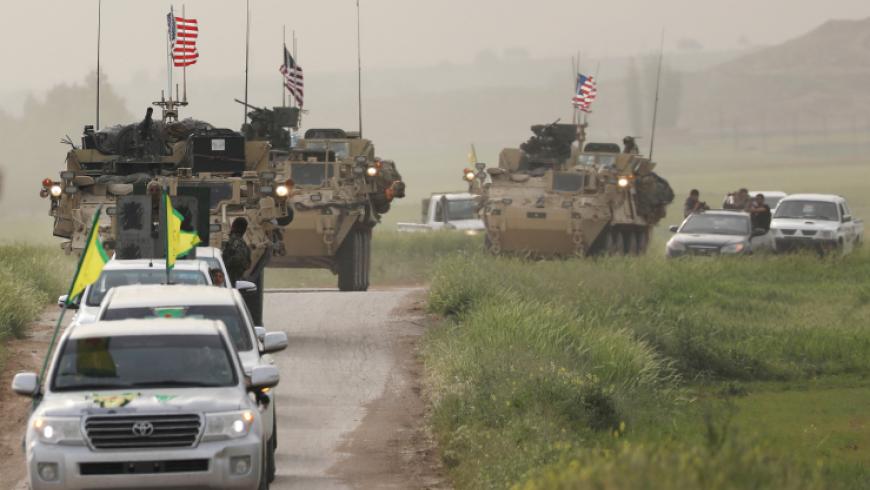
Recent months have seen a marked shift in the American approach to northeastern Syria, set against a backdrop of swiftly evolving field and security developments in the region.
These changes appear set to continue in the near future, particularly in the wake of an attack on U.S. forces in the Palmyra area, east of Homs, on Saturday (13 December), carried out by an individual affiliated with the Islamic State (ISIS).
Enhanced Security Measures for Former ISIS Affiliates
Sources familiar with the movements of the International Coalition forces in Iraq and Syria informed Syria TV that the American side began implementing stricter security protocols several months ago regarding detention facilities housing former ISIS members. These facilities are primarily located in Al-Hasakah Governorate.
According to the sources, the Coalition has transferred senior ISIS leaders from the Ghweran and Al-Kam Al-Sini prisons to facilities under its control in Iraq. This move is reportedly based on intelligence suggesting communication between the Syrian Democratic Forces (SDF) and Iraqi factions.
The sources added that these actions aim to pre-empt any resurgence of ISIS cell activity within Syrian territory—an outcome that could undermine the stability of the new Syrian government and disrupt its ongoing political and security efforts.
Since early December, the International Coalition has established a special committee to oversee the remaining detainees held in Al-Hassakeh’s detention centres.
This development followed intelligence shared by the Syrian government with the Coalition, confirming the arrest of ISIS cells that had recently escaped from SDF-run prisons.
Pressure on the SDF to Coordinate with Damascus
Available information indicates that the U.S.-led International Coalition is now encouraging the SDF to engage in security coordination with the Syrian government. The objective is to mitigate the vulnerabilities currently enabling ISIS cells to operate within Syria.
Washington is reportedly seeking to establish joint operations between the SDF’s counter-terrorism units and Syrian intelligence, alongside facilitating field-level coordination between the Deir ez-Zor Military Council and government forces.
This American initiative underscores a renewed focus on controlling Syria’s security environment, amid stalled negotiations between the SDF and Damascus over potential integration.
As such, the United States may be attempting to transform the security file into a gateway for building trust between the two sides. Successful coordination could, in the future, allow the Trump administration to scale back its military presence in Syria—relying instead on a contingent of advisors and technicians to support local partners in the ongoing fight against ISIS.
SDF Frustration with the Trump Administration
Aldar Khalil, a senior figure in the Democratic Union Party (PYD) and a key architect of the Autonomous Administration, has voiced criticism of the U.S. Special Envoy to Syria, Thomas Brac.
In remarks made on Saturday, Khalil condemned Brac’s attempts to dictate solutions to the Syrian people, asking: “Who gave him this right, and how can he ignore the fact that America itself is governed through decentralisation?”
One week prior to Khalil’s statement, SDF Commander Mazlum Abdi gave an interview to the Israeli daily The Jerusalem Post, in which he noted a decline in international support for the SDF following President Donald Trump’s decision to shut down the U.S. Agency for International Development (USAID).
Abdi highlighted a reduction in security personnel and the ongoing threat posed by ISIS. His remarks may be interpreted as a plea for Israeli backing, amid Washington’s waning support for the SDF in favour of closer ties with the Syrian government—which has now formally joined the International Coalition against ISIS.
During his appearance at the Doha Forum 2025, the U.S. Envoy to Syria reiterated his scepticism about decentralisation in the Middle East. He cited the fragmentation of the Balkans into seven states as a source of instability and referenced the complications decentralisation has brought in Iraq.
It is increasingly apparent that the circumstances which once enabled the SDF’s political and military ascent are gradually eroding. This shift is driven by several factors, including Republican control of both the White House and the House of Representatives, the collapse of the Assad regime, and the emergence of the current Syrian government as a viable partner for the Trump administration in curbing Iranian influence in Syria and halting arms smuggling into Lebanon.
This article was translated and edited by The Syrian Observer. The Syrian Observer has not verified the content of this story. Responsibility for the information and views set out in this article lies entirely with the author.