
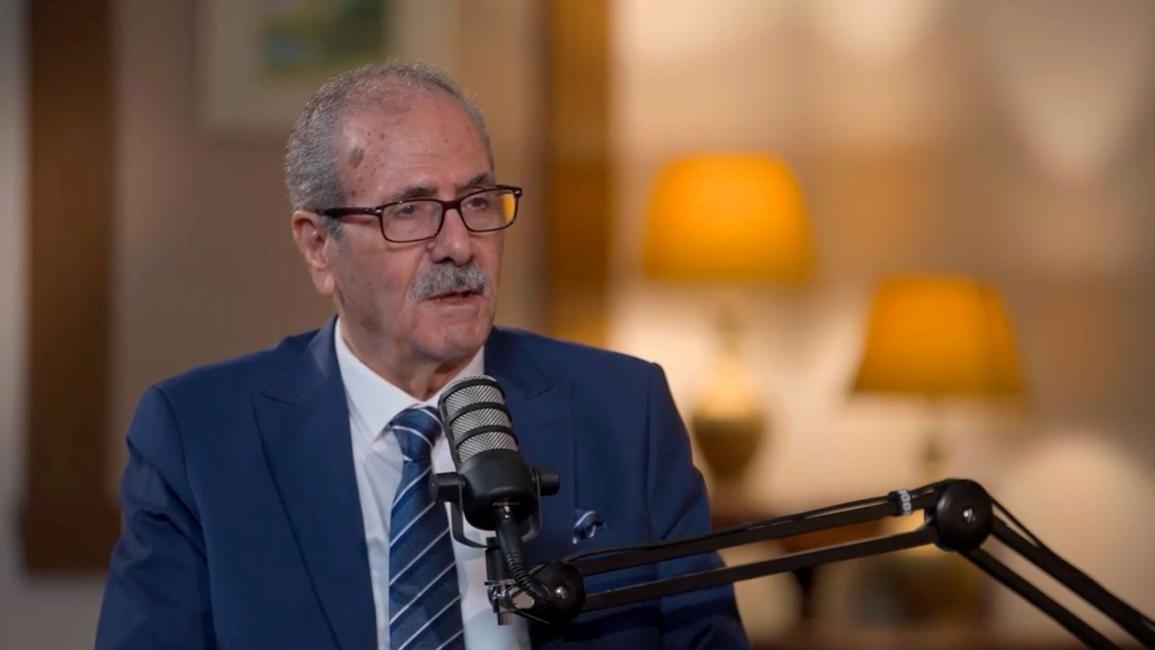
The recent podcast dialogue between Syrian journalist Anas Azraq and economist Hussein al-Sharaa, broadcast on Arabi Plus under the title And the Conversation Continues, proved far more layered than a simple exchange between interviewer and guest. What gave it its depth was not merely that the guest is the father of the man who toppled Bashar al-Assad’s regime and now serves as president of Syria.
To watch this dialogue casually would be to miss its essence: it functioned as a character study, an excavation of memory, and an encounter with a world shaped by political and social upheavals. Hussein al-Sharaa emerged in the conversation like a sheikh walking out of Syria’s long night of oppression, carrying with him the Golan Heights—his lost Andalusia—its springs, its mosaic of Arabs, Turkmen, Circassians, Sunnis, Druze, Christians, peasants, Bedouins, and townsfolk. His voice cracked whenever he spoke of Jibbein, his village, echoing the pain of Palestinians whose villages were erased and renamed into ruins.
The conversation spanned his chronicle of Syria since the short-lived union with Egypt (1958–61), but narrated from the perspective of the poor who benefited from its promises of schools, free education, infrastructure, and transport. Unlike politicians, Sharaa viewed unity through the eyes of those it lifted, a perspective that made him a Nasserist—and cost him dearly throughout his life.
From there unfolded the adventures of a “Golan father”: imprisonment, militancy with the Palestinians under George Habash, exile in Iraq. He was part of a rising middle class—children of peasants, workers, and students who dreamt of Arab unity, fought occupation, and struggled to secure a place in public life. Even in exile, he clung to education and work, enduring hardships that would one day echo in his son’s trajectory.
His memory was a catalogue—names, times, climates, companies, contracts, even furniture. One sensed he had prepared his recollections long before anyone asked.
It was no accident that his son, during his underground years, adopted the nom de guerre “al-Joulani.” This interview illuminated the social and political soil from which the younger Sharaa emerged: the dialect spoken at home, the father’s battles, the imprint of a household whose convictions shaped its children. Even the simplicity in Hussein al-Sharaa’s speech finds reflection in the deliberate plainness of his son’s presidential demeanor.
The conversation did not shy from recounting Hussein al-Sharaa’s clashes with Hafez al-Assad’s regime, with its generals and security chiefs, nor from the betrayals endured by those Syrians who thought they could still build projects of their own. From the Golan Heights to Damascus, his life mirrored the thwarted dreams of generations, whether loyalists to the public sector or dreamers who sought to plant palms in the desert.
Through his father’s recollections, the outlines of President Ahmad al-Sharaa’s political program came into focus. Hussein was a fighter, a refugee, a researcher, a government advisor, an oil expert, an author, and, at times, a grocer, baker, and founder of a private university. His resilience was itself a triumph. When his son later declared “a conquest without vengeance,” it was these life-struggles that imbued the phrase with meaning, restoring dignity to the displaced Golanis, victims of both Israeli occupation and Ba’athist exploitation.
The sensitivity of such a conversation lies in Syrians’ need to understand the sources of their new president’s thinking, absent as they were for decades of party-less, closed politics. By allowing Hussein al-Sharaa to speak, the interview illuminated what labels such as “takfiri” or “Daesh” could never explain.
Anas Azraq, for his part, showed restraint. By leaving some questions unasked—about a son’s flirtation with Salafi jihadism, or why Hussein still calls his son “Sheikh”—he allowed silences to draw the viewer deeper. In those silences lay complicity with the audience, and perhaps the beginning of the kind of dialogue Syrians hope will lead to a structured constitutional republic.al