
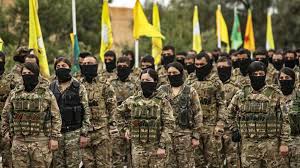
No Syrian Kurd remains unaware of the true nature of the defunct Syrian regime—especially after its failure to neutralize the Kurds during the Syrian revolution and after Kurdish political leaders refused to answer the calls of the fleeing president, Bashar al-Assad. I was among those leaders: he requested to meet me four times, and I rejected every invitation. His response was to summon his former ally, the Kurdistan Workers’ Party (PKK), for assistance.
PKK militants are based in the Qandil Mountains, and its leadership moves between those mountains and Iran, maintaining close coordination with Iranian intelligence. It was therefore unsurprising that the PKK rushed to answer the regime’s call. In fact, it seized the opportunity to exact revenge on the Kurds and distort their cause—just as it has long done to our people in Turkish Kurdistan.
At first, the party’s supporters adopted a “peaceful” tactic: obstructing Kurdish demonstrations. Their numbers were in the hundreds, while Kurdish protesters filled the streets in the thousands. When they failed to confront the protests, they escalated to a new phase: forming militias under the name “YPG” (People’s Protection Units), followed by the “YPJ” (Women’s Protection Units). Their mission was to suppress Kurdish demonstrations and silence the free voices calling for liberty and the fall of the regime.
These militias soon committed massacre after massacre: the killing of a father and two young men from the Sheikh Nasan family in Afrin—one body dragged behind a car; the Tel Ghazal massacre in Kobani, which claimed six lives; the Amuda massacre, where seven people were murdered in cold blood in scenes reminiscent of Hollywood films; and the killing of three brothers in Qamishli.
They continued with assassinations, including that of the struggler Nasreddin Brahik, a member of the political bureau of the Kurdish Democratic Party in Syria (PDK-S), and the kidnapping of the struggler Bahzad Dorsin, also a member of the political bureau, whose fate remains unknown to this day.
I myself was on their assassination list before our comrade Nasreddin Brahik. I was forced to flee Syria to escape their brutality and remain unable to return to my city. Both my parents passed away, and I could not attend their funerals.
In 2015, the “Syrian Democratic Forces” (SDF) were established, with the YPG and YPJ forming its backbone and real leadership. This organization has inflicted oppression, persecution, and repression upon the Kurds exceeding even that of the defunct regime. Through intimidation, forced conscription, ideological indoctrination in schools, and the suppression of dissent, it has displaced nearly one-third of Syria’s Kurdish population.
Not content with harsh repression, it has also contributed to the spread of drug addiction and entrenched poverty in Kurdish regions despite their natural wealth. The organization controls the flow of two major rivers—the Tigris and Euphrates—as well as the Tabqa Dam. Yet electricity remains absent, forcing reliance on generators, and potable water has been unavailable in Hasakah for nearly a decade, leaving people dependent on tanker-delivered, non-potable water.
The vast revenues from eastern Syria—oil, agriculture, livestock, and border crossings—are more than sufficient to provide a dignified life for all Syrians. Instead, the region suffers from extreme poverty, rampant corruption, drug trafficking, the kidnapping of minors, and the digging of tunnels in every city and village, all financed by billions siphoned from the people’s livelihood.
They also entered Arab regions such as Deir ez-Zor and Raqqa as occupiers, seeking to distort their social fabric by promoting ideas alien to local values and imposing hollow ideologies with no regard for customs or traditions.
A striking paradox lies in the fact that the PKK—long a military tool of a regime that denied the Kurds’ very existence and oppressed them for decades—now opposes a system that has officially recognized the Kurds as an integral component of society, affirming their language, identity, and culture through a presidential decree. This alone reveals that the organization has no genuine connection to the Kurdish cause. Its true pursuit is power, privilege, and an agenda wholly detached from our people’s aspirations.
The time has come for voices to rise and demand that they leave our country without farewell, so we may salvage what remains from their destructive legacy. Return to your caves; your conditional employment contract has expired. History is recording, and it will not forgive your crimes against our people and their just cause. Justice and history will hold you accountable—if not today, then in due time.
This article was translated and edited by The Syrian Observer. The Syrian Observer has not verified the content of this story. Responsibility for the information and views set out in this article lies entirely with the author.