
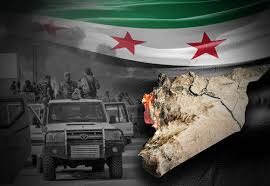
Nearly a year has passed since the massacres on Syria’s coast, yet the killing has not truly stopped. Any honest reckoning must begin there. For the families of the victims — especially the Alawites who were murdered around this time last March — time has not moved forward. The wound has not healed. It has simply been pushed out of sight.
The ferocious regional war now consuming public attention is likely to deepen that sense of grievance. Syrians are watching it largely from the sidelines, some with a troubling sense of relief that the destruction is falling elsewhere. In certain circles, there is even open satisfaction at reports of death here or there, wrapped in slogans of hostility toward Iran or Israel, with little thought for the wider consequences for the region or for Syria itself. Yet Syria’s own transformation has never been separate from the storms around it.
More troubling still, there is no serious Syrian debate about the regional war that might explain the neglect of urgent domestic questions. The opposite is true. The refusal to confront the coast massacres is part of a broader refusal to think at all, especially about matters that unsettle those eager to believe that everything is now in order.
The massacres cannot be understood through casualty figures alone, though the number is large by any measure — whether one looks at the authorities’ own admissions or at the irreducible value of each life lost. Their deeper significance lies elsewhere. Treating them as an isolated episode would be a grave mistake with grave consequences. They were a foundational event in post-Assad Syria. If that was not clear at the time, the violence that later erupted in Suwayda and the Jazira has made it unmistakable.
The events are known to have begun with military operations carried out by local groups described as “remnants” of the old order. These groups reportedly targeted units of the new security apparatus, and in the absence of reliable information, wildly inflated numbers circulated about the security personnel killed. That helped generate a mood of rage and panic, along with the sense that the new authorities themselves were under existential threat. Yet the government committee later formed to investigate the events produced figures far removed from those used to justify the general mobilization. By its own account, the authorities and the auxiliary forces rallying behind them amounted to roughly 400,000 fighters — a scale wholly disproportionate to the threat posed by those “remnant” groups.
This combination of mass mobilization and irregular armed support served one clear purpose: to diffuse responsibility for the massacres. It is difficult to believe this happened spontaneously. The same logic would later reappear in Suwayda under the banner of tribal mobilization. Its reuse suggests that what proved effective the first time was deliberately revived the second.
There had always been reason to fear individual acts of revenge against Alawites, especially where relatives of victims knew the identity of those who had harmed them. Yet such acts, had they occurred, would likely have remained limited. There had also been real hope — encouraged by the relatively disciplined conduct of the factions that led the offensive against Assad — that the era of mass killing had ended with the understandings and circumstances that brought down his rule. Many hoped the new authorities would not repeat the defining sin of the old regime by becoming a party to civil war.
What followed the massacres was, in truth, an extension of them, both in theory and in practice. Some intellectuals treated the killings as predictable, even normal, comparing them to other civil conflicts in which vengeance took far more sweeping forms. What such arguments overlooked was their own implication: that the conflict in Syria had not actually ended, and that the much-advertised “change” in Syria had not truly taken place. That is, incidentally, exactly what the victims’ families themselves have been saying.
On a broader level, memories of massacres committed by the Assad regime were invoked to justify new massacres. This revived one of the ugliest habits of the Syrian war: the use of atrocity as a tool of mobilization. Throughout the conflict, victims were exploited for political ends. Genuine grief — grief that honored the dead — was often absent. The aim was to win external sympathy and intensify hatred, not to pursue justice. At its worst, this fed the machinery of sectarian resentment in service of familiar projects shaped by both domestic and external actors.
Where massacres are used in this way, justice disappears. It is telling that over the past year, the language of transitional justice has rarely appeared in public discourse among supporters of the authorities except as a way of justifying new killings of Alawites, or during the rare moments when Alawites protested arbitrary decisions affecting their livelihoods or abuses threatening their safety. Such selective invocations expose the hypocrisy of those who claim to speak in the name of justice while substituting vengeance for it. Their real aim is plain enough: to criminalize an entire sectarian community in defiance of reason, law, and even the religious principles they claim to uphold, all of which hold that guilt belongs to the perpetrator alone and punishment must be individual.
Meanwhile, the authorities appear to practice a form of selective justice that serves their interests above all. They show no real objection to the vengeful conception of justice embraced by their own social base. There is a striking lack of sensitivity to the way this language is used to threaten Alawites and undermine civil peace, according to a brutal formula: either total domination, requiring the victim’s total silence, or revenge, which has become another word for permissible violation.
It is no exaggeration to say that what followed the massacres has amounted to a form of low-level, controlled violation. For a year now, the killings of Alawite men have never entirely ceased, nor have the abductions targeting Alawite women. These crimes have been met with indifference by the authorities. When women were abducted, an official representative denied that abductions had taken place at all. In such a context, denial becomes a form of encouragement. In one recent killing, the victim was a Christian woman in a district of Homs with a predominantly Alawite presence. Her family reportedly said that an official told them she had been killed because the perpetrators believed she was Alawite.
This sustained targeting has prevented the massacre from becoming a memory. However painful memory may be, it at least belongs to something that has ended. Here, the wound remains open because the violence has not truly stopped. The problem is not limited to the ineffectiveness of the committee formed after the authorities acknowledged the massacres, nor to the familiar fact that the easiest way to drain a cause of its substance is to refer it to a committee. There is, more fundamentally, a broad indifference to what happened, especially because it has not generated meaningful external pressure on the authorities.
To describe the massacres as a foundational event is to say more than that their consequences endure. It is to say that their aftershocks continue to shape Syria’s present, even if they have not yet taken the form of organized counter-violence. The claims made about a “new Syria” falter at this open wound, and again at the later wound inflicted by the massacres against the Druze. There is no hierarchy of blood, except in one respect: the coast massacres were the first after Assad’s fall, and they were foundational in another sense too, because some of their worst features were later replicated in Suwayda.
The aftershocks are felt first by the immediate victims, who have not recovered anything resembling a normal life. The threat of renewed violation has prevented many survivors from living normally to this day. From there, the circles widen. They reach millions of other Syrians who fear more than the massacres themselves; they fear the condition of exposure that followed them. Whether or not those fears are openly expressed is beside the point. They are real, even if many prefer to look away.
Paradoxically, this same foundational event may be the most obvious place to begin repairing the damage — for other Syrians as well as for the direct victims — provided there is a serious process and enough time to rebuild trust. That remains a distant hope. The reality, for now, is starker: a full year has not yet passed since the massacres, because the violation they unleashed has not ended.
This article was translated and edited by The Syrian Observer. The Syrian Observer has not verified the content of this story. Responsibility for the information and views set out in this article lies entirely with the author.