
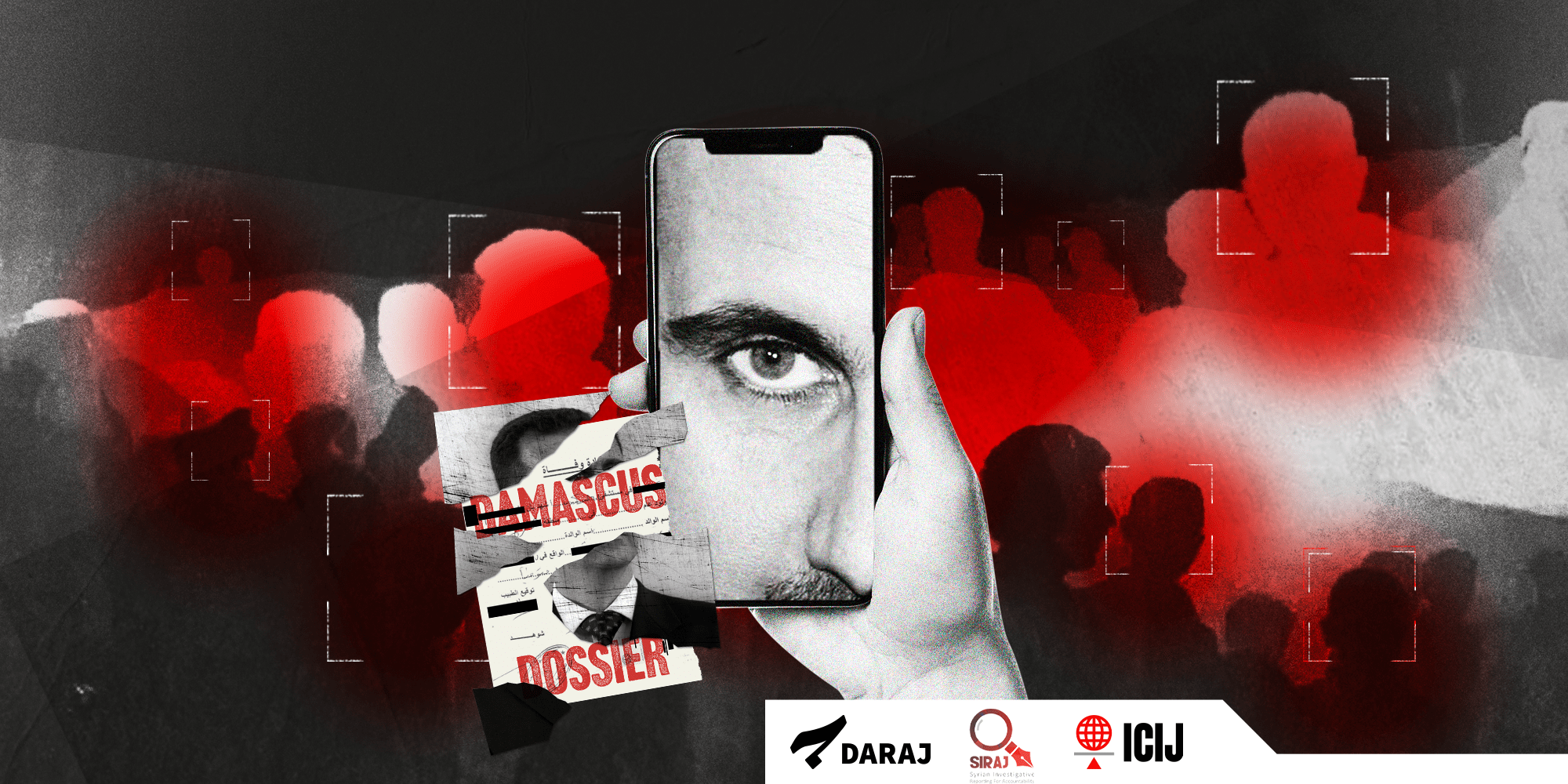
In the final years of Bashar al-Assad’s rule, Syria was not only a battlefield but a laboratory of surveillance. Technologies that in other nations are deployed to protect citizens or combat organized crime were twisted into instruments of repression. The Damascus Files — a leak of more than 134,000 documents spanning three decades — expose the architecture of espionage that ensnared ordinary Syrians, and reveal how foreign allies, notably China and Iran, helped build and refine this machinery.
The documents, analyzed by the International Consortium of Investigative Journalists (ICIJ) and partners across 20 countries, show how Assad’s intelligence services weaponized imported devices, foreign training, and domestic cruelty to prolong their grip on power.
The Arrest of Hanin Imran
On June 23, 2024, journalist Hanin Imran set out for an ordinary day in Damascus. She moved through the city unaware that her phone had already betrayed her. Within minutes of sitting down in a study center, security agents arrived, demanded identification, and singled her out.
Her arrest led to torture in the notorious Mezzeh Military Airport prison, where her digital life was stripped bare. She later realized she had been tracked by an IMSI catcher — locally known as al-Rashida — a device capable of intercepting mobile signals and pinpointing her location.
Her story was not unique. Dozens of others were detained after being digitally hunted, their phone numbers flagged in intelligence files, their movements mapped, their lives reduced to entries in a ledger of suspicion.
Training Under “Friends”
The Damascus Files reveal that Syrian operatives were repeatedly trained to master these devices. By 2023, courses in “source management and technical processing” were routine, and by 2024 the program intensified. Chinese trainers supervised sessions on the use of 4G IMSI catchers, while Iranian advisers taught Syrian agents to break locks, infiltrate homes, and extract data from damaged storage devices.
Iran’s involvement extended beyond digital espionage. Files describe training in opening safes, duplicating car keys, and even maintaining Syrian aircraft. One 2018 document pointed to an Iranian-run chemical weapons facility near Damascus. China, meanwhile, hosted Syrian officers for radar workshops and supplied advanced interception technologies, while shielding Assad diplomatically at the United Nations.
Bureaucracy of Repression
The Damascus Files reveal the banality of authoritarian control. Memoranda catalogued hundreds of “targets,” each with a phone number, an accusation, and a fate: arrest, continued pursuit, or disappearance. Some were accused of political opposition, others of currency dealings, and some of trivial offenses such as insulting Hezbollah in a private call.
General Hussam Louqa, head of the General Intelligence Directorate until the regime’s collapse in December 2024, oversaw this machinery. Under his command, 233 individuals were tracked in a single year, their lives reduced to statistics in a system designed to perpetuate fear.
Technology as a Net Over Society
The files show how surveillance was weaponized to prolong Assad’s grip on power. Internet blackouts silenced protest hubs. IMSI catchers masqueraded as cell towers, tricking phones into connecting and revealing their owners. Algorithms mapped networks of callers, identifying “coordination groups” for arrest. Even traders and businessmen were targeted, their financial activities monitored to extract revenue for a regime starved by sanctions.
What emerges is a portrait of a state that turned technology into a net cast over society. Surveillance was not neutral; it was predatory. It ensnared activists, merchants, and ordinary citizens alike, stripping them of privacy and, often, of freedom.
International Complicity
The revelations also expose the complicity of foreign powers and companies. Chinese and Iranian training, imported devices, and global suppliers all fed into Assad’s apparatus. Legal experts argue that misuse of such technologies does not merely violate privacy; when paired with torture, enforced disappearance, and systemic abuse, it can amount to crimes against humanity.
The European Union’s new Corporate Sustainability Due Diligence Directive underscores this point, requiring companies to identify and prevent human rights abuses in their supply chains. Yet the Damascus Files suggest that suppliers of surveillance technology may have aided one of the most brutal regimes of the 21st century.
The Mechanics of Fear
The documents detail how surveillance was routinized. Each year, intelligence branches compiled “Objectives of the System,” listing hundreds of phone numbers, names, and accusations. Some were flagged for “contact with terrorists,” others for “foreign currency dealings,” still others for trivial offenses.
The fate of each target was noted: arrested, pursued, or marked as “failed” if the phone line was disconnected. In some cases, numbers were registered to individuals already in prison, showing how recycled SIM cards ensnared new victims.
Voices from Within
Defectors from Assad’s intelligence apparatus confirm the scale of surveillance. One former engineer described being ordered to design algorithms that mapped networks of callers, identifying “coordination committees” for arrest. Another recalled installing antennas on vehicles to intercept signals during mobile operations.
These accounts underscore how surveillance was not an occasional tactic but a systemic practice, embedded in the daily routines of Assad’s intelligence services.
The Role of Iran and China
Iran’s role was both technical and operational. Documents describe Iranian trainers teaching Syrians to open locks, infiltrate homes, and extract data from damaged devices. Other files suggest Iranian involvement in maintaining aircraft and even operating chemical weapons facilities.
China’s role was equally significant. Syrian officers were sent to China for radar workshops, and Chinese trainers supervised courses on IMSI catchers. Beijing also shielded Assad diplomatically, using its veto at the UN Security Council to block resolutions condemning the regime.
Crimes Against Humanity
Legal experts argue that the misuse of surveillance technologies in Syria amounts to more than privacy violations. When paired with torture, enforced disappearance, and systemic abuse, it can constitute crimes against humanity.
The Damascus Files provide evidence of this misuse, showing how surveillance was used not to protect citizens but to persecute them.
A Testament to Repression
The Damascus Files stand as testimony: a record of how foreign training, imported devices, and domestic cruelty converged to create one of the most pervasive systems of repression in the modern Middle East. They reveal not only the mechanics of surveillance but also its human toll — the lives disrupted, the voices silenced, the futures stolen.
In the end, the files remind us that technology is never neutral. In the hands of a regime bent on survival at any cost, it becomes a weapon. And in Syria, it became the silent machinery of tyranny, grinding on until the very last days of Assad’s rule.
This article was translated and edited by The Syrian Observer. The Syrian Observer has not verified the content of this story. Responsibility for the information and views set out in this article lies entirely with the author.