
Suweida, the mountainous province once known for its quiet defiance and autonomous spirit, now lies in ruin—its streets littered with bodies, its hospitals crippled, its people cut off from water, electricity, and communication. Yet amid this devastation, a ceasefire was declared at dawn on Saturday, ostensibly halting the bloodshed that has claimed over 700 lives in less than a week. Whether this truce marks the first step toward stability or merely a pause before renewed descent into chaos remains uncertain.
The ceasefire, brokered under international pressure, follows a devastating campaign launched by the Syrian government, which sent tanks and allied tribal militias into Suweida to reassert control over what it framed as a lawless enclave dominated by armed factions. The official narrative, as relayed by Syrian Minister of Information Hamza Mustafa, casts the intervention as a “purely national” endeavor aimed at protecting civilians and restoring order. But this claim is starkly contradicted by eyewitness accounts and field reports that speak of summary executions, home burnings, and the systematic humiliation of Druze civilians.
Damascus, it appears, gravely miscalculated. According to multiple sources cited by Reuters, Syrian officials mistakenly believed they had tacit approval from both Washington and Tel Aviv to deploy forces in the south. Israeli jets, however, responded with swift and punishing airstrikes—not only on Syrian units in Suweida but also on targets in Damascus. The message was unmistakable: any attempt to unilaterally redraw the balance of power in the south would be met with force.
This misstep has exposed not only the fragility of the transitional government led by President Ahmad al-Sharaa but also the limits of its military and diplomatic reach. Lacking a disciplined national army, the state relied on a patchwork of irregulars—many of whom are suspected of extremist leanings—making the incursion into Suweida not only a security failure but a political catastrophe.
It was only after these events spiraled out of control that an international emergency effort took shape. In Amman, Jordanian Foreign Minister Ayman Safadi hosted his Syrian counterpart, Asaad al-Shibani, and U.S. Special Envoy Thomas Barak in a hastily convened trilateral summit. The outcome was a three-phase ceasefire plan that laid out security, humanitarian, and administrative steps toward de-escalation.
A Fragile Accord: Truce Amid the Rubble
The ceasefire roadmap outlines the immediate deployment of internal security forces, the creation of humanitarian corridors with Daraa, and the gradual reactivation of state institutions. Both Jordan and the United States welcomed Syria’s renewed commitment to de-escalation and accountability. Yet beneath the surface, international actors remain skeptical of Damascus’s capacity—and willingness—to follow through.
Meanwhile, the humanitarian situation continues to deteriorate. Suweida is functionally under siege. Hospitals have been bombed, water is scarce, and telecommunications have been deliberately severed. Reports speak of mass graves delayed, medical care paralyzed, and families scavenging for basic necessities.
In a rare regional intervention, Sheikh Mowafaq Tarif—the spiritual leader of the Druze community in Israel—voiced support for the ceasefire while warning of its fragility. He urged Damascus to adopt a more inclusive national vision, revealing the existence of backchannel negotiations between Syrian and Israeli officials, reportedly mediated by the United States. Suweida, thus, emerges not only as a domestic crisis but a node of international diplomacy.
President Sharaa’s decision to assign security responsibilities to local Druze authorities may serve as a gesture of reconciliation—but it also underscores the central government’s eroded authority in key regions.
The Stakes Ahead: Fragmentation or Federal Renewal?
Suweida’s ordeal is more than a provincial tragedy—it is a microcosm of the Syrian state’s existential crisis. How can Syria maintain its territorial integrity while accommodating the demands of regions that no longer trust Damascus? How can the new government restore order without reverting to the brutalities of the past? And how can international actors assist in de-escalation without entrenching foreign spheres of influence?
For now, the guns have fallen silent. But silence in Suweida is not peace—it is paralysis. Unless the ceasefire is transformed into a pathway for real political reform, humanitarian relief, and national reconciliation, it risks becoming yet another fleeting accord in a decade-long tragedy. Suweida may be the first true test of post-Assad Syria’s ability to govern—or the first warning of its irreversible fragmentation.
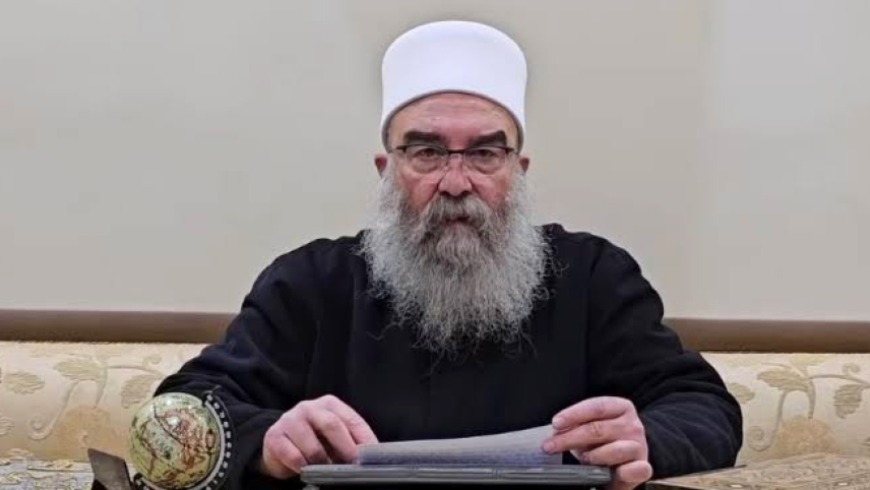
Sheikh Hammoud al-Hannawi
Sheikh Hammoud al-Hannawi, the eldest among Suweida’s Sheikhs al-‘Aql, was born in the village of Sahel al-Balata in 1943. He is the son of Sheikh al-‘Aql Yahya al-Hannawi. After completing his education in 1963, he spent over thirteen years teaching in Deir ez-Zor before returning to his hometown. He later pursued studies in Arabic and travelled abroad for work, eventually returning to assume the religious leadership following his father’s death.
Throughout the years of the Syrian revolution, Hannawi maintained a position of neutrality and consistently advocated for civil peace. He continued to uphold this stance after the fall of the regime, frequently stressing the importance of national dialogue as a means to unify the country, and warning that Syria’s fragmentation was not in the national interest. He has expressed optimism regarding President Ahmed al-Sharaa. Notably, Hannawi did not exacerbate tensions during the recent clashes, remaining firm in his commitment to civil peace and inclusive national dialogue.
Hikmat al-Hijri
Hikmat al-Hijri is widely regarded as the most controversial of Suweida’s Sheikhs al-‘Aql, with many observers seeing his stance as obstructive to negotiations with the Syrian state. He firmly opposes the state’s presence in Suweida and has repeatedly called for international protection, accusing the Syrian government of terrorism and asserting that the state will not enter Suweida, which he insists should be governed by its own people.
Hijri’s rhetoric resonates with numerous armed factions—including the Military Council and the Counter-Terrorism Forces—as well as smaller groups, criminal networks, arms and drug traffickers, and former regime military officers operating in the governorate. These actors back his declarations, fuelling internal strife and violence, as a reassertion of state authority would threaten their interests and disrupt illicit economic networks. According to local sources, al-Hijri is protected by a small faction known as Shield of Monotheism.
Born on 9 June 1965 in Venezuela, Hijri returned with his family to Suweida at a young age. He studied law in Damascus, later returning to Venezuela for work before settling back in Suweida in 1998. He assumed the position of Sheikh al-‘Aql in 2012 after the death of his brother, Ahmad al-Hijri, in a car accident. Earlier in his career, Hijri had supported the Assad regime and, in 2015, publicly called for arming the Druze and endorsing compulsory military service under regime authority. However, following the regime’s collapse, he shifted to a staunchly oppositional stance against the new Syrian state and its leadership.
Hijri played a prominent role in the most recent unrest in Suweida, reiterating demands for international protection and rejecting all proposed agreements—including the ceasefire announced by Sheikh Youssef al-Jarbu’.
Conflicting Agendas
The competing interests of Suweida’s military and religious forces reveal a province deeply divided in both orientation and allegiance. Neither the military nor religious leaderships present a unified front. Instead, shifting alliances and ideological rifts have consistently shaped the province’s complex political landscape. While the full ramifications of the latest events are still unfolding, Israel’s invocation of “protecting the Druze” as a pretext for intervention has provoked sharp reactions—infuriating factions such as the Men of Dignity Forces, the Sheikh of Dignity Forces, and the Ahrar Jabal al-Arab Gathering, while being welcomed by others, including the Counter-Terrorism Forces and the Military Council.
Looking ahead, several scenarios emerge that could define the trajectory of Suweida’s internal dynamics:
Scenario One:
A de-escalation driven by the ascendancy of moderate voices advocating for civil peace and dialogue—such as the Sheikh of Dignity Forces, the Ahrar Jabal al-Arab Gathering, and Sheikhs Hannawi and Jarbu’. Their ability to sway other factions away from violence and prevent further escalation will be vital, especially amid widespread Syrian resentment and a surge of mutual recriminations between Suweida and other Syrians angered by Israel’s military actions.
Scenario Two:
A dramatic shift in internal alliances, transforming conflict into cohesion in the face of sectarian warfare. Under such pressures, Suweida’s armed groups may set aside their differences to form a unified bloc. Though unlikely, this outcome cannot be entirely ruled out—especially considering recent attacks by Military Council factions on the headquarters of the Ahrar Jabal al-Arab Gathering and the Sheikh of Dignity Forces, amid accusations of treachery and collaboration with the Syrian state.
Scenario Three:
An intensifying divide between Suweida’s population and its factional leaderships, potentially descending into internal warfare spurred by mutual accusations. This would risk plunging the province into a deeper cycle of violence with far-reaching implications—not just within Syria, but across the broader Druze community. Similar divisions are already visible among Druze factions in Lebanon, split between supporters of the Syrian state and Suweida’s state-aligned forces, and those who back Sheikh al-Hijri and the Military Council. Moreover, the possibility of Israeli Druze actors—political, religious, or military—intervening in support of one side over another could further exacerbate the situation, transforming it from a local dispute into a transnational crisis.
And Aid Convoy Enters Suweida Without Government Delegation
A humanitarian aid convoy entered the southern Syrian city of Suweida on Sunday, under the sole supervision of the Syrian Arab Red Crescent, according to a correspondent for Syria TV.
The convoy entered without the previously announced official delegation, which was set to include the Minister of Health, the Minister of Emergency and Disaster Affairs, the Minister of Social Affairs and Labour, and the Governor of Suweida.
Health Minister Musab al-Ali confirmed to our correspondent that the convoy had reached the outskirts of the town of Al-Qurayya.
He also stated that Sheikh Hikmat al-Hijri, one of the senior spiritual leaders of the Druze community in Syria, rejected the entry of the official government delegation accompanying the convoy. All efforts, therefore, were focused on ensuring the successful delivery of the humanitarian assistance.
The convoy’s intended destination is Suweida National Hospital, where it will provide medical services. According to Ali, Sheikh Hijri opposed the delegation’s visit and had received warning messages discouraging the entry of government officials.
Earlier this morning, the Syrian government had announced the dispatch of a humanitarian aid convoy to Suweida, following a halt in hostilities and the opening of safe corridors into the city.
The Syria TV correspondent reported that over 40 trucks loaded with relief supplies were sent by the government to Busra al-Sham in eastern Daraa province in preparation for delivery to Suweida.
The government also announced the opening of two safe passages between the provinces of Daraa and Suweida—one in Busra al-Sham and another in Busra al-Harir—to facilitate the delivery of aid, evacuation of the wounded, and safe passage for civilians wishing to leave areas of unrest.
Sanctions
Special Envoy, Tom Barrack, post on X:
“President Trump’s decision to lift sanctions was a principled step, offering the Syrian people a chance to move beyond years of unimaginable suffering and atrocities. The international community has largely rallied behind the nascent Syrian government, watching with cautious optimism as it seeks to transition from a legacy of pain to a future of hope. Yet, this fragile ambition is now overshadowed by profound shock, as brutal acts by warring factions on the ground undermine the government’s authority and disrupt any semblance of order. All factions must immediately lay down their arms, cease hostilities, and abandon cycles of tribal vengeance. Syria stands at a critical juncture—peace and dialogue must prevail—and prevail now.”