
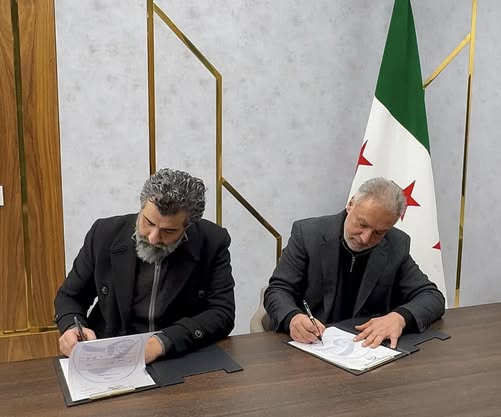
Mohammed Hamcho, one of Syria’s most prominent and controversial businessmen associated with the former regime, has announced the signing of a comprehensive agreement with the new government. The move has triggered widespread debate about the rehabilitation of figures from the country’s previous economic elite.
In a personal statement, Hamcho described the agreement as marking a “new phase,” thereby reopening scrutiny into one of the most contentious names in Syria’s recent economic history.
A “New Page”
Posting on his official platform, Hamcho said he had signed a “comprehensive agreement” with the new government within the bounds of legal procedure. He stressed that the aim was to “formalise and stabilise the legal status” of his affairs and begin a new chapter, notably sidestepping any reference to past allegations.
“Syria is moving towards a phase defined by hope and building the future,” he stated, citing what he described as productive cooperation between state institutions and the private sector, in the interest of the nation and its people.
Hamcho extended his thanks to President Ahmed Al-Shar, commending a policy of “turning the page on the past and opening new horizons based on stability, joint effort and national unity.” He called for collective action to improve living conditions and serve the public interest.
However, the statement—lacking any specific details about the nature of the agreement—has sparked intense scrutiny. Key questions remain unanswered regarding its political and economic significance, its timing, and what a “new page” means in practice for individuals deeply embedded in the former regime’s power structures.
Controversy and a Swift Resolution
The announcement has drawn sharp criticism from Syrian activists, especially over the process behind the settlement. Observers noted that the figure pictured alongside Hamcho is Rami Sawwan, also known as “Sheikh Abu Zaid”, a member of the Committee to Combat Illicit Gains.
The Committee later confirmed the settlement under a “Voluntary Disclosure Programme” launched only a week earlier. Critics argue the programme appears tailored to this specific case and may lay the groundwork for similar deals involving other businessmen close to the former regime.
While the programme’s stated objective is to “achieve economic justice and ensure transparency of assets and properties held by individuals suspected of benefiting from proximity to the former regime,” many activists remain sceptical. They question whether such goals can be met through agreements that prioritise reconciliation without serious scrutiny or accountability—reflected in the language of Hamcho’s statement.
Concerns were also raised about the speed of the process. The Committee cited “extensive investigations and a comprehensive review of financial disclosures and assets,” yet critics argue such a detailed evaluation could not have been completed within the space of a week—casting doubt on the programme’s credibility.
A Heavyweight in the Syrian Economy
Born in Damascus in 1966, Hamcho holds a degree in electrical engineering from Damascus University and an MBA (2005). His career has spanned business and politics: he has served as secretary of the Damascus Chamber of Commerce, secretary of the Federation of Syrian Chambers of Commerce, and head of the Metals and Smelting Council—a body involved in reconstruction files.
He was elected to the People’s Council as a representative for Damascus in 2016. As chairman of both Hamcho International Group and the Syrian-Chinese Business Council, he became a central figure in the nexus of economic and political power under the former regime.
Hamcho is widely regarded as one of the most influential businessmen to emerge over the past two decades. His name has become synonymous with major sectors of the economy and with proximity to powerful regime insiders.
He heads a holding group comprising nearly 20 companies operating in a wide range of fields: metallurgy, construction materials, electricity, and civil contracting in the water, oil, gas and petrochemicals sectors. The group also has interests in telecommunications, IT, hospitality and car rentals—solidifying its presence both inside and outside the Syrian market.
Hamcho’s economic rise, particularly since the 1990s, has long been linked to his close ties with Maher al-Assad, brother of the former president. As such, he has featured prominently in discussions of systemic corruption in Syria’s economy.
From Sanctions to Delisting
Given this background, Hamcho was placed on US and EU sanctions lists, accused of acting as an economic proxy for the regime and managing financial dealings on behalf of senior officials.
When the US Treasury sanctioned him in August 2011, it stated that Hamcho “built his fortune on ties to regime insiders”, presenting the move as a direct consequence of his role within the Assad-era economy. Though European sanctions were temporarily lifted in 2014, he was relisted in 2015—resulting in asset freezes and an EU travel ban.
A Test for Syria’s “New Phase”
The agreement presents a critical test for the new government’s narrative of a “new phase”. It exposes the tension between pragmatic efforts to revive the economy by reintegrating capital, and the moral and political risks of rehabilitating figures emblematic of the old order.
As Syria undergoes political transition and seeks relief from international sanctions, the reappearance of businessmen once closely tied to the regime will not go unnoticed. The move raises fundamental questions about the future of the Syrian economy and how the country will reconcile forward-looking policies with calls for justice and transparency.
This article was translated and edited by The Syrian Observer. The Syrian Observer has not verified the content of this story. Responsibility for the information and views set out in this article lies entirely with the author.