
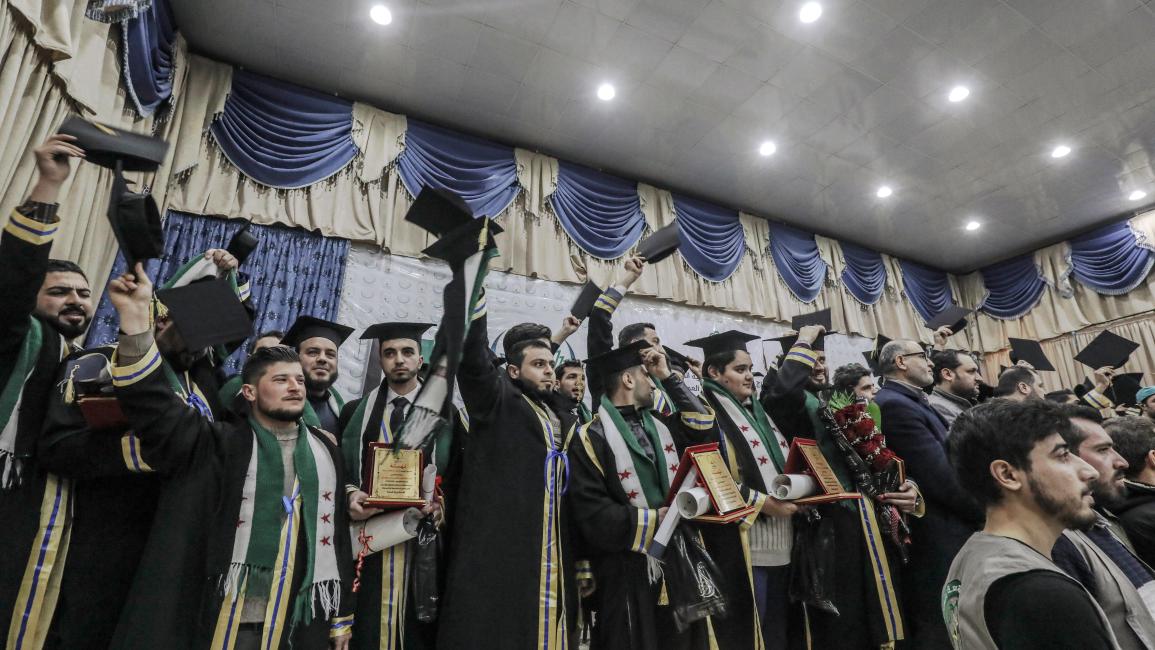
No one can say with certainty what has become of Syria’s university graduates. The civil war that erupted in 2011 left behind catastrophic consequences: Syrian society fractured, and nearly half the population fled their towns and villages, either to other parts of the country or abroad. A Syrian graduate from a Turkish, Lebanese, Jordanian, or Egyptian university faces circumstances entirely different from those who studied inside Syria. It is difficult to determine their numbers, let alone trace the divergent paths their lives have taken.
Those who remained in Syria are hardly better off than their peers who became refugees. The war crushed the economy across all sectors. Industry suffered devastating blows as factories and workshops in Damascus, Aleppo, Homs, Hama, and other once-industrial cities were destroyed. These cities had formed the backbone of local production, meeting domestic needs and supplying goods for export.
Agriculture and livestock, long central to Syria’s food security, also sustained massive losses that will take years to recover. The collapse of the national currency, the erosion of wages, and the deterioration of public services compounded the crisis. When these factors are added to the security situation and the country’s geographic fragmentation, the chances of young people finding work that matches their qualifications become slim, if not impossible.
Thousands of graduates have chosen to leave the country, even if it means risking their lives on “death boats.” Others are forced into precarious day-labor jobs, driving taxis, or working in low-paid trades. This outcome is partly the result of vanishing investment, driven away by political instability and economic hardship. Many service and craft-based businesses have shut down, laid off their workers, or operate at only a fraction of their former capacity.
Even graduates with skills that typically offer more flexibility are struggling. Doctors, despite low wages and the difficulty of opening private clinics, cannot find opportunities to practice their specialties. Engineers face similar obstacles and are leaving the country in large numbers. The situation is even worse for professions considered lower on the labor-market ladder.
Unemployment figures do not merely reflect the distortion of Syria’s labor market; they also reveal who is paying the highest price. Those with advanced qualifications—especially women—bear the brunt. They face both unemployment and the pressure to accept whatever work is available, even if it has nothing to do with their field of study. Many are forced to set aside their degrees and take on any job that allows them to survive.
All of this comes without delving into the broader crisis of higher education itself: declining academic standards, shrinking competencies among graduates, and the widening gap between theoretical and applied fields of study.
This article was translated and edited by The Syrian Observer. The Syrian Observer has not verified the content of this story. Responsibility for the information and views set out in this article lies entirely with the author.