
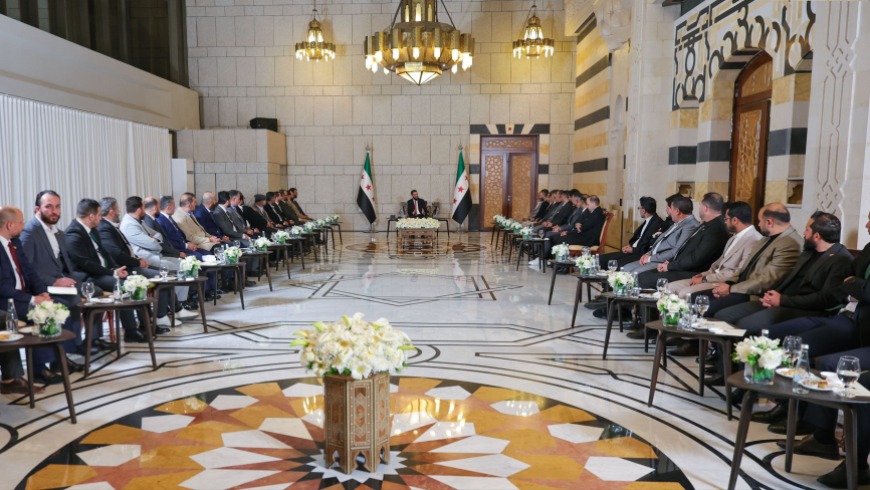
President Ahmed al-Sharaa met on Tuesday with a group of media professionals and civil society activists at the People’s Palace in Damascus to discuss the role of the media and community initiatives in strengthening public awareness and reinforcing national responsibility.
According to the Syrian Presidency, the meeting addressed key domestic challenges as well as current regional developments and their broader implications. President al-Sharaa listened to the participants’ interventions and proposals, stressing that the coming phase requires unified efforts and a collaborative “one-team” approach to serve the national interest and support the path toward stability and development.
Plans to Revitalize Local Media and Broaden Representation
In parallel, Minister of Information Hamza al-Mustafa outlined new plans to reinvigorate local media and ensure that diverse communities are represented within the national media narrative. He underscored the need to produce content that resonates with the public and reflects their daily concerns, moving away from “selectivity and fragmentation.”
Al-Mustafa noted that the Ministry aims to build an interactive relationship with audiences outside the capital, particularly in media centers that were “marginalized by the deposed regime.” He emphasized the importance of involving local communities in shaping media content and restoring their presence in the national conversation.
During the launch ceremony of the 2026 Professional and Ethical Code of Conduct for the Media Sector in Syria, the Minister highlighted that the document is the product of a “collective effort” involving more than a thousand journalists over several months.
He described the Code as the “most significant in the Middle East and North Africa” in terms of detail, clarity, and its comprehensive approach to professional and ethical standards. Al-Mustafa stressed that the Code is “a starting point, not a transient document,” affirming that it belongs to all Syrian journalists. He announced that an annual conference will be held to review and further develop the framework in line with evolving media challenges.
This article was translated and edited by The Syrian Observer. The Syrian Observer has not verified the content of this story. Responsibility for the information and views set out in this article lies entirely with the author.