
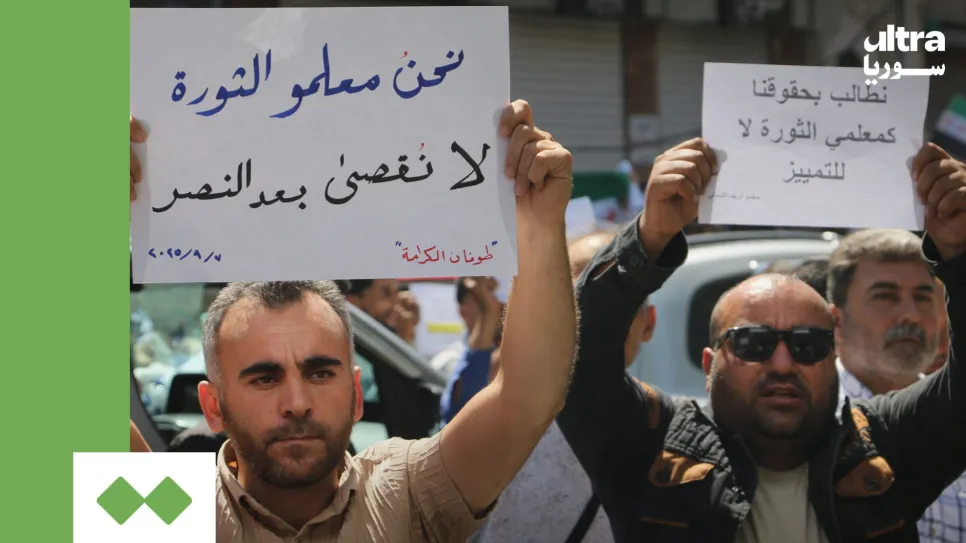
In recent weeks, much of northern Syria has witnessed a near-total standstill in educational activity, as teachers across numerous schools have embarked on an open-ended strike. This sweeping action arises not from whim, but from years of neglect, marked by sporadic protests and repeated appeals for fair pay—none of which have yielded substantial reform. Amid rising costs of living and stagnating salaries, teachers have now drawn a firm line in the sand.
Ahmad Smi’eh, 49, a teacher at the Atma camp school, told Ultra Syria: “Suspending education was not an easy decision. But after years of governmental indifference to our daily struggles, we had no choice.” He explained that his colleagues have long endured relentless pressure while earning wages insufficient to meet even basic needs.
“Our goal is to protect our professional dignity and ensure that our children continue to receive an education,” he added. “This strike is our last resort to make our voices heard.” With household costs soaring and wages increasingly inadequate, the teachers see this movement as their final stand—a declaration of their worth and their commitment to education.
The mobilisation has been accompanied by a series of sit-ins, statements, and rallies, with educational communities joining forces in an unprecedented show of unity and coordination.
Origins and Catalysts of the Strike
Long before the fall of Assad, teachers in the north had staged numerous protests, particularly in areas under the control of Idlib’s Salvation Government. They called for fair wages and better living conditions, yet these demands were met with silence.
With the collapse of the Assad regime, teachers intensified their campaign, holding vigils outside schools and the Education Directorate in Idlib, and organising marches across the region. Yet despite the passion, their efforts continued to fall on deaf ears.
The current crisis erupted when the Finance Directorate disbursed salaries via the “Sham Cash” system—without the anticipated increases previously promised. Teachers had hoped for wage adjustments that reflected the rising cost of living, and the announcement of unchanged pay sparked a storm of anger.
Currently, teacher salaries range between $130 and $150 per month, with rural educators in Idlib earning between $115 and $130, and those in northern Aleppo receiving as little as $94. These amounts fall far below the poverty line, with monthly household expenses now exceeding $300. Food prices, rent, and daily essentials have all risen sharply, leaving teachers unable to make ends meet.
“We have protested repeatedly and appealed constantly, but nothing has changed,” said Smi’eh. “This strike is now the only way forward. We want all stakeholders to understand that a teacher—who educates the next generation—deserves to live with dignity and provide for their family.”
The Strike Spreads Across the Region
As the strike gains momentum, schools are closing their doors, and classrooms have become sites of protest. Banners bearing slogans such as “Sit-in because we’re hungry” and “A teacher should not be humiliated” are now commonplace.
The movement spans Idlib, Atma, Kansafra, Sarmada, Qah, Taftanaz, Harim, Babka, and rural parts of Aleppo. In Qah, large numbers of teachers held a sit-in outside their school complex, continuing their protest within the premises before gathering outside.
Imran al-Ali, 38, an organiser of the Qah sit-in, told Ultra Syria: “These actions were carefully planned to ensure our message is clear. This is not sabotage. It’s a way of shedding light on the daily struggles we face.” He added that all participants are united in their demand for immediate government action. “The strike will continue until there are serious steps forward. Without that, nothing will change.”
He continued: “We’ve put our demands in writing, reflected our pain in slogans and signs. We understand there may be criticism, but our message is clear: education cannot continue unless teachers are treated with dignity.”
The strike has now affected more than half the schools in some regions, halting lessons for thousands of pupils. Parents have shown strong support for the movement, convinced that fair pay for teachers is vital for a sustainable education system.
Pay Disparities Across Public Sectors
Central to the teachers’ grievances is the stark disparity between their wages and those of employees in other sectors. While teachers in rural Idlib earn $115–$130, and those in Aleppo around $94, Defence Ministry personnel are paid between $200 and $350, and government-affiliated journalists earn between $500 and $1,200.
“How can such an unjust gap exist between us and other public servants?” asked al-Ali. “Teachers are supposed to be the foundation of the country’s future, yet we’re paid less than anyone else. This injustice is why we won’t back down.”
These inequalities, seen as a symptom of broader structural neglect, have been compounded by a lack of media coverage—something educators attribute to the financial ties between the press and authorities.
Broken Promises and Growing Frustration
This is not the first protest of its kind, but it is by far the largest in scale. The Finance Ministry has previously pledged to increase wages within weeks—promises that have repeatedly gone unfulfilled.
Teachers recount enduring difficult conditions in recent months, but the pattern of empty pledges has worn down their patience. For many, striking has become the only viable option.
“My salary doesn’t even last half a month,” said al-Ali. “I’ve had to borrow money just to cover the basics.” In many schools, lessons have stopped entirely, and blackboards bear stark messages: “The teacher stands at the front of famine”—a grim symbol of their current hardship.
The Union and Government Response
Days ago, the Teachers’ Union released a statement endorsing the strike, describing the teachers’ demands as legitimate and representative of a sector-wide crisis. It urged members to pursue official channels while pledging to monitor the government’s response to promised reforms.
Idlib Governor Muhammad Abdulrahman said: “The Education Ministry has thoroughly examined the teachers’ concerns and is working on a fair and lasting solution.” He added: “The final approval is near, pending administrative and financial procedures.”
He stressed that “teachers are the backbone of education, and their rights are a priority,” and appealed for patience as the process concludes. However, many educators are sceptical—pointing out that similar assurances have been made in the past, always without results. They insist the strike will continue until real change is delivered.
Meanwhile, an audio recording has circulated in some areas, reportedly featuring an education official threatening to replace striking teachers—sparking a fierce backlash and hardening the resolve of protesters.
Official Silence and an Uncertain Path Forward
Ultra Syria sought comment from the Education Directorate in Idlib regarding the delayed wage increases, the effects of the strike, and the government’s planned response. Despite multiple attempts and a full-day wait, no statement was provided. Offices remained closed to journalists and the public alike.
As the strike continues to grow, its end remains unclear. The scale and unity of the movement have made it impossible to ignore. The future of education in northern Syria now rests on whether authorities will finally deliver the fairness and basic livelihood that teachers have long been denied.
Though teachers emphasise that the strike is not aimed at harming pupils, they argue that ensuring their own survival is essential to safeguarding the future of education itself.
This article was translated and edited by The Syrian Observer. The Syrian Observer has not verified the content of this story. Responsibility for the information and views set out in this article lies entirely with the author.