
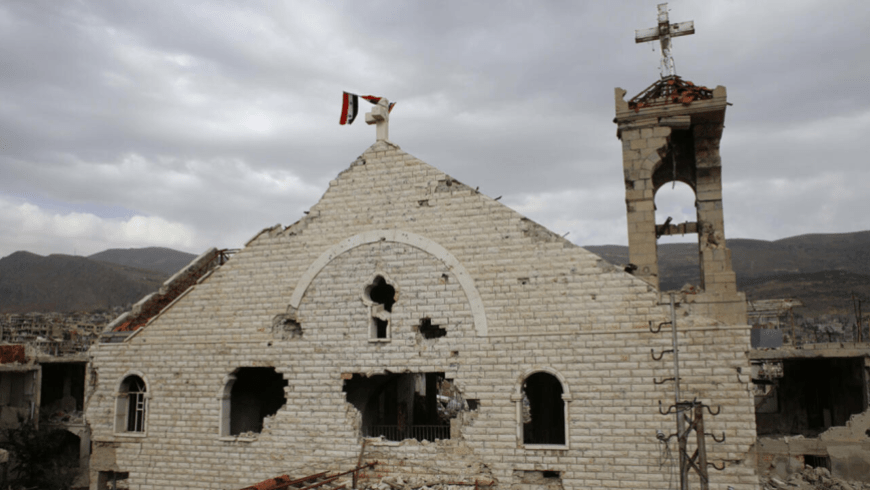
Amid the unfolding complexities of Syria’s contemporary narrative, one phenomenon stands out for its profound human, social and civilisational weight: the emigration of Syrian Christians. This historic departure spans two distinct waves—the first preceding Hafez al-Assad’s rise to power, surging in the late 1950s and throughout the 1960s toward Lebanon, Europe and the Americas; the second beginning in the 1970s and continuing with unwavering momentum to the present day.
Drawing on authoritative demographic studies, including the CIA’s World Factbook—known in Arabic as Kitab Haqa’iq al-Alam—Christian representation in Syria has seen a dramatic decline. In the early 1970s, Christians accounted for over 15 percent of the population. By the end of Hafez al-Assad’s rule, this figure had fallen below 8 percent. Under Bashar al-Assad, it has now diminished to less than 2 percent. Across both regimes—each styling itself as a “protector of minorities”—more than 85 percent of Syrian Christians have departed their ancestral homeland in search of safety, dignity and stability, conditions that steadily eroded under successive Assads.
This exodus represents not merely a demographic shift but the slow evacuation of one of the Orient’s oldest civilisational layers—communities whose presence has enriched the region’s cultural fabric for centuries. Their departure unravels a legacy of coexistence and dialogue, threatening not only the Christian community but the broader identity of Syria itself.
Reliable statistics in Syria remain elusive due to limited data infrastructure. Yet, churches—custodians of the community’s granular records—offer approximate insights. Today, the Christian population is estimated at between 300,000 and 500,000, concentrated primarily in Damascus and Aleppo. In Aleppo alone, the Christian presence has shrunk from approximately 500,000 in 2011 to around 25,000, according to the Independent Arabia. This is a stark contrast to Syria’s historic status as a relative sanctuary for Christians in the Middle East—under Ottoman and French rule, Christians comprised nearly a quarter of the population by the late 19th century.
As a consequence, the departure of Christians cannot be viewed as an internal matter alone. It signals the erosion of centuries-old cultural bridges between East and West, and the loss of a vital interlocutor in Syria’s intellectual, economic and diplomatic engagement with the wider world.
A confluence of factors has driven this migration, particularly in the last two decades. Chief among them is the collapse of security and the deepening instability across the country. The outbreak of the Syrian revolution and the Assad regime’s ruthless dismantling of state infrastructure drove many to seek safety abroad. The rise of extremist factions and the unchecked flow of arms further endangered minority communities, enabling lawless groups to seize power and spread terror with impunity.
The Assad regime capitalised on this chaos to present itself as the final bulwark against extremism. This narrative found sympathetic ears among international actors discomfited by jihadist violence, allowing Assad to secure crucial support from states keen to avoid further destabilisation—even at the cost of propping up a regime accused of widespread repression and brutality.
The flight of Christians from Syria is not merely a tragic statistic—it is the disintegration of a cultural heritage and a direct threat to the pluralistic essence of the region.
Other contributing factors include lower birth rates among Christian families, favourable immigration policies by European governments, and the longstanding presence of Syrian Christian diaspora communities that eased the transition for new migrants. Added to this are perceptions of systemic discrimination, particularly legal and constitutional provisions such as the requirement that Syria’s president must be Muslim. While the nation’s demographic majority might naturally yield a Muslim president through democratic means (though Syria has never held open presidential elections), this legal stipulation nonetheless reinforces the perception of second-class citizenship among Christians. In practice, however, the presidency has remained a hereditary post, confined to the Assad dynasty—rendering any broader debate about representation largely moot.
This steady erosion of citizenship and civic equality has undermined intercommunal cohesion and deepened the estrangement of minority groups.
The exodus of Syria’s Christians marks the unravelling of a multi-millennial presence—a cornerstone of the region’s diversity and identity. Those who remain, though vastly diminished in number, embody resilience. Their future depends largely on the state’s capacity to restore stability and uphold principles of tolerance, inclusion and full citizenship.
The plight of Eastern Christians extends beyond Syria, touching Iraq, Lebanon and Egypt, and presaging a Middle East increasingly bereft of Christian communities. This trajectory threatens to give rise to homogenous, monochrome societies, absent the cultural heterogeneity that has historically defined the region.
The survival of Christianity in Syria, and the possibility of return for those who have fled, hinge on political resolution, genuine inclusivity, and the enshrinement of equal rights for all citizens. Without these conditions, Syria risks losing not just a people, but an irreplaceable part of its soul.
This article was translated and edited by The Syrian Observer. The Syrian Observer has not verified the content of this story. Responsibility for the information and views set out in this article lies entirely with the author.