
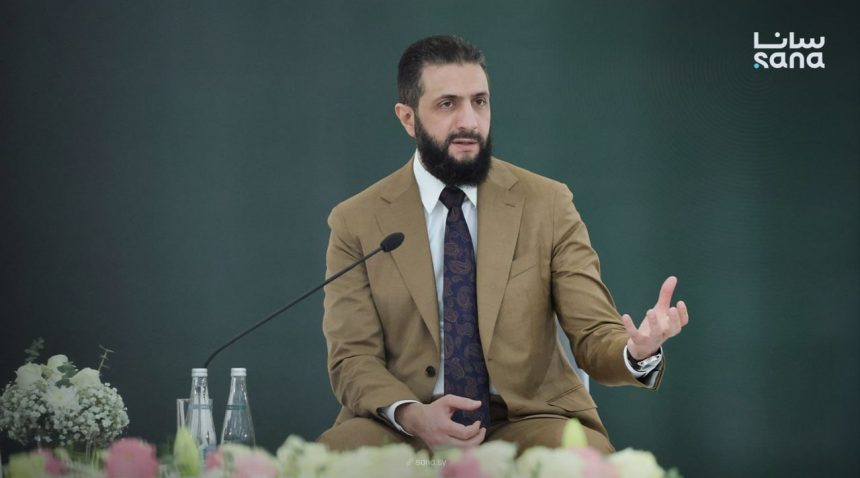
In a formal address at the People’s Palace in Damascus, delivered after Eid al-Fitr felicitations, President Ahmad al-Sharaa set out a sweeping vision for Syria’s economic revival. He announced that the approved budget for the fiscal year 2026 is estimated at nearly $10.5 billion, a fivefold expansion compared with the 2024 budget. The President described this leap as a remarkable accomplishment achieved within only sixteen months.
President Sharaa projected that the Gross Domestic Product for the current year will stand between $60 billion and $65 billion. Such a recovery would return national output to its 2010 level and open the way for a significant improvement in public services. Reflecting on the recent fiscal path, he noted that government expenditure in 2024 amounted to $2 billion. By 2025, the country recorded a growth rate of 30 to 35 percent, with GDP rising to $32 billion and expenditure reaching $3.5 billion. This period also witnessed the first budget surplus in Syria’s history.
The liberation of key regions has restored essential resources to the state and strengthened the economy in the vital domains of energy, food, and water security. As a result, forty percent of this year’s budget is allocated to public services, particularly health and education. President Sharaa acknowledged the scale of the challenges facing Syrian society and the breadth of its needs. He affirmed the state’s determination to meet these demands and observed that the restoration of service infrastructure requires patience after years of systemic collapse, even as the government advances with notable momentum.
Resolving the displacement crisis stands at the heart of the government’s agenda. Plans are being prepared to enable citizens to return to their towns and villages. A substantial financial allocation has been reserved for the rehabilitation of infrastructure in devastated areas, with priority given to the countrysides of Idlib, Aleppo, Northern Hama, and Northern Latakia, as well as Eastern Ghouta, Daraa, and Deir ez-Zor. An infrastructure support fund of no less than $3 billion will be established, financed entirely through government resources rather than external aid or loans.
The President also highlighted a strategic programme for the Al-Jazira region, which includes the provinces of Deir ez-Zor, Al-Hasakah, and Raqqa. This initiative will focus on developing hospitals, schools, and transport networks, while improvements to services will extend across all other Syrian cities.
In support of social welfare, President Sharaa announced an increase in the minimum wage following recommendations from the Ministry of Finance and in consideration of prevailing poverty indicators. This measure accompanies a general 50 percent salary increase for all public-sector employees, along with specialised increments for physicians, engineers, and staff in oversight institutions.
The President noted that since the beginning of the transition, cumulative wage increases, reinforced by a stronger exchange rate, have reached approximately 550 percent. In certain specialised sectors, the rise has approached 1200 percent. He concluded by affirming that the foremost duty of the state is the empowerment of its citizens. The measures announced represent the opening steps of a sustained effort to ensure that Syrians live with the dignity and pride that reflect their heritage and their commitment to the nation.
This article was translated and edited by The Syrian Observer. The Syrian Observer has not verified the content of this story. Responsibility for the information and views set out in this article lies entirely with the author.