
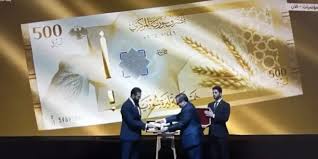
The unveiling of Syria’s redesigned banknotes has ignited a debate that extends far beyond aesthetics. For some, the new lira represents a long-awaited technical correction to a distorted monetary system. For others, it is a political document that speaks through what it shows—and what it deliberately avoids. Between these two poles stand two sharply different readings: one grounded in economic pragmatism, the other in cultural and historical symbolism.
- The Economic Lens: A Necessary Step, but Not a Sufficient One
From an economic standpoint, replacing the Syrian currency is not a cosmetic gesture but a practical necessity. Years of inflation have forced citizens to carry unwieldy stacks of cash, and banks to store and count deposits that arrive in sacks rather than envelopes. In a country where nearly all transactions are conducted in cash due to the absence of electronic payment systems, the burden has become untenable.
Samir Seifan, Director of the Haramoon Centre argues that removing zeros can indeed ease daily transactions and reduce logistical strain. Yet he stresses that the real solution lies in introducing electronic payments, which would liberate Syrians from the tyranny of physical cash altogether. The Central Bank claims to be negotiating with international institutions to build this infrastructure, but even if successful, adoption will be slow. Many merchants will resist electronic payments because they expose real turnover and undermine widespread tax evasion.
More critically, Seifan warns that currency replacement must occur only under conditions of monetary stability. Removing zeros without addressing the underlying causes of inflation risks a rapid return to collapse. Stability requires a balance between money supply, available goods and services, and the velocity of market transactions. Today, the authorities maintain the exchange rate at 11,000 pounds per dollar only by restricting cash withdrawals. If more liquidity were released, the pound would fall again.
At the same time, the state faces enormous spending obligations: reconstruction, infrastructure, resettling displaced families, funding the army and security apparatus, and running public institutions. With sanctions lifted, excuses have evaporated. The authorities must now choose between expanding spending—risking inflation—or maintaining tight monetary control—risking stagnation.
In Seifan’s view, the new currency can succeed only if embedded within a broader framework of fiscal discipline, institutional reform, and technological modernization. Otherwise, it becomes a numerical adjustment masking deeper structural decay.
- The Symbolic Lens: A Currency That Flees from History
If Seifan examines the new lira through the logic of economics, Lubna Haddad, Syrian writer and philographer, approaches it as a cultural artifact—one that reveals the state’s anxieties more clearly than its intentions.
For Haddad, the new banknote is not simply redesigned; it is a silent political document. Its most striking feature is the total disappearance of the human figure. In its place appear olives, oranges, roses, cotton, mulberries, and wheat, along with shy depictions of a gazelle, a bird, and a horse. These are safe, neutral symbols—timeless, apolitical, and unthreatening.
This erasure, she argues, cannot be separated from the influence of strict Salafi doctrines that prohibit imagery. Rather than confront theological debates, the authorities chose the path of least resistance: eliminating the human form altogether.
But Haddad sees a deeper motive. By avoiding human faces, the state also avoids choosing which humans to honor. And by avoiding antiquities—Ebla, Ugarit, Palmyra, Apamea, Bosra, Aleppo’s citadel—it avoids acknowledging a history that predates Islam and contradicts the narrow identity it now promotes. These monuments testify to a Syria that is older, broader, and more plural than any single religious or political narrative.
Thus, the new currency becomes a tool not of commemoration but of erasure. It reflects a state uncomfortable with the weight of its own past, preferring a landscape of plants and animals to the complexity of civilizations. Even the name “Syria,” with its ancient and contested origins, stands as a reminder of a history that cannot be rewritten by decree.
In Haddad’s reading, the new lira is a carefully managed void:
a currency without faces, without heroes, without memory;
a currency without antiquities, without roots, without time.
III. Two Readings, One Moment of Truth
Taken together, Seifan and Haddad illuminate two dimensions of the same phenomenon.
- Seifan warns that without economic stability, institutional reform, and technological modernization, the new currency risks becoming a hollow gesture.
- Haddad warns that without historical honesty and cultural confidence, the new currency risks becoming a hollow identity.
One speaks of inflation, liquidity, and electronic payments.
The other speaks of memory, symbolism, and the politics of erasure.
Both, however, converge on a single truth: a currency is never just a medium of exchange. It is a mirror of the state that issues it.
In the end, Syrians will judge the new lira not by its colours or its symbols, but by whether it can restore dignity to their daily lives—economically, culturally, and historically.
When the Smallest Banknote Becomes a Driver of Inflation
The Syrian government’s decision to introduce a new currency has been presented as a technical step towards monetary reform, a symbolic break with the past, and a gesture aimed at simplifying daily transactions. Yet beneath the surface lies a structural flaw with far-reaching economic consequences—one that risks burdening the very people the reform purports to assist. The issue is deceptively simple: the smallest banknote in the new series will be 10 Syrian Liras, equivalent to roughly ten cents, with no coins of smaller value.
At first glance, this may appear trivial. In reality, it is a design choice that will trigger automatic, mechanical inflation, particularly for low-income households. When a currency lacks small denominations, markets lose the ability to express precise prices. Goods that should cost 3, 5 or 7 Liras cannot be priced accordingly. Even prices such as 12, 15 or 22 Liras become unworkable. Every transaction must be rounded up to the nearest ten.
This is not a matter of speculation. It is a well-documented economic phenomenon known as denomination-induced inflation. When the smallest unit of currency is too large, sellers have no choice but to round prices upwards, and buyers are left to bear the difference. The result is a silent, pervasive inflation that does not stem from supply and demand or monetary expansion, but from the design of the currency itself.
The consequences fall most heavily on the poor. Low-value goods—bread, vegetables, bus fares, essential household items—are affected first. A loaf of bread that should cost 6 Liras will now be priced at 10, a 66 percent increase imposed not by market forces but by the absence of 1 or 5-Lira denominations. A bus fare that should be 17 Liras becomes 20. These increments may seem minor in isolation, but for families subsisting on an average income of 10,000 Liras, they represent a significant erosion of purchasing power.
In most countries, coins exist precisely to avoid this outcome. They allow fine-grained pricing, protect consumers from forced rounding, and ensure that the smallest transactions remain fair and manageable. By removing coins and setting the minimum denomination at 10 Liras, the Syrian authorities have effectively dismantled the lower rungs of the pricing ladder. The poor will pay the price for this omission—quite literally.
The irony lies in the reform’s stated goals of simplification and modernisation. Yet without a full spectrum of denominations, the new currency risks becoming a source of distortion rather than clarity. It simplifies accounting at the expense of complicating daily life. It reduces the number of zeros on banknotes while increasing the number of hidden costs in practice.
A currency is not merely a symbol of sovereignty; it is a tool that shapes economic behaviour. When designed without consideration for the realities of everyday transactions, it can deepen inequality and accelerate inflation. The Syrian government may have hoped to inaugurate a new era of monetary stability, but unless it reconsiders the architecture of its smallest units, the reform will function as a regressive tax on the poor—a tax levied not by legislation, but by rounding.
Ultimately, the success of any currency lies not in its colours or slogans, but in its ability to serve those who use it. A banknote that cannot express the real value of goods is not a symbol of renewal—it is a barrier to fairness. Unless this flaw is addressed, the new Syrian Lira will carry within it the seeds of the very inflation it was intended to resolve.