
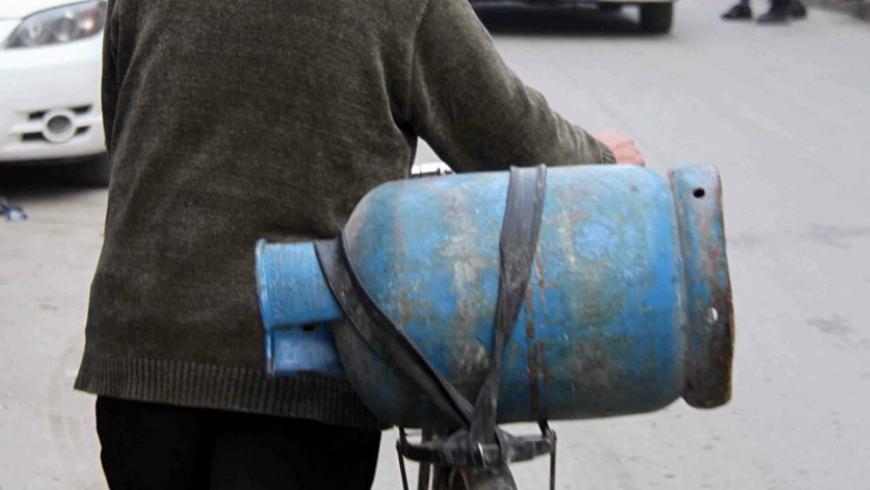
As the month of Ramadan approaches, markets in Damascus and its countryside are witnessing a noticeable shortage in household gas cylinders, accompanied by a sharp rise in black-market prices far exceeding the official rate of 126,000 Syrian pounds.
Field surveys and citizen testimonies indicate that cylinders are being sold at significantly inflated prices across several areas. In the Damascus Suburb region, the price has climbed to around 200,000 pounds, while residents in Jaramana and Muadamiyat al-Sham report prices reaching nearly 300,000 pounds.
The crisis is not limited to soaring prices. Many residents say the commodity has become difficult to obtain altogether. In the Al-Tadamon area, citizens confirmed that authorized distributors have no available stock. Others reported being unable to secure cylinders even on the black market, despite being willing to pay more than 200,000 pounds.
In Beit Sahm, residents described a complete halt in supply, forcing some families to rely on small “travel gas cylinders” as a temporary substitute. However, the price per kilogram for these cylinders has surged from approximately 20,000 pounds to 50,000 pounds.
Citizens attribute the increased demand to rising electricity costs. Many households have reduced their reliance on electrical appliances for cooking and heating, turning instead to gas — a shift that has intensified pressure on available supplies.
With Ramadan drawing near, some residents have begun stockpiling cylinders whenever they become available, fearing future shortages. This behavior, while understandable, has contributed to increased congestion at distribution centers. Similar complaints have been reported from other governorates.
Ministry of Energy: Delay Was Logistical and Has Been Resolved
In response to public concerns, the Director of the Media Department at the Ministry of Energy, Abdul Hamid Sallat, told Al-Thawra that the current shortage stems from a temporary delay in the unloading and connection operations of a gas shipment at the port.
Mr. Sallat explained that adverse weather conditions, along with technical and navigational challenges, affected the safety of the unloading process along the Syrian coast. He confirmed that the issue has now been resolved and that pumping operations have gradually resumed — a development he expects will positively impact distribution centers starting tomorrow.
He stressed that contracted quantities are fully available and that the situation was merely a logistical delay. The commodity, he said, will reach households within 24 to 48 hours at most.
Mr. Sallat urged citizens not to be swayed by rumors, affirming that the situation is stable and that the Ministry remains committed to ensuring the availability of gas, especially with the approach of Ramadan.
This article was translated and edited by The Syrian Observer. The Syrian Observer has not verified the content of this story. Responsibility for the information and views set out in this article lies entirely with the author.