
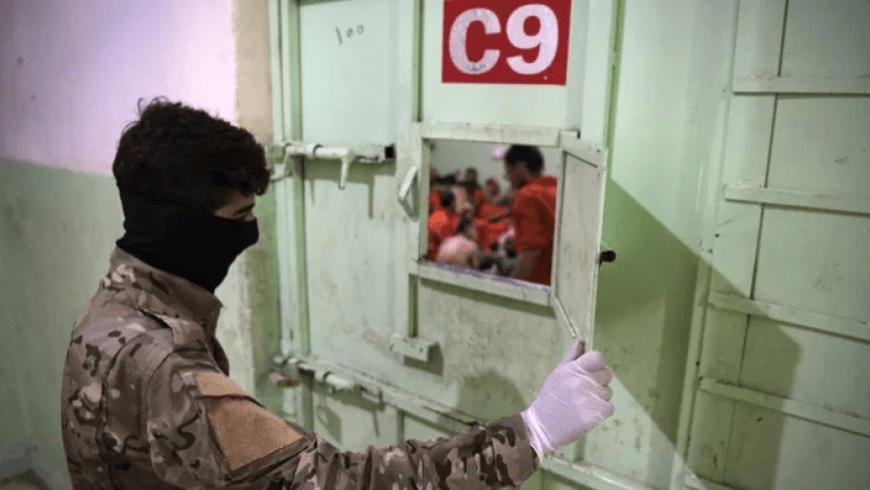
The Syrian Network for Human Rights has issued an urgent appeal for the protection of former detention centers previously controlled by the Syrian Democratic Forces (SDF), following the recent handover of several facilities to Syrian government forces. In a report released today, the Network warned of the risk that crucial evidence of serious violations could be destroyed or compromised.
Describing the facilities as “crime scenes”, the report stressed that they contain vital proof of systemic abuses, including killings, arbitrary detention, enforced disappearances and torture. The affected centers are located across the governorates of Raqqa, Hassakeh and Deir ez-Zor, and were known to have held political activists, civilians, women, children, and individuals accused of affiliation with the Islamic State (ISIS).
Between 8 December 2024 and 23 January 2026, the Network documented the killing of 204 civilians, among them 24 children and 19 women, alongside 819 cases of arbitrary arrest and 15 cases involving torture and ill-treatment. It noted that verification efforts are ongoing, but the figures already highlight the urgency of securing evidence and holding perpetrators to account.
The report emphasized that the transfer of these facilities to Syrian state control places full legal responsibility on the authorities to investigate the violations, safeguard the evidence, and prevent any form of impunity. It called for all procedures to follow internationally recognized standards for criminal investigations, and urged immediate and transparent inquiries that center on victims’ rights and advance the broader goals of transitional justice.
Drawing on experience, the Network warned that evidence may be lost through deliberate destruction, environmental damage or improper storage, rendering it inadmissible in court. It called for the protection of administrative records, facility infrastructure and digital material, and the establishment of a precise chain of custody to guarantee the integrity and legal viability of the evidence.
The Syrian authorities were urged to secure the liberated centers without delay, deploying trained personnel and establishing tightly monitored perimeters. The report also called for a public declaration confirming the state’s commitment to evidence preservation, the urgent passage of laws criminalizing tampering, and the signing of cooperation agreements with neutral international mechanisms and relevant United Nations bodies responsible for evidence collection and determining the fate of the missing.
A dedicated section addressed the situation in Al-Hol camp, where the Network called for comprehensive documentation of detainees’ identities and conditions, investigations into deaths, the safeguarding of records, the separation of families, and the establishment of information centers to assist relatives of the missing and support future identification efforts.
The report concluded by affirming that the protection of evidence in these detention centers is essential not only for ensuring accountability but also for preserving the historical memory of violations suffered by Syrians. It warned that the loss of such material would represent a squandered opportunity to pursue justice and uncover the fate of thousands of victims of enforced disappearance.
This article was translated and edited by The Syrian Observer. The Syrian Observer has not verified the content of this story. Responsibility for the information and views set out in this article lies entirely with the author.