
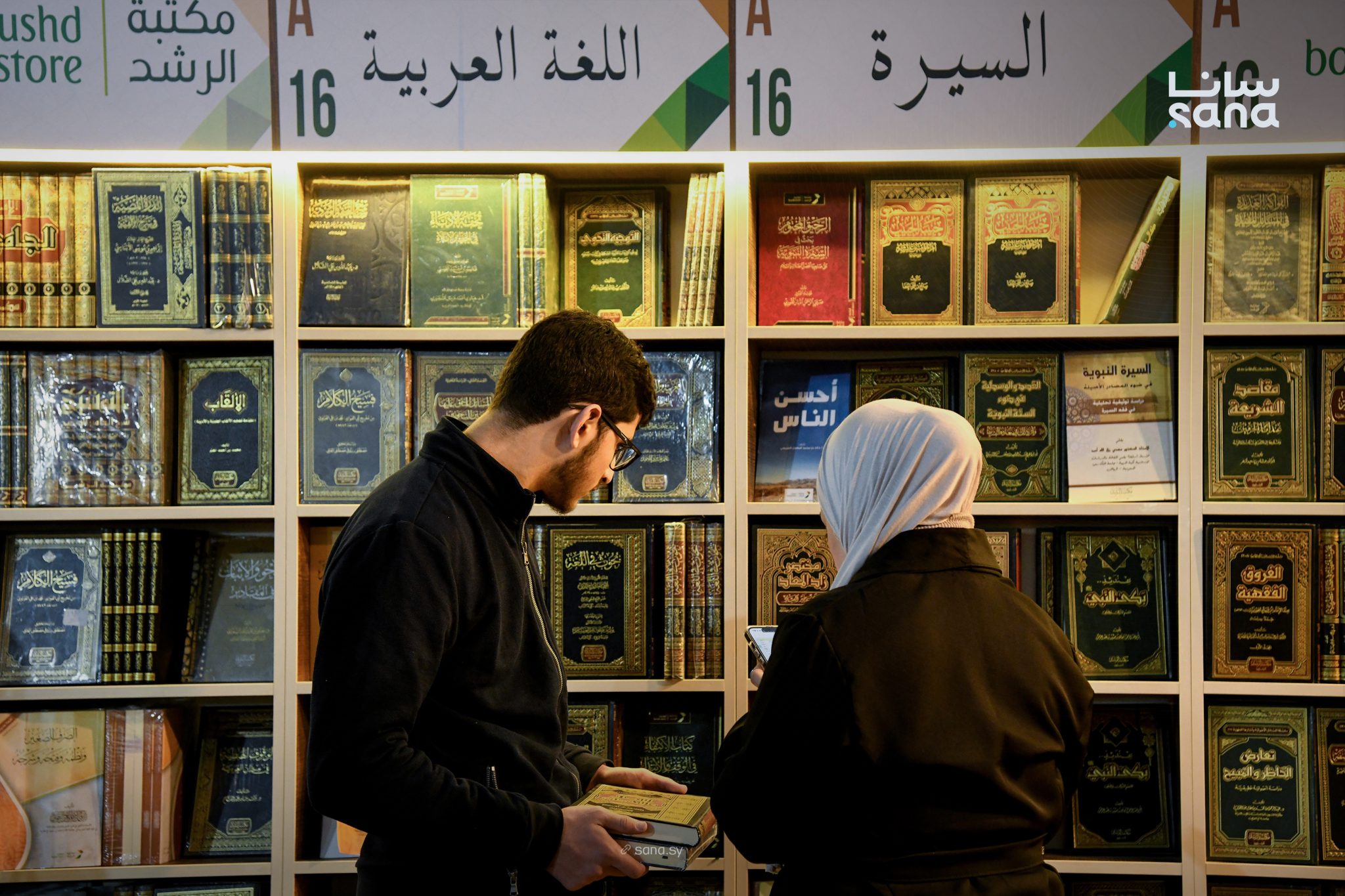
The Damascus International Book Fair has returned—reviving its familiar joy, its layered contradictions, and its perennial stumbles. For the first time since 2019, the fair has reclaimed its Arab and international character, drawing crowds that spill into Bab Touma Square. Dedicated buses are scarce, forcing book lovers to squeeze into whatever transport they can find, yet the very act of attending feels, for many, like a small act of cultural reclamation—a gesture toward continuity in a country where continuity is rare.
At first glance, the throngs might suggest that the nation of “Iqra”—Read—has rediscovered its founding imperative. The presence of Arab guests reinforces this hopeful illusion. But a closer walk through the aisles reveals a more intricate story, one shaped by economic hardship, logistical disarray, and a shifting literary landscape.
A Fair Without a Map
Visitors navigate a maze with no signage for publishing houses, a red carpet laid with little care, and no printed directory to guide them. Searching for renowned publishers—Ninoua, Ward, Al-Riyad al-Rayyes—becomes a pilgrimage undertaken by instinct alone.
Yet the true barrier is price. A modest Arabic grammar book costs six dollars—a steep sum in a country where the average monthly income hovers below one hundred. Even the much-advertised “Discount Section,” promising books for 250 lira, turns out to be a linguistic sleight of hand: the price refers to the new currency, meaning 25,000 lira.
The Syrian General Book Organization’s booth, once a refuge for affordable reading, offers little relief. Its shelves are sparse, limited to publications from the past two years, all priced at the same daunting 25,000 lira.
A New Canon Emerges
Perhaps the most striking transformation is thematic. Where religious titles were once nearly absent, they now constitute an estimated half of all offerings—predominantly Sunni. For some visitors, this is a welcome correction.
“This is not negative,” said a young man who had just purchased works by poet Salim Barakat. “Everyone must be present. In the past, religious books were almost marginalised. Now they have a strong presence.”
Another visitor praised what he described as a “wide margin of freedom,” pleased that “all intellectual currents are present with their books.” Their comments reflect a profound shift in the fair’s cultural tenor.
The guest list underscores this change. Among the prominent invitees are Islamic scholars and thinkers such as Abdul Karim Bakkar, Yaseen Alloush, and Abdul Rahman Al-Haj, alongside Sudanese filmmaker Amjad Al-Nour, Jordanian novelist Ayman Al-Atoom, Palestinian writer Adham Al-Sharqawi, and Turkish academic Yasin Aktay.
A sardonic remark circulating among attendees captures the tension succinctly: “The Syrians aren’t buying, and the guests are Islamists—thank God.” The quip lays bare the gap between the fair’s ideological presentation and the purchasing power of its local audience.
In one notable incident, Iraqi intelligence alerted organisers to the presence of a book by jihadist theorist Abu Musab al-Zarqawi, Hadith of the Rejectionists. The title was promptly withdrawn. Some observers hailed the move as a “monumental step” in curbing extremist literature, crediting the Iraqi warning with preventing its circulation.
Publishers Hope Against the Odds
Despite the economic disconnect, Arab publishers remain optimistic. A Kuwaiti publisher praised the “voracious and cultured Syrian reader,” pointing to the overwhelming crowds as an encouraging sign. A representative from Qatar’s Ministry of Culture spoke at length about strengthening Arab cultural ties and exporting Qatari “intellectual methodology,” including projects on AI in poetry and interactive literary games.
The fair’s official scale is undeniably impressive:
35 countries, 500 publishing houses, 100,000 titles, more than 650 cultural events, and seven new cultural awards.
Beyond the bookshelves, volunteer initiatives such as “This Is My Life” for children, youth awareness groups, and da‘wa associations fill the halls. Government ministries display their projects, and a notable “Kurdish Wing” operates under the Ministry of Culture’s umbrella.
A Bittersweet Return
As evening falls, visitors drift out—often without the bulging sacks of books, the shawwalat, that once defined the fair’s heyday. Their departure is softened only slightly by the free cups of hot coffee handed out by a bank at the exit.
The fair, in the end, is a bittersweet symphony: a vibrant testament to the enduring hunger for the written word, yet a stark mirror reflecting the economic and ideological transformations reshaping Syrian society. It rekindles memory even as the 25,000-lira price tag stings.
This article was translated and edited by The Syrian Observer. The Syrian Observer has not verified the content of this story. Responsibility for the information and views set out in this article lies entirely with the author.