
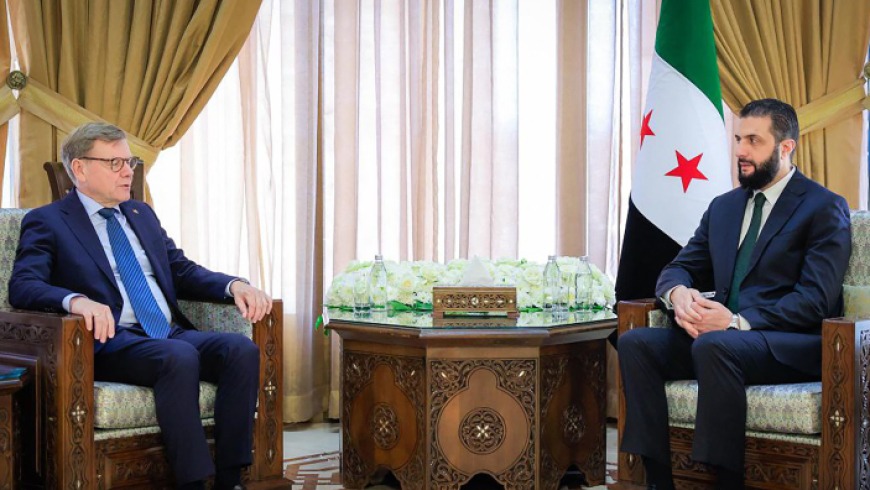
In the final days of last month, the arrival of Germany’s new Foreign Minister, Johann Wadephul, in Damascus marked more than a diplomatic courtesy call—it signalled a definitive shift in Berlin’s political stance towards Syria, nearly a year after the formation of the transitional authority. The visit, preceded by a preparatory mission from his predecessor Annalena Baerbock, did not occur in isolation. Rather, it arose from a convergence of mounting domestic and international pressures compelling Germany to break with established engagement norms and reshape its approach to Damascus.
Germany’s move in the Syrian capital reflects not a comprehensive foreign policy strategy, but a measured transition towards what may be termed “crisis-file management”—a traditional model of statecraft invoked when internal demands collide with the exigencies of external influence. In this phase, Berlin is guided by what political science labels adaptive pragmatism: a sober recognition of Syria’s political reality as it is, avoiding sweeping negotiations or geopolitical manoeuvring in favour of narrower technical priorities—chief among them, the refugee question.
This restrained yet significant engagement stands in stark contrast to France’s visible retreat—not a result of a change in Paris’s core position on the transitional regime, but rather a reprioritisation of national interests. In foreign policy theory, this is known as interest stratification: the relegation of low-yield diplomatic engagements in favour of files entangled with domestic unrest, legitimacy challenges, and internal security concerns. In this context, France’s withdrawal mirrors a broader strategic attrition weakening its posture across Africa and yielding peripheral arenas to the initiative of its European peers. Internal political fragmentation and crises of executive legitimacy have further accelerated this shift.
France’s caution in Syria should not be mistaken for a reversal of policy, but rather as a by-product of declining relevance in open arenas of competition, favouring defensive recentering over outward-facing engagement. While Germany steps forward to fill the void left by France and other European capitals, Paris maintains a distant watch—lacking both effective pressure tools and a sufficiently agile vision to navigate domestic challenges and Syria’s evolving landscape.
The Impetus Behind Germany’s Advance
In the recalibration of European engagement with Syria, Wadephul’s visit to Damascus signalled a lateral pivot of the Continent’s centre of gravity towards more pragmatic horizons. The visit stood out not only for its timing but for its substance: Germany approached Syria as a pragmatic partner, seeking viable levers of influence within the current context, rather than attempting to act as custodian of a unified European narrative.
This marks a tectonic shift in Germany’s Syrian calculus, driven more by internal political pressures—chiefly, migration concerns—than by a coherent European strategy or institutional EU mandates. The refugee issue has become a perennial fixture in Germany’s domestic debate, with rising calls for organised voluntary returns. According to the tenets of liberal realism, such repatriation efforts require direct engagement with the Syrian authorities, as state stability is essential for reintegration frameworks.
This is the essence of Germany’s adaptive pragmatism: recalibrating policy in response to evolving realities while reinterpreting its stated principles through the lens of geopolitical developments and institutional constraints at the EU level.
Beyond domestic pressures, a critical geopolitical motivator lies in Germany’s aspiration to expand its diplomatic footprint amid major regional upheavals—capitalising on a tacit redistribution of roles within Europe. As calls mount for a more autonomous foreign policy—particularly in matters touching on security, migration, and external borders—Syria emerges as a strategic testing ground for a polycentric European policy, unshackled from monolithic doctrines and outdated normative rhetoric.
From this vantage point, Berlin views Syria as a proving ground for long-term influence, balancing operational coordination with the EU’s broader political and constitutional commitments.
The polycentric model challenges the traditional view of the EU as a single, coherent actor, instead embracing a flexible and pluralistic approach that reflects national divergences. Informed by liberal-realist theory, it enables certain member states—Germany foremost among them—to assume tailored leadership roles without awaiting Brussels’ consensus or deferring to French-led frameworks. This mirrors the dynamic seen in Ukraine, where Poland and the Baltic states spearheaded a forward policy beyond the EU’s institutional pace. In Syria, Germany’s framed diplomacy allows it to forge lines of influence and cooperation consistent with EU norms, while preserving strategic latitude.
Berlin is thus pursuing a dual strategy: on one front, it manages refugee and migration dossiers aligned with domestic political pressures; on the other, it cultivates discreet channels with Damascus for humanitarian or service-oriented initiatives, laying the groundwork for technical normalisation. Such approaches—known in diplomatic theory as low-tension relations or limited engagement policies—are common in transitional contexts, where functional coordination must coexist with broader political ambiguity.
The Boundaries of French Retrenchment
While France was initially among the first to express conditional openness to engagement with Syria’s transitional authority earlier this year, its practical actions have been sparse and calculated—suggesting a shift from proactive leadership to strategic observation as it awaits clearer regional and institutional developments.
Since the last presidential election, France has been engulfed in internal political turbulence and governmental fragility, leading to a reordering of foreign policy priorities. Ukraine and European security now dominate the agenda, while the domestic rise of the far-right has pushed migration and identity issues to the forefront. France’s posture on Syria has therefore leaned towards a security-humanitarian axis, rather than a political-transitional one.
Once the standard-bearer of Europe’s Syria policy, France has been overshadowed by shifts within the Union that have redistributed diplomatic responsibilities. Germany, Italy, Hungary and Austria are now carving out distinct vectors in the Middle East. Amid this realignment, Paris has stepped back, awaiting a consensus within the EU on how to structure its relationship with Damascus.
Diverging Tools of Influence
While Wadephul’s mission has not entirely shifted the Syrian portfolio’s centre of gravity from Paris to Berlin, it does signal a slow transformation in the EU’s internal power dynamics. Where France retains long-standing political and symbolic capital, Germany is building influence through functional instruments—robust institutions, economic leverage, and diplomatic efficiency—opening avenues for low-friction technical partnerships with Damascus that do not require a full EU mandate.
This divergence may lead to a functional division of labour: Germany handling executive portfolios such as migration, aid, and essential services, while France preserves its role as a political overseer through its UN channels and legal discourse.
Yet this arrangement is tenuous. Should Germany succeed in establishing stable communication with Damascus, it may gradually assume primacy in shaping Europe’s Syria policy—particularly if France fails to offer compelling alternatives that could reassert its leadership.
Europe’s approach to Syria remains fragmented, guided more by national capitals than by cohesive EU strategies. Wadephul’s trip to Damascus may ultimately mark the dawn of a new phase in Europe’s management of the Syrian file—one grounded in political realism.
The outcome will depend less on the scale of Germany’s involvement, and more on Syria’s willingness to reciprocate and Berlin’s capacity to sustain its efforts under the European umbrella.
If Paris continues in its posture of observational stewardship, it risks being gradually edged out of the equation—unable to match its rhetorical influence with tangible instruments of policy.
For now, Syria stands as a new arena in the evolving contest of intra-European influence.
This article was translated and edited by The Syrian Observer. The Syrian Observer has not verified the content of this story. Responsibility for the information and views set out in this article lies entirely with the author.