
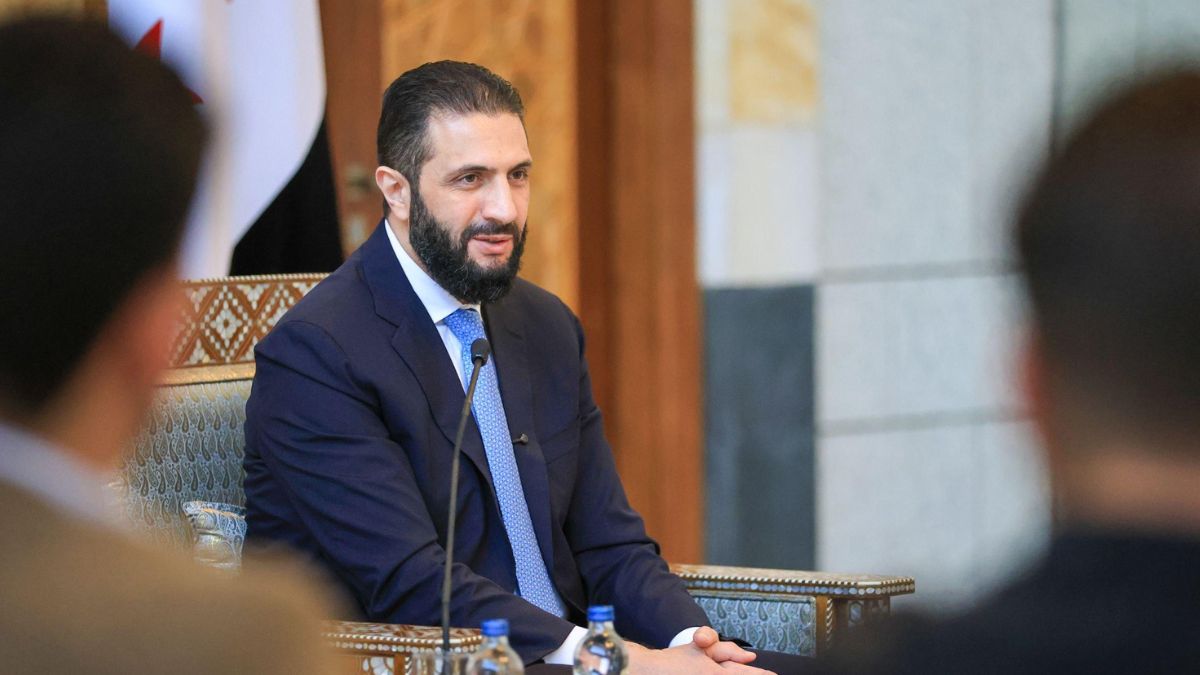
The Syrian Embassy in Moscow announced on Wednesday that Syria’s transitional president, Ahmed al-Sharaa, will head the Syrian delegation to the upcoming Russian-Arab Summit in October, according to Russia’s Sputnik news agency.
The announcement followed a press conference in Damascus on September 9 by Syrian Foreign Minister Asaad al-Shibani, who appeared alongside a Russian delegation led by Deputy Prime Minister Alexander Novak.
Russian Recognition
Kirill Semenov, an analyst with the Russian International Affairs Council, told Vedomosti that al-Sharaa’s visit to Moscow would amount to official recognition of Syria’s new authorities as legitimate partners for cooperation. “Existing communications with Damascus already indicate that de facto legitimization has occurred,” Semenov said.
Russian Foreign Minister Sergey Lavrov, during al-Shibani’s earlier visit to Moscow on July 31, said Moscow was anticipating al-Sharaa’s participation in the summit on October 15, adding: “We agreed to cooperate in overcoming challenges and reaffirmed our commitment to preserving Syria’s unity, sovereignty, and independence.”
On May 17, Russian President Vladimir Putin formally invited all Arab League leaders to the inaugural Russian-Arab Summit. The Kremlin said the gathering would strengthen dialogue, broaden cooperation, and contribute to “peace, security, and stability” in the Middle East and North Africa.
Deepening Relations
During Tuesday’s meeting with Novak’s delegation, al-Shibani described Syrian-Russian ties as “deep, marked by stages of friendship and cooperation, though not always balanced.”
The Syrian side included, in addition to al-Shibani, Maher al-Sharaa, Secretary-General of the Presidency; intelligence chief Hussein al-Salama; Chief of Staff Ali al-Naasan; and the ministers of economy, industry, health, and finance. The Russian delegation featured Construction and Housing Minister Irek Faizullin and representatives from 14 ministries, including defense and foreign affairs.
Al-Shibani denounced Israeli airstrikes on Syrian territory as a threat to regional stability, according to the Syrian Arab News Agency (SANA). He also highlighted Syria’s cooperation with the Organisation for the Prohibition of Chemical Weapons, stressing that Damascus had “turned the page on obfuscation and denial” inherited from the former regime.
He added that all foreign military presences in Syria should “serve the Syrian people’s future”—a reference to Russian bases on the Syrian coast.
Novak said Syrian-Russian relations are under the direct supervision of President Putin, describing Syria as a “promising Middle Eastern country” and urging deeper economic and political cooperation.
Fuel for Security
According to Nikolai Sukhov, a senior researcher at the Russian Academy of Sciences’ Institute of Oriental Studies (IMEMO), Damascus expects to receive near-free fuel in exchange for guarantees protecting Russian bases and personnel. He also noted calls for the return of Russian specialists to revive Syria’s oil and gas fields.
Sukhov emphasized that Syria remains critically short of fuel, as its new Gulf backers, Qatar and Saudi Arabia, provide only limited supplies and are reluctant to expand support amid worsening socioeconomic conditions.
This article was translated and edited by The Syrian Observer. The Syrian Observer has not verified the content of this story. Responsibility for the information and views set out in this article lies entirely with the author.