
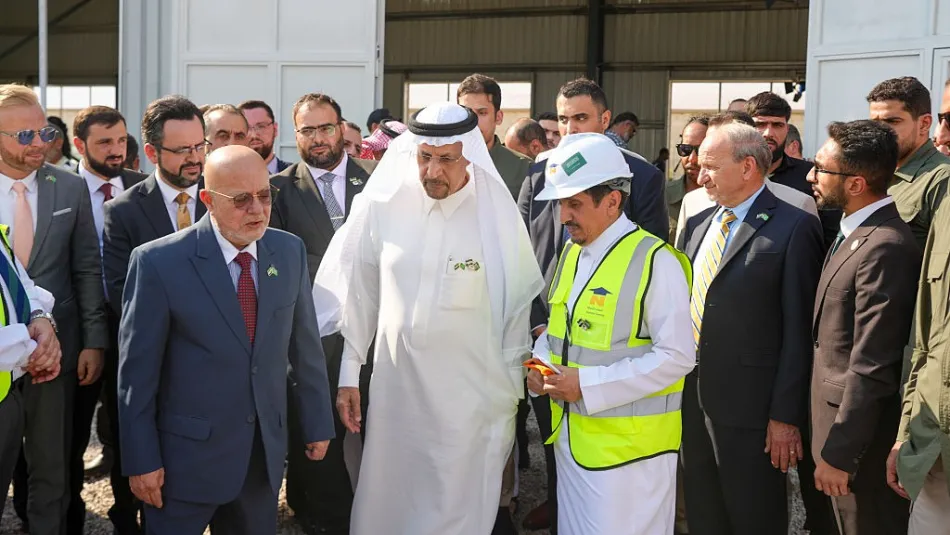
In a pivotal moment for Syria’s post-Assad reconstruction, a high-level Saudi economic delegation, led by the Minister of Investment and comprising 130 prominent business leaders, arrived in Damascus to advance investment initiatives. This landmark visit, directed by Saudi Crown Prince Mohammed bin Salman, underscores a strategic commitment to bolster Syria’s economic recovery and regional reintegration, even as the transitional government grapples with stabilizing regions like Suweida following recent unrest. The Saudi initiative reflects a bold and timely show of support, aimed at fostering hope and stability in a nation emerging from decades of conflict.
A Strategic Investment Push
The Saudi delegation’s arrival, described as a directive from Crown Prince Mohammed bin Salman to “invest in Syria as you invest in Saudi Arabia,” signals a deliberate move to support Syria’s economic revitalization. The timing is significant, coinciding with ongoing challenges in Suweida, where tensions persist despite the cessation of armed clashes. Analysts view the visit not as a mere coincidence but as a calculated political and economic gesture to strengthen Syria’s stability and reshape its regional relationships, particularly within the Arab world.
Investment is often described as risk-averse, gravitating toward stable environments with clear legal frameworks and guaranteed returns. Syria, still navigating internal divisions and the aftermath of conflict, has yet to achieve full stability. The Saudi decision to invest at this juncture is thus a courageous step, signaling confidence in Syria’s potential and aiming to shift the national narrative from loss and uncertainty to optimism and opportunity.
Economic Support as a Catalyst for Stability
The Saudi initiative seeks to reframe Syria’s internal dynamics, moving from a focus on post-conflict recovery to a vision of prosperity and growth. By injecting significant investment, Saudi Arabia aims to help Damascus address regional challenges, particularly in Suweida, where separatist sentiments have emerged. The delegation’s presence is intended to demonstrate that Syria’s transitional government is advancing toward development, encouraging communities in restive areas to engage in the national project. Economic progress, the reasoning goes, fosters pride in citizenship and counters divisive forces such as sectarianism or external interference, which have historically undermined Syrian unity.
The visit also aligns with broader Arab support for Syria’s reintegration. By prioritizing investment in marginalized regions and rural areas, the government can address historical grievances, reduce the appeal of separatist movements, and strengthen national cohesion. This approach, if successful, could transform Suweida’s crisis into a manageable, temporary issue, reintegrating the region into Syria’s broader developmental framework.
Challenges and the Path Forward
While Saudi Arabia’s support—alongside contributions from other regional partners in economic, political, and security domains—is substantial, it alone cannot resolve Syria’s complex internal challenges. The transitional government faces significant hurdles, including lingering sectarian tensions, the unresolved status of areas controlled by the Syrian Democratic Forces (SDF), and the need to rebuild a sense of citizenship eroded by the Assad regime’s policies. Incidents like the controversial death of Youssef Labbad in custody highlight ongoing concerns about transparency and governance, which could undermine public trust if not addressed.
To maximize the impact of external support, Damascus must prioritize internal reforms. Key among these is enhancing transparency to align government promises with tangible outcomes, particularly in strengthening internal security and fostering an environment conducive to economic growth. Investment strategies should focus on underserved regions, potentially surpassing efforts in the capital, to ensure equitable development and counter separatist tendencies. Additionally, the government must address the dangerous rise of online polarization and hate speech, which risks deepening societal divisions and fueling sectarian violence—a proven recipe for fragmentation.
A Call for Strategic Vision
The Saudi delegation’s visit comes at a critical juncture, offering Syria a chance to translate international support into a sustainable development program. However, the window for such support is not infinite, and Damascus must act strategically to leverage it effectively. This requires a dual focus: externally, on securing Syria’s role as a stable regional ally, and internally, on fostering unity and restoring the concept of citizenship. By addressing historical crises with inclusive policies and transparent governance, the government can prevent local tensions, such as those in Suweida or the coast, from escalating into broader threats to national security.
The success of this approach will hinge on the government’s ability to balance external partnerships with internal cohesion. Economic development, coupled with robust reforms, can shift Syria from a state of revolutionary legitimacy to one grounded in democratic, electoral legitimacy. This transition is essential for ensuring long-term stability and reclaiming Syria’s regional role.
The Saudi economic delegation’s visit to Damascus marks a turning point in Syria’s reconstruction efforts, offering substantial support at a time of significant challenges. By prioritizing investment and regional reintegration, Saudi Arabia is helping Syria move toward stability and prosperity. However, the onus lies on Damascus to complement this support with internal reforms, transparent governance, and inclusive development. By addressing regional tensions and rebuilding national unity, Syria can transform this moment of opportunity into a foundation for lasting stability and a renewed sense of citizenship.
This article was translated and edited by The Syrian Observer. The Syrian Observer has not verified the content of this story. Responsibility for the information and views set out in this article lies entirely with the author.