
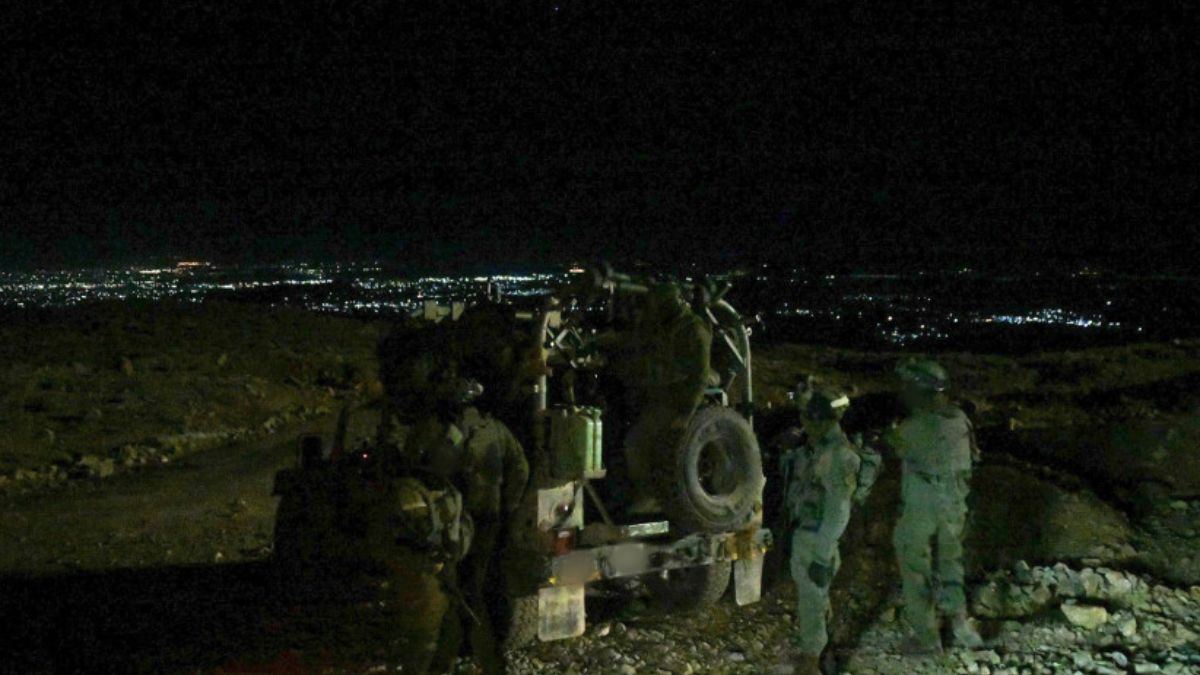
On October 4, seventeen Israeli armored vehicles surrounded the home of Mihna al-Buraidi in the village of Jumla, in western Daraa countryside. Armed soldiers suddenly stormed the house, pointing their weapons at all family members.
According to Mihna, speaking to Enab Baladi, the Israeli forces arrested his son and his friends, who were visiting the house, handcuffed them, and brought in sniffer dogs to search for weapons but found none. The soldiers then seized three mobile phones and a computer before taking his son away. His fate remains unknown.
The detainees have been identified as Mohammad al-Buraidi, Mahmoud al-Buraidi, and Mohammad al-Samouri, whose whereabouts remain undisclosed at the time of this report. Mihna appealed to the Syrian government and international organizations to intervene immediately to uncover their fate.
Repeated Arrests
Such arrests of civilians from Daraa and Quneitra provinces in southern Syria have become increasingly frequent, carried out by Israeli forces that continue to conduct incursions into border villages and towns.
While Israel sometimes releases detainees a few hours after their arrest, others remain in custody with no information about their condition or location, prompting repeated appeals from families and human rights groups.
On October 10, Israeli forces arrested five civilians from the village of Sida al-Hanout in southern Quneitra—two shepherds and three farmers—near the ceasefire line.
UNDOF’s Position
Families of the detainees have appealed to the United Nations Disengagement Observer Force (UNDOF), stationed in the village of Jumla, to intervene and clarify the fate of their detained relatives.
UNDOF responded with an English-language letter, stating that, according to the information available, the Israeli army is holding the individuals on charges of involvement in “terrorist activities” against the State of Israel.
The mission added that the detainees are awaiting trial before Israeli courts, are being held under “lawful conditions,” and that their health status is stable.
Jumla is a border village situated on the banks of the Raqqad Valley, which separates it from the occupied Syrian Golan Heights. Its roughly 4,000 residents rely mainly on agriculture and beekeeping.
Israel has previously carried out raids and arrests in several border areas inside Syria, claiming to target individuals affiliated with Iranian-backed militias.
Israeli army spokesperson Avichay Adraee wrote on X (formerly Twitter) on September 12 that the Israeli army had captured “terrorist cells operated by the Quds Force’s Special Operations Unit” in a series of what he called “special operations.”
Adraee added that in March and April 2024, Israeli forces had arrested two field operatives of Unit 840 inside Syria—Zidan al-Tawil and Mohammad al-Karyan.
“The UN Response Is Not Enough”
Mihna al-Buraidi, father of one of the detainees, told Enab Baladi that the UNDOF letter was the only information the families had received, calling it insufficient.
He demanded either the release of the detainees or a clear explanation of the alleged “terrorist activities” they are accused of.
Al-Buraidi said he had approached Syria’s Ministries of Foreign Affairs and Information in Damascus but received no response.
Israel typically releases detainees from border villages in the Yarmouk Basin within hours of arrest, yet the current detainees remain in custody more than twelve days after their capture.
The fate of two others, Ali al-Abdullah (19) and his cousin Baha al-Abdullah (17), arrested by Israel on June 29, 2024, in the village of Maariya in western Daraa, also remains unknown, despite promises from Syrian authorities to follow up on the matter.
A New Security Reality
According to al-Buraidi, Israeli forces now enter any area in western Yarmouk Basin at will, facing no deterrence, and sometimes act on false reports from local collaborators.
Since the fall of the former Syrian regime, Israel has imposed what locals describe as a “new security reality.” On December 8, 2024, it occupied the al-Jazira point, west of Maariya, turning it into a military outpost fortified with tanks, armored vehicles, and drone launch platforms.
Al-Jazira’s location is strategically critical, separating the Raqqad and Yarmouk valleys, overlooking most villages of the Yarmouk Basin, bordering Jordan to the south and the occupied Golan Heights to the west.