
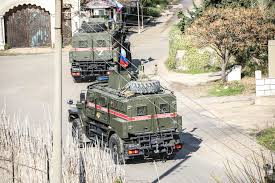
In recent weeks, Russia has intensified its military presence in Qamishli, a key Kurdish political hub in northeastern Syria, raising questions about its strategic aims in a region where multiple powers are vying for influence. Local sources report a surge in Russian warplane activity over the city, with cargo flights transporting equipment and personnel from the Hmeimim airbase to Qamishli International Airport and nearby strategic locations.
The escalation—most notably a solo patrol conducted on 4 August involving four Russian armoured vehicles and two helicopters—occurred without coordination with the Kurdish-led Syrian Democratic Forces (SDF). The patrol, the first of its kind in years, traversed the Qamishli–Tirbespi road and appeared to carry strong political overtones, coinciding with a Syrian government delegation’s visit to Moscow.
Analysts interpret Russia’s actions as an effort to fill a legal and administrative vacuum in northeast Syria following the collapse of Bashar al-Assad’s regime on 8 December 2024. Qamishli’s airport, a longstanding point of Russian interest since the partial US withdrawal in 2019, is now emerging as a cornerstone in Moscow’s strategy to reassert its influence in a zone contested by Turkey, the United States, the Syrian transitional government, and the SDF.
From Mediation to Assertion
Russia’s involvement in Qamishli dates back to late 2019, when it positioned itself as a buffer force between the SDF and Turkish troops, conducting joint patrols to prevent clashes. The recent absence of both SDF and Kurdish Asayish forces in the patrol signals a departure from that cooperative model. While SDF sources confirmed they were informed in advance, their non-participation underscores a shift towards unilateral Russian manoeuvres.
A senior official in the Kurdish-led Autonomous Administration, speaking anonymously to Daraj, suggested Moscow may be renegotiating its strategic alliances. “Russia is aware Damascus might reassess previous accords, including those governing its military foothold in Tartus and Hmeimim,” the official said, referencing the 1972 agreement underpinning Russia’s naval presence. Recent sectarian unrest and civilian displacement along Syria’s coast have reportedly added to Moscow’s concerns about the long-term viability of these arrangements.
Strategic Messaging
The use of helicopters in routine patrols is widely viewed as a show of force, potentially testing responses from the US, France, and Turkey. Observers say the moves could be tactical pressure on the SDF to accept new terms in security and political negotiations with Damascus. Others suggest a possible Russian-Turkish understanding aimed at curbing SDF influence while securing Moscow’s interests in Syria, possibly in exchange for economic or military concessions.
Damascus Reportedly Seeks Return of Russian Patrols to Southern Syria
The timing of the patrol—concurrent with meetings between Syrian Foreign Minister Assaad al-Shibani, Russian President Vladimir Putin, and Foreign Minister Sergey Lavrov—has fuelled speculation over new understandings that could facilitate Damascus’s return to parts of the northeast with Russian backing.
Regional and International Dynamics
Russia’s manoeuvres in Qamishli are part of a broader geopolitical play. Facing diplomatic isolation over Ukraine, Moscow appears to be leveraging its Syrian presence in negotiations with Ankara, Tehran, and Washington. For Damascus, a potential American withdrawal from areas east of the Euphrates represents an opportunity to reclaim territory lost since 2012. For the SDF, Russia’s independent actions are a clear indication that Moscow can—and will—act without their consent, potentially pushing them to the margins of future political arrangements.
Reports of new deployments—including the arrival of two Ilyushin transport aircraft, low-altitude helicopter flights, and the installation of Pantsir-S1 air defence systems and electronic warfare units—underscore Russia’s intent to solidify its position and deter rival powers.
Potential Scenarios
Should Russia continue its unilateral patrols backed by air support, it may seek to impose new security arrangements limiting the SDF’s operational space in sensitive areas. Such a shift could redefine communication channels between Moscow and Damascus, marginalising Kurdish actors in the process. The absence of official statements from the Russian Defence Ministry, Damascus, or the SDF about the patrol has only deepened the ambiguity, prompting speculation of behind-the-scenes negotiations.
A New Power Play
Qamishli is quickly becoming a proving ground for Russia’s ambitions in post-Assad Syria. By transitioning from mediator to direct player, Moscow appears poised to reshape the region’s political and military dynamics. The presence—or absence—of US forces remains a decisive variable in what is becoming a high-stakes contest for influence in Syria’s volatile northeast.
As one analyst put it: “Russia’s actions in Qamishli are not just about logistics; they’re a signal—Moscow is here to stay and is ready to work directly with Damascus and Ankara to secure its interests.” Whether this approach ushers in a new balance or heightens tensions will depend on the responses from Washington, the SDF, and Turkey in the weeks ahead.
This article was translated and edited by The Syrian Observer. The Syrian Observer has not verified the content of this story. Responsibility for the information and views set out in this article lies entirely with the author.