
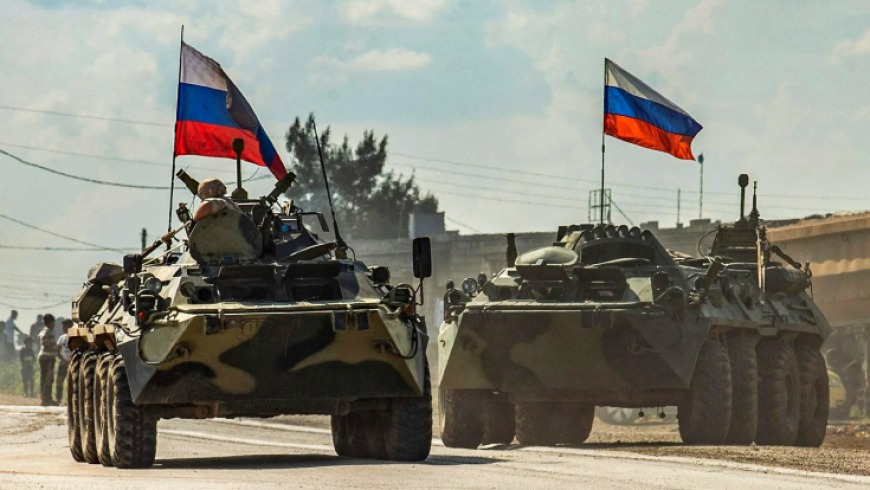
The Syrian government is reportedly seeking the return of Russian patrols to the country’s southern provinces, a measure it believes could help curb Israeli military operations in the region. According to the Russian daily Kommersant, Damascus claims Israeli activity has intensified in recent months under the pretext of creating a buffer zone and “protecting the Druze”.
An anonymous source present at a meeting between Syrian Foreign Minister Asaad al-Shibani and members of the Syrian community in Moscow last month said President Ahmad al-Sharaa administration is keen to see Russian military police resume their former positions in the south. The source suggested that Moscow could play a pivotal role in managing relations between Syria and Israel.
Kommersant also reported that Russian forces recently conducted a patrol in Qamishli—the first since the fall of the Assad regime—signalling what it described as growing cooperation between Moscow and Damascus. Notably, the patrol was carried out solely by Russian forces, without participation from the Syrian Democratic Forces (SDF).
When asked about Tel Aviv’s position on renewed Russian activity in southern Syria, an Israeli source told the newspaper that the response would depend on existing agreements between Russia and Israel, as well as Moscow’s stance if a deal is struck with Damascus to reinstate the patrols.
First Syrian Ministerial Visit to Moscow Since Assad’s Ouster
On 31 July, Foreign Minister Asaad al-Shibani and Defence Minister Murhaf Abu Qasra travelled to Moscow for their first official visit since the Assad regime’s removal. The ministers held separate meetings with their Russian counterparts—Sergey Lavrov and Andrey Belousov—to discuss bilateral ties and the situation in Syria.
Lavrov reaffirmed Russia’s commitment to strengthening relations with Damascus, highlighting the importance of mutual respect and shared interests. He praised President Sharaa initiatives, saying they would help the country overcome its crisis, and reiterated calls for the immediate lifting of sanctions on Syria. He also confirmed that both governments had agreed to review existing bilateral agreements.
Shibani said Syria was “now open to the world” and was seeking partnerships based on equality and mutual interest. He called for full cooperation with Moscow to support the transitional justice process and secure victims’ rights, describing dialogue with Russia as a “strategic step” for Syria’s future. He also announced the formation of a committee to reassess bilateral agreements in line with the needs of Syrians during the reconstruction phase.
The minister accused Israel of exacerbating tensions through repeated strikes on Syrian territory, saying such actions further complicate the situation and destabilise the region. He stressed that only the state can guarantee civilian security and warned that armed groups operating outside government control would lead to instability, citing recent unrest in Suweida as an example.
This article was translated and edited by The Syrian Observer. The Syrian Observer has not verified the content of this story. Responsibility for the information and views set out in this article lies entirely with the author.