
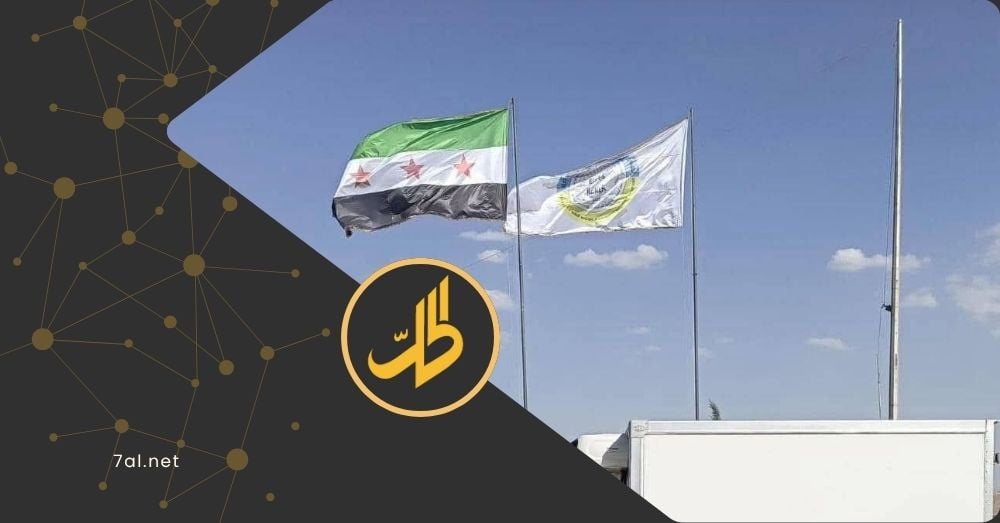
Two days ago, the Autonomous Administration of North and East Syria raised the Syrian national flag over the Semalka/Fishkhabour border crossing with the Kurdistan Region of Iraq—a move that sparked wide-ranging debate over its implications and whether it signals a more serious and effective resumption of negotiations between Damascus and the Autonomous Administration or the Syrian Democratic Forces (SDF).
Some observers suggest the gesture may be a prelude to activating the March 10 agreement signed between SDF Commander Mazloum Abdi and Syria’s transitional president Ahmad al-Sharaa.
Symbolism and Strategic Messaging
Speaking to Rudaw Media Network, Mahmoud al-Maslat, co-chair of the Syrian Democratic Council (SDC), stated: “This reflects our belief in the unity of the Syrian people and territory,” adding that talks with the Syrian government in Damascus are ongoing and that “the Syrian flag has always been present in our centers—nothing has changed in that regard.”
A source close to the Autonomous Administration told Al-Hal Net that raising the flag at the crossing was “a confidence-building measure” and a message that the SDF and the administration in general are not seeking partition or separatism, contrary to certain narratives.
The same source clarified that the move was not directly coordinated with the transitional government in Damascus, but rather emerged from discussions with a third party involved in the Syrian file—whose identity was not disclosed.
SDC Delegation Meets UK Officials, Delivers Message from Mazloum Abdi
The source added that further steps are expected to follow, potentially leading to broader understandings in North and East Syria that could enhance national stability and security.
Preliminary Understandings with Turkey
In parallel, Ilham Ahmed, co-chair of the Autonomous Administration’s Department of Foreign Relations, revealed a “preliminary understanding” regarding the management of the Qamishli–Nusaybin border crossing. She noted that negotiations may lead to reopening the crossing or establishing a joint management mechanism.
In an interview with Al-Majalla magazine, Ahmed stated: “Turkey is open to the proposal, the interim government is open, and we are open. A dialogue on the details is expected.”
Analysts believe the border crossings could serve as a negotiating platform bringing together Damascus, the Autonomous Administration, and Turkey—testing mutual trust among all parties.
Back in late May, SDF Commander Mazloum Abdi announced that his forces were in direct contact with Turkey and open to improving relations, including a potential meeting with Turkish President Recep Tayyip Erdoğan.
A Strategic Signal, Not Just a Symbol
The Syrian flag raised at this strategic border crossing can be read as a symbolic gesture by the Autonomous Administration affirming its commitment to Syria’s territorial unity—at a time when accusations persist that it seeks to establish an independent Kurdish entity.
This move sends multiple political messages: first, that the Autonomous Administration is open to a serious negotiating track with Damascus; second, that it does not pose a threat to Turkish national security and sees itself as part of the Syrian state, capable of contributing to any future settlement.
Ilham Ahmed Reveals Key Points of Disagreement in Talks with Damascus
Given that border crossings are among the most sensitive issues in northeastern Syria—serving as vital economic lifelines—the raising of the Syrian flag at Semalka reflects a willingness by the Autonomous Administration to grant Damascus symbolic presence at strategic points, in exchange for greater political recognition within the Syrian constitution or security guarantees.
The ongoing discussions around the Qamishli–Nusaybin crossing reinforce the idea that border management could become a gateway to broader understandings involving Damascus, Ankara, and the SDF.
In essence, this move appears to be more than a symbolic or protocol gesture—it signals a recalibration of the negotiation landscape between Damascus and the Autonomous Administration, and an attempt to reassure Turkey and the international community that North and East Syria remains part of Syria’s future. Whether this gesture evolves into practical mechanisms for broader agreements or remains a symbolic overture is yet to be seen.
This article was translated and edited by The Syrian Observer. The Syrian Observer has not verified the content of this story. Responsibility for the information and views set out in this article lies entirely with the author.