
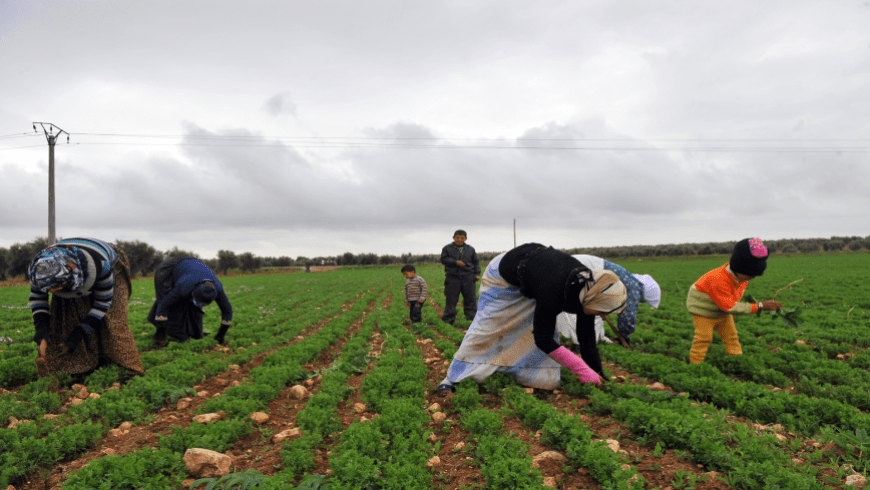
A historical examination of Syrian rural society reveals it as a foundational space where the interplay of economy, social structure and political power unfolded. This perspective transcends reductive views of the countryside as merely a productive adjunct to the city or state. Across more than a century of modern Syrian history, the rural sphere has been crucial in shaping labour relations, patterns of land ownership, solidarity networks and forms of social control—playing a decisive role both during periods of state stability and in moments of upheaval.
The agricultural transformations Syria has undergone since the late Ottoman era cannot be understood as merely technical or legal shifts. They were intrinsically tied to redefining the peasant’s position within society, redistributing power within the countryside, and gradually integrating rural areas into the logic of the central state and market. These transformations, though cumulative, never culminated in a sustainable agricultural economy or a cohesive rural society—leaving the countryside vulnerable to fragmentation and out-migration years before the outbreak of the Syrian revolution.
Historical Shifts in Syrian Agricultural and Rural Structure
The modern Syrian agricultural structure emerged in a historical context shaped by legislation, economic conditions and political-security dynamics from the late 19th century onwards. The Ottoman Land Code of 1858 played a pivotal role in reorganising agricultural property, transferring land from traditional communal frameworks into a legal structure that enabled consolidation and monopolisation. As a result, vast tracts of land passed into the hands of local notables and absentee landlords, while a significant portion of peasants became agricultural labourers tied to the land through wage relations rather than ownership (Batatu, 1999, pp. 45–62).
During the French Mandate, the Syrian countryside was instrumentalised to manage political and economic stability. The Mandate authorities maintained rural patronage networks—especially in Hauran, the Ghab plain and al-Jazira—while introducing limited improvements in irrigation and infrastructure that left existing class structures largely intact. This reinforced deep social imbalances, making the countryside prone to periodic unrest (Khoury, 1987, pp. 133–150).
Following independence, agrarian reform was employed as a mechanism to rebalance society, particularly during the 1950s and 1960s. However, the implementation of these policies—especially post-1963—resulted in the countryside being integrated into the central state apparatus through control of production, pricing and marketing, rather than the genuine economic empowerment of the peasantry. In areas such as al-Jazira, state policies on wheat and cotton effectively tethered farmers to government institutions, restricting economic autonomy and fostering long-term vulnerability (Hinnebusch, 2001, pp. 78–95). In time, the countryside became economically dependent on the state, without the development of a resilient productive base—setting the stage for extensive rural migration and the gradual disintegration of community structures.
The Peasant in the Syrian National Movement and Post-Independence Power Relations
The Syrian peasant has historically played a central role in shaping the political sphere. Since the 1920s, rural areas were at the forefront of resistance against the French Mandate—particularly in Hauran, Jabal al-Arab and the countryside of the coast and al-Jazira—where national aspirations intertwined with social grievances over taxation, land control and factional dominance. Rural revolts such as the Great Syrian Revolt (1925–1927), led by Sultan al-Atrash, reflected the convergence of political and social demands, including land and labour rights (Khoury, 1987, pp. 201–235).
After independence, the peasant retained a symbolic presence in national rhetoric, idealised as a moral and productive figure. Yet this symbolism was not matched by meaningful institutional inclusion. Urban-based political parties utilised the countryside as an electoral and organisational base without providing mechanisms for genuine rural participation. As military coups reshaped the political landscape, peasant-state relations became increasingly defined by centralisation, with party and syndicate institutions managing rural affairs from above (Batatu, 1999, pp. 301–335).
The agrarian reform policies of the 1950s and 1960s marked a critical juncture. While land redistribution improved conditions for many and reduced the dominance of large landowners—especially in the Ghab and Hauran—this process coincided with the centralisation of decision-making. Agriculture became subject to state-controlled pricing, crop marketing and support mechanisms linked to political allegiance (Hinnebusch, 2001, pp. 112–138).
In this framework, rural leadership evolved from local authority based on property or status into administrative intermediaries between the peasantry and the state. In al-Jazira, for instance, cotton policy revolved around state cooperatives, weakening grassroots initiative and tying rural incomes to a single crop and centralised pricing, thereby entrenching long-term economic fragility (Mundy, 2015, pp. 145–162). Over time, rural political participation declined, replaced by clientelistic networks offering protection in return for loyalty. The peasant ceased to be a political agent and became an object of policy—a trajectory that widened the gulf between rural society and the state, paving the way for protest and migration.
Socio-Economic Cohesion in the Syrian Countryside
Cohesion in Syrian rural society developed through a complex web of agricultural labour, shared risk, mutual interests and seasonal rhythms—beyond kinship ties alone. Extended families, village proximity and informal cooperation mechanisms such as ‘auna (collective aid) and harvest-time labour exchange formed a social safety net, buffering poverty and environmental shocks in the absence of state support (Batatu, 1999, pp. 88–104).
This cohesion eroded gradually with the rise of a cash economy and the integration of agriculture into national markets. In regions such as Hauran and the Ghab plain, subsistence farming remained dominant until the 1960s, with limited surplus for trade. However, the rise of cash crops—particularly cotton in al-Jazira—realigned rural life around market and state demands, replacing traditional cooperation with fragile contractual arrangements (Hinnebusch, 2001, pp. 96–111).
As state involvement in marketing and pricing increased, peasants grew dependent on official institutions for income and payment schedules. This shift restructured rural hierarchies, elevating those connected to agricultural bureaucracy while marginalising smallholders and seasonal workers. In the coastal region, for example, the decline of traditional tobacco farming—amid monopolistic control—undermined local economic autonomy and social balance.
Meanwhile, seasonal migration—both to Syrian cities and abroad—weakened daily social bonds. What began as a temporary survival strategy gradually became a permanent lifestyle, redistributing family roles and reducing youth involvement in agriculture. This led to the erosion of generational knowledge and vocational inheritance, especially as rural youth pursued education in urban centres (Seurat, 1989, pp. 71–86).
By the eve of the Syrian revolution, the rural social fabric had lost much of its resilience. Once a societal safety net, the countryside now required protection. The revolution took root in rural Syria not simply due to political motives, but because of deep structural vulnerabilities: economic disempowerment, lack of institutional autonomy and social fragmentation. These were the results of a long historical weakening—not merely a reaction to the war.
Transformations of Rural Life in the Era of the Syrian Revolution
The Syrian revolution exposed longstanding dysfunctions within the rural economy. By 2011, rural areas were experiencing a steep decline in agricultural productivity, escalating production costs and deteriorating water resources—especially in al-Jazira, the Upper Euphrates, Idlib and the countryside of Aleppo and Hama. Mismanaged water policies and a prolonged drought from 2006 to 2010 had already driven thousands from their villages (FAO, 2011).
With the revolution’s outbreak, the countryside transformed from a fragile productive environment into a battleground of violence and displacement. Agricultural lands were ravaged by military operations, supply and marketing chains collapsed, and irrigation systems failed—particularly in the Ghab, and the countryside of Aleppo and Idlib. Peasants could no longer organise their lives around the agricultural calendar but instead focused on daily survival, signalling a fundamental rupture in rural life (UNDP, 2017).
The uprising also redefined city-countryside relations. Once a site of seasonal labour migration, the countryside became a source of mass displacement, targeted by sieges and systematic depopulation campaigns—particularly in rural Damascus, Homs, Hama, Idlib, Aleppo, Deir ez-Zor and Raqqa. This created a dual burden: loss of productive labour and the transformation of rural zones into centres for displaced populations. In northern Idlib and western Aleppo, new livelihood patterns emerged based on aid dependency, precarious work and the marginalisation of agriculture to unprecedented levels.
Conclusion
A comprehensive reading of Syrian rural society reveals that its apparent collapse during the revolution and war was in fact the culmination of deep-rooted structural imbalances. For decades, the countryside served as a bedrock of social stability and economic reproduction—yet was steadily subsumed by a centralised state and a constrained market, without genuine empowerment. This process undermined its autonomy, fractured its social fabric and left migration as the only viable escape route for many.
In the post-Assad era, rebuilding the countryside requires more than physical reconstruction or humanitarian aid. It demands a fundamental reimagining of the relationship between land and labour, agricultural policy and social justice, and between the state and local communities. Only through such a transformation can the Syrian countryside reclaim its role as a pillar of national resilience and development.
This article was translated and edited by The Syrian Observer. The Syrian Observer has not verified the content of this story. Responsibility for the information and views set out in this article lies entirely with the author.