
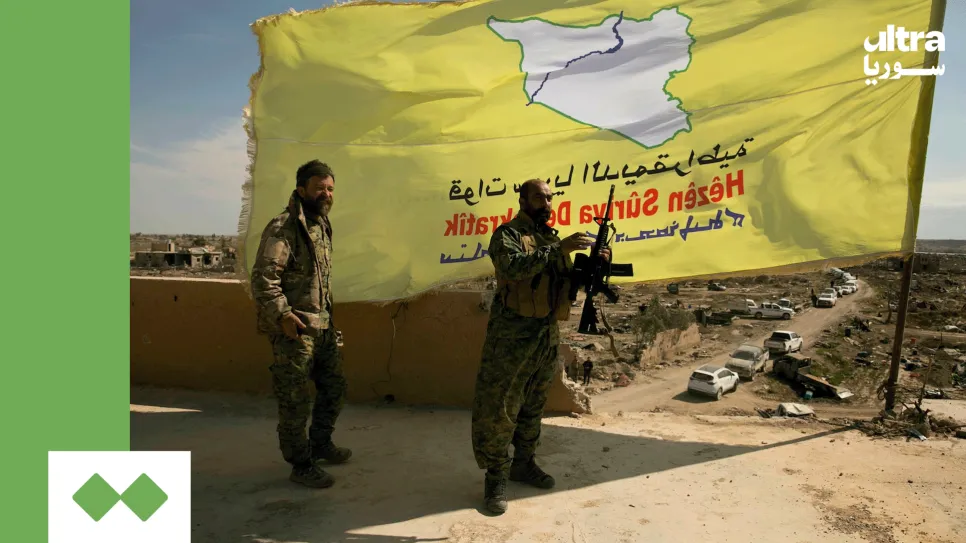
The visit of Mane‘ al-Jarba, sheikh of the great Shammar tribe, to Damascus and his audience with Ahmed al-Sharaa, president of the transitional period, has unleashed a torrent of speculation about the imminent dismantling of the Syrian Democratic Forces (SDF) and the closing act of their presence on the Syrian stage. In truth, the journey was undertaken in full coordination with SDF commanders, as Kurdish sources in Qamishli confirmed to *Ultra Syria*. It represents a calculated attempt to break the deadlock in negotiations by passing through the tribal door, a passage that has never, throughout Syria’s long crisis, delivered decisive victory to any single party and is unlikely to do so now, regardless of the triumphant tableaux certain media outlets rush to compose.
Those same sources stress that Mazloum Abdi’s declaration at the Middle East Peace and Security Forum in Duhok, insisting that Syria’s future rests upon resolute administrative decentralization executed from Damascus, rests on firm assurances conveyed to the SDF by American, French, and Russian intermediaries. No external power, they maintain, is presently encouraging a new military adventure in Syria, not even Turkey, whose posture toward the armed Kurdish factor has grown markedly cooler since the PKK announced its dissolution and the prospect of Abdullah Öcalan’s release began to take shape.
Despite public complaints from Damascus and elsewhere about the sluggish implementation of agreements, both the capital and the SDF face mounting pressure from their respective patrons to reach political settlements that would finally close the eastern file and open the region to the international investment Syria so desperately needs, above all in energy. States that view Syria as an investment opportunity have no interest in pouring capital into a theatre still shadowed by conflict.
An Uncalculated Clash
Last Wednesday’s fighting around Ma‘adan in eastern Raqqa countryside revealed how slowly the fuses of armed confrontation are being extracted. The SDF’s official statement described a defensive response to a drone attack launched by ISIS cells operating from government-held positions, an accusation that amounts to a direct charge of complicity or criminal negligence against Damascus. Government-aligned media, in turn, depicted the episode as a premeditated SDF provocation: artillery preparation followed by a ground assault on army outposts near Ghanem al-Ali. Since the regime’s fall, the SDF has indeed extended its deployment along the western bank of the Euphrates, securing additional depth.
This exchange of blame explains why the two sides still struggle to speak the same language in front of the very powers that guarantee and sustain them. Yet the SDF is navigating the moment with cold realism. As rumors circulated of an abrupt American disengagement from its Kurdish partners, the SDF quietly moved to preserve and even expand the Russian military presence at Qamishli airfield, a signal impossible to misread: Washington must reckon with the possibility of a pivot toward Moscow. France, too, has intensified its mediation, issuing invitations for SDF-Damascus talks on its soil, encounters that sources close to Qamishli decision-makers expect to recur soon.
The Path of Necessity
Inside the Kurdish political house, repairing relations with yesterday’s adversaries now defines the agenda of the Democratic Union Party leadership, the spinal column of the SDF. Mazloum Abdi’s recent journey to Iraqi Kurdistan and his meetings with Masoud Barzani and representatives of the once bitterly hostile Kurdish National Council signal that the priority has shifted decisively toward internal Kurdish reconciliation. The leadership understands that negotiations with Damascus can no longer be conducted unilaterally; a single, unified Kurdish delegation must carry the demand for constitutionally enshrined rights, and that delegation must itself reflect the broader demographic mosaic of the east.
Thus, intensive contacts continue across the Jazira and the Euphrates basin, knitting Kurdish commanders together with their Arab tribal allies and other communities. The SDF retains room for political maneuver, but only one realistic destination remains: an accord with the transitional government on the shape of eastern governance and the mechanics of integration. Informed sources describe this integration as largely symbolic, a matter of renaming rather than disbanding. The Asayish will continue to function as the region’s public-security force under whatever new title is agreed; the SDF’s military backbone will preserve its role in border defense and internal stability, rebranded perhaps as brigades or divisions, while Damascus’s own troops will enjoy no substantial footprint in the territory.
A pilot phase is expected to begin in the countryside of Deir-ez-Zor, where joint checkpoints and crossings will come under direct American supervision to ensure smooth operation and build confidence for wider application. The posting of government-appointed administrators inside SDF areas will likewise remain a protocol formality.
Among the thorniest outstanding issues are the irreconcilable legal frameworks currently in force: the SDF’s insistence on civil marriage contracts versus Damascus’s attachment to religious ones, and the still-unresolved question of school curricula. Decentralization, once constitutionally anchored, would provide the legal scaffolding for eastern self-rule. Yet even with national interest elevated above narrower agendas on both sides, no one anticipates swift or painless resolutions. Dialogue will be protracted, incremental, and fraught, but for the SDF, as for Damascus, the margin for any other course has all but vanished.
This article was translated and edited by The Syrian Observer. The Syrian Observer has not verified the content of this story. Responsibility for the information and views set out in this article lies entirely with the author.