
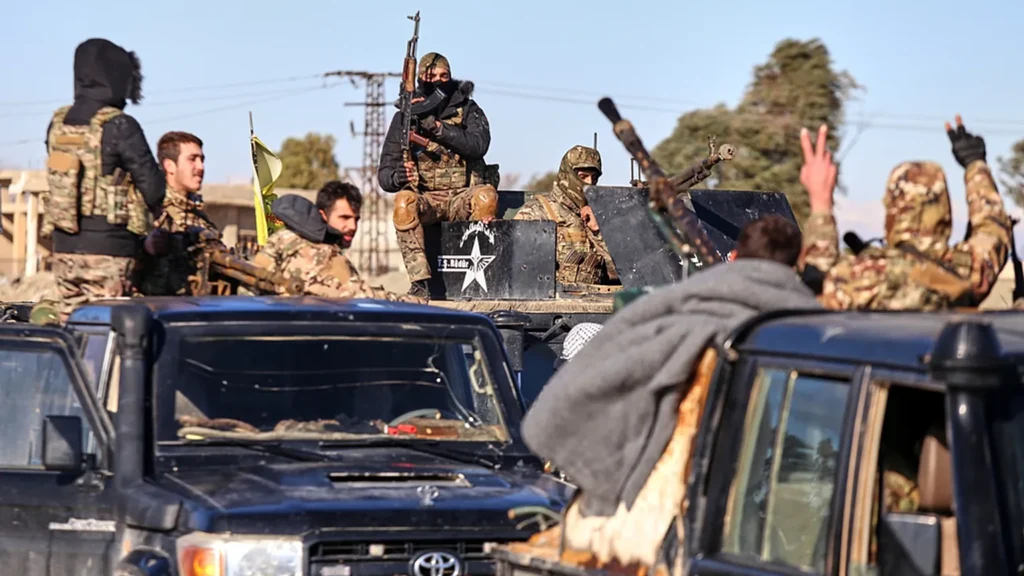
The rapid shifts unfolding in the Euphrates region offer a textbook illustration of what political-science literature terms the “end of functional roles” for non-state actors. After years of military and political expansion, the Syrian Democratic Forces (SDF) have arrived at a moment of structural unravelling and dissolution into the institutions of the central state.
This outcome was not accidental. It emerged from cumulative strategic miscalculations, misplaced wagers on shifting international balances, and a persistent disregard for the region’s geographical and social realities.
The fall of the SDF project can be understood through what has come to be known as the “Kabul Moment”—the instant when local actors discover that the surplus power they wielded was never inherent, but merely borrowed from a great power that retains the “luxury of abandonment.” The SDF leadership succumbed to the illusion that a tactical counterterrorism partnership with Washington had evolved into a lasting political commitment to sustain a separatist or quasi-autonomous entity.
Once international priorities shifted, this strategic exposure left the SDF without a protective umbrella. They realized—too late—that projects born in “power vacuums” possess a functional shelf life that expires the moment their utility ends, forcing them to confront a geography that recognizes only the sovereignty of the nation-state.
Militarily, the defeat did not result from shortages in materiel or fortifications. It reflected a cascading defensive collapse rooted in internal fragmentation. The project, marketed as a “democratic alliance,” proved unable to bridge the widening gulf between its hardened core and the Arab majority living under its rule.
The political and social marginalization of Arab tribes transformed them from a presumed incubator into an internal pressure point that hastened the breach of the defensive system. As government forces advanced with agile field tactics, SDF lines crumbled in sequence. Frontline fighters lacked a unifying combat doctrine tied to the land they defended, turning the promised “legendary resistance” into little more than desperate delaying actions.
A close reading of the negotiation track reveals that the SDF leadership engaged in a form of strategic gambling through its repeated rejection of Damascus’s proposals. In early 2026, a framework for administrative and political integration was on the table, guaranteeing a minimum degree of specificity. Yet the SDF’s bet on time and foreign intervention squandered that opportunity.
Today, the SDF is compelled to accept the terms of a “full return” devoid of sovereign distinction. Its military structure has been reduced from organized formations to individuals absorbed into the Syrian army, while border crossings have reverted to central-state control. In practical terms, this marks the end of the “self-administration project,” relegating it to a brief chapter in the history of the Syrian conflict.
Recent political and legislative initiatives from the Syrian presidency—particularly those addressing Kurdish cultural and national rights—delivered the coup de grâce to the SDF project. By embedding Kurdish demands within a comprehensive national framework, the separatist leadership lost its political raison d’être, easing international acceptance—including from the United States—of the emerging reality.
The metamorphosis of SDF leaders from internationally backed “generals” commanding an alliance into “employees” or “governors” within the state’s administrative hierarchy—as suggested by the potential appointment of Mazloum Abdi as Governor of al-Hasakah—offers the clearest expression of the return to the natural order. Parallel authorities dissolve once the state reasserts its primacy.
The SDF experience stands as a vivid lesson: external power leveraged at the expense of national and social equilibrium is a doomed path. Legitimacy does not flow from transient air cover, but from integration into the national fabric and recognition of geopolitical realities—realities that consistently affirm the state as the sole constant in the equation of stability.
This article was translated and edited by The Syrian Observer. The Syrian Observer has not verified the content of this story. Responsibility for the information and views set out in this article lies entirely with the author.