
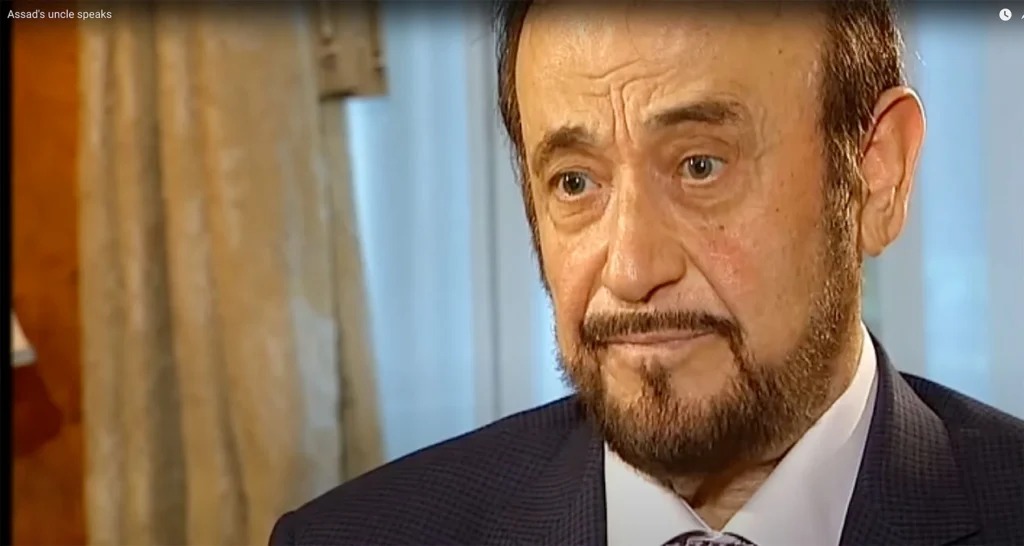
Rifaat al-Assad, the younger brother of former Syrian president Hafez al-Assad and a long-standing symbol of brutality and corruption in modern Syrian history, died on Wednesday at the age of 88. Widely accused of overseeing mass killings and severe human rights abuses, he also amassed vast wealth believed to have been siphoned from public funds.
Born in 1937 in Qardaha, Latakia province, Rifaat came from a poor farming family. He studied political science at the University of Damascus and later earned a doctorate in economics in 1977. He married four times and had 16 children.
Rifaat joined the Baath Party in 1952 and pursued a military career that expanded rapidly after the party seized power. He played a key role in internal power struggles within the regime, and became an essential enforcer after Hafez al-Assad took control in 1970. In 1971, he established the Defence Companies (Saraya al-Difa‘), an elite force of roughly 40,000 troops that functioned as a parallel army designed to protect the regime from internal threats.
Throughout the late 1970s and early 1980s, Rifaat’s influence grew as the state escalated its confrontation with the Muslim Brotherhood. In 1979, he publicly advocated extreme measures against opposition forces, invoking Stalinist repression and calling for sweeping “purification” policies, including the closure of mosques, which he described as breeding grounds for sectarianism.
His name became inseparable from the 1982 Hama massacre, when regime forces crushed an Islamist uprising. According to the Syrian Network for Human Rights, the assault left around 40,000 dead, thousands missing, and large sections of the city destroyed, including dozens of mosques and churches. Rifaat also faced accusations of involvement in the 1980 Tadmor (Palmyra) prison massacre, carried out after a failed assassination attempt on Hafez al-Assad.
In 1984, after Hafez fell seriously ill, Rifaat attempted to position himself as successor, triggering an armed standoff in Damascus between his forces and units loyal to the president. The crisis ended with Rifaat’s exile under a financial settlement, after which he lived between France, Spain, and the UK, styling himself as a potential alternative leader.
Over time, his European fortune drew increasing scrutiny. French courts convicted him in 2020 on money-laundering charges, sentencing him to four years in prison and ordering the confiscation of assets worth around €100 million, along with a London property valued at £29 million. Authorities in Britain and Spain also froze or seized assets linked to him, while Switzerland issued an arrest warrant in 2023 over alleged war crimes committed in 1982.
Rifaat briefly returned to Syria in 2021, reportedly with Bashar al-Assad’s approval, after more than three decades abroad. Following Bashar’s fall, he allegedly attempted to flee via a Russian air base but was denied entry, eventually making his way to Lebanon and then Oman.
Estimates of Rifaat’s wealth vary, but investigative and judicial records suggest a vast property portfolio once valued at roughly $850 million. Some accounts claim his fortune stemmed partly from the 1984 deal that secured his departure, while French rulings concluded it was largely derived from embezzled Syrian public money laundered through offshore networks.
France has since begun steps to transfer part of the confiscated funds back to Syria under legal safeguards, with an initial tranche reportedly set at €32 million. Further efforts are underway to expand seizures and recover additional assets held abroad, amid growing calls to ensure that recovered money supports humanitarian and development projects rather than political repression.
This article was translated and edited by The Syrian Observer. The Syrian Observer has not verified the content of this story. Responsibility for the information and views set out in this article lies entirely with the author.