
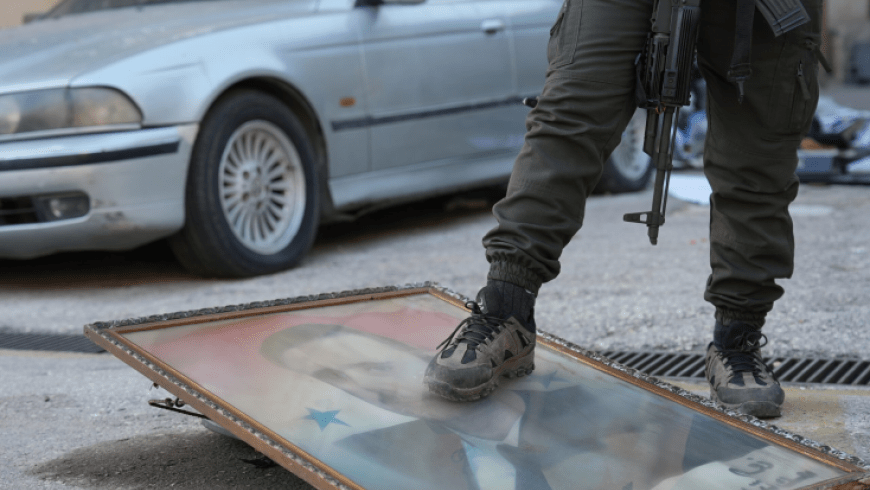
In the aftermath of war, victory often arrives long before legitimacy. The guns fall silent, front lines fade, and a new authority declares the conflict resolved. Yet beneath this surface calm, unresolved questions linger—smoldering like embers beneath ash. Syria today reflects this condition: a landscape shaped by what can only be described as a phantom victory.
Since the fall of the Assad regime in December 2024, the new leadership has tightened its grip on territory and institutions. Triumphal language has seeped into public discourse, and the machinery of the state appears to be stitching itself back together. But controlling geography is not the same as controlling the future. Military or political dominance can impose order, but it cannot, on its own, create legitimacy.
Legitimacy grows from mutual recognition—citizens seeing themselves reflected in the state that governs them. Without that recognition, stability remains fragile. Syria’s current trajectory raises troubling questions. Rather than turning victory into a shared national project, the emerging order risks hardening it into a narrative of exclusion, one that equates dissent with disloyalty and diversity with threat.
This dynamic is visible not only in political appointments and institutional restructuring, but also in cultural life. The recent Damascus Book Fair, promoted as a symbol of national renewal, exposed the limits of this supposed openness. Many Syrian writers—especially those shaped by exile and war—found themselves absent or pushed to the margins. The issue was not simply participation in a cultural event, but what that absence revealed: a narrowing public sphere and an implicit claim that only certain experiences belong in the official story of Syria.
These patterns point to a deeper contradiction. The state looks stronger in form but weaker in meaning. Its authority rests on administrative capacity, yet its social foundations remain unsettled. Citizenship risks being redefined not as a relationship of equal rights, but as a test of loyalty to a single narrative. In such an environment, memory itself becomes a political tool—used less to understand the past than to justify the present.
History offers a clear warning. States built on victory alone rarely achieve lasting stability. The impulse to shut down debate, to treat triumph as a final moral verdict, creates only the illusion of resolution. The underlying conflicts do not vanish; they retreat, waiting for the conditions in which they can return.
Syria’s challenge today is not to defend its victory, but to redefine it. Real victory is not the elimination of rivals; it is the creation of a political community where former adversaries can coexist under shared rules. This requires more than administrative reform. It demands a new social contract grounded in rights rather than privilege, participation rather than selection, and citizenship rather than allegiance.
Such a path is slower and less dramatic than the rapid consolidation of power. It requires uncertainty, compromise, and humility. Yet it remains the only route to a durable state.
Otherwise, Syria may discover—too late—that what it mistook for victory was only an interlude, another pause in a cycle of conflict that has yet to truly end.
This article was translated and edited by The Syrian Observer. The Syrian Observer has not verified the content of this story. Responsibility for the information and views set out in this article lies entirely with the author.