
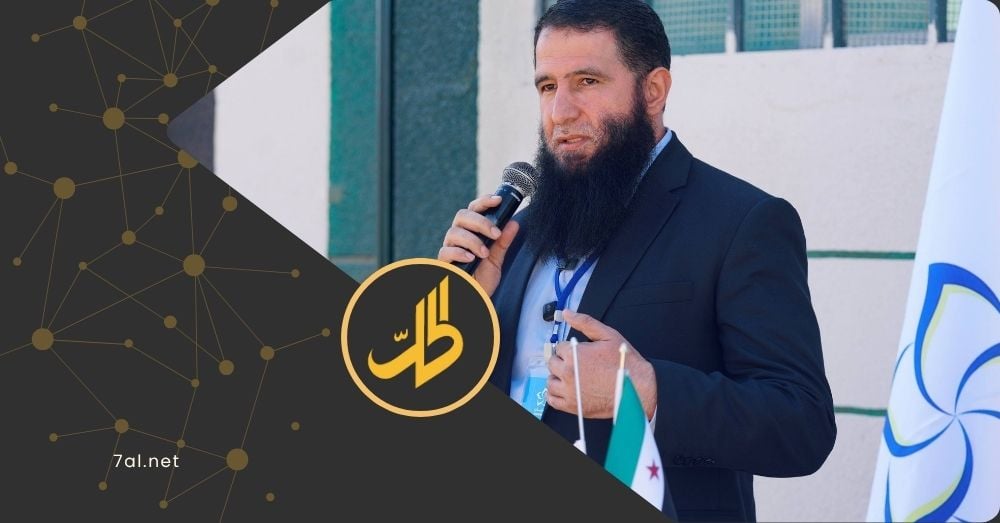
Activists and local pages have circulated a video showing Abdullah Ghannoum, a newly appointed member of Syria’s People’s Assembly, delivering sermons in several mosques. In one segment, he urges young men to take up arms and to teach children how to handle weapons, preparing them for what he describes as “major battles ahead” against the Druze in southern Syria and areas controlled by the Syrian Democratic Forces.
In another part of the same clip he tells women to observe modesty and criticises men who “allow their wives to smoke shisha”. The remarks have provoked widespread outrage and condemnation. Many Syrians view them as overt and dangerous incitement targeting segments of society.
Incendiary rhetoric
During his mosque sermons, where he is referred to as “Sheikh”, Ghannoum, who is highly active on social media and has a large following on Facebook, declares: “I must address the issue of weapons and the chaos of arms. Why? Because we are a nation that will never part with its weapons from this day forward. Our youth must learn to handle weapons and carry a cartridge belt. The young men of our nation must treat weapons like a book, like a car.”
He adds: “Weapons must become an integral part of the youth, living with them, inseparable like a cartridge belt. We are a nation that will live in jihad for the sake of God and meet the Almighty on this path. Do not distance yourself from weapons; do not set them aside.”
Ghannoum also calls for children to be taught to handle arms. “You must learn its rules and how to deal with this weapon. Bring your sons, the sons of your brothers, friends, and students, and teach them how to handle weapons. Don’t fear it; don’t hide it from them, because in a moment, they might grab the weapon and try to learn alone. Teach them yourself.”
In a particularly provocative passage he says: “I always remind you that we are heading into battles. By God the Almighty, if you think the battles will end with the remnants of HTS or the SDF or others, you are mistaken. The major battles are coming.”
Transitional government’s duty
Some observers note these calls predate Ghannoum’s selection by the electoral committee appointed by Syria’s transitional president, Ahmed al-Sharaa. Others argue the ideological content of his remarks reflects a mindset unlikely to change once he assumes his parliamentary seat.
Followers of the view that action is required say responsibility for confronting this dangerous and escalating rhetoric lies with Syria’s transitional government. They expect the authorities to take serious steps to curb hate speech and sectarian or communal incitement. Such discourse has intensified recently and is said to have been a primary driver behind the violations and massacres targeting Alawites and Druze in recent months.
Activists have also shared a video of Bassam al-Hasiri, known as “Abu Ahmad Akhlak”, who was appointed by the transitional government to manage endowments in Suwayda province. In the clip he delivers a lecture inciting against Druze, Alawites and Ismailis, labelling them “enemies of the Sunnis”.
The previous Syrian regime released al-Hasiri in April 2011. By early 2015 he had become the “emir” for Jabhat al-Nusra, now Hayat Tahrir al-Sham, in eastern Daraa, overseeing the group’s military operations in the area. On 22 February 2017 he was added to the United Nations sanctions list for his ties to ISIS and al-Qaeda.
Activists have also circulated a video of two individuals known as “Abu al-Alamin” and “Abu Muawiya” performing songs containing offensive sectarian slogans targeting Alawites, Druze and Kurds. The clip has provoked broad condemnation among Syrians, who warn that such rhetoric threatens civil peace and deepens societal divisions.