
The new legislative authority in Syria, whose members were elected on October 5, through a mixed and indirect system, faces a series of complex tasks — from passing new legislation and ratifying treaties and agreements issued after the fall of Bashar al-Assad’s regime in December 2024, to revisiting old laws and transferring conflicts into the halls of the People’s Assembly to be debated under its dome — an institution that, for decades, served merely as a symbolic façade for the previous regime and its ruling party.
The recent elections raised questions about the ability to form a new parliament capable of filling the legislative vacuum amid political, military, and economic challenges, as well as sectarian and ethnic divisions and security instability dominating the general climate.
According to the mechanism established by the constitutional declaration, regional bodies formed by a Higher Committee — whose members were appointed by President Ahmad al-Sharaa — elected two-thirds of the 210-member Assembly, while al-Sharaa is to appoint the remaining third to ensure fair representation and competence.
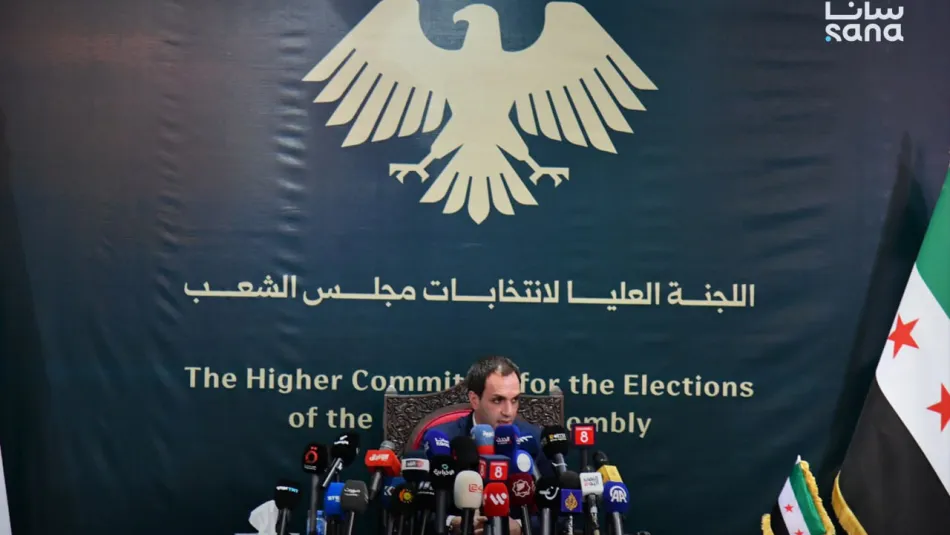
At a press conference on October 6, attended by Enab Baladi, the spokesperson for the Higher Elections Committee, Nawar Najmeh, stated that “the number of seats filled during these elections is 119,” while 21 seats remain vacant for the provinces of Suweida (in southern Syria) and Raqqa and Hassakeh (under the control of the Syrian Democratic Forces, SDF) in northeastern Syria.
A total of 1,578 candidates participated in the elections, 14% of whom were women, distributed across 50 electoral districts.
Enab Baladi examines in this report the role of Syria’s new People’s Assembly, discussing the challenges it faces in exercising its legislative powers under current political and economic conditions, while also presenting the views of experts and analysts on the reforms and efforts that could enhance the effectiveness of the legislative authority and support state stability during the transitional phase.
Dominance of Power and Representation Gaps
During a session organized by the “Salon Syria for Thought and Culture” on October 9, titled “The First People’s Assembly Elections After Liberation (Mechanisms, Results, Challenges)”, Nawar Najmeh emphasized the importance of national dialogue, stating that “dialogue for the sake of dialogue yields no practical results; it must take place under the dome of the People’s Assembly, where legislation, the constitution, and agreements can be debated calmly and effectively.”
He added that civil peace is closely tied to national dialogue, and that the People’s Assembly could serve as a driver of peaceful coexistence and legitimacy-based development, much like the models that supported the rise of the Gulf countries and Asian Tigers.
Najmeh stressed Syria’s need for new laws and legislation to create a favorable environment for economic growth, predicting that the legislative council will contribute to drafting a permanent constitution for the country.
Study Findings: One-Party Dominance and Lack of Diversity
However, the representation ratios within the Assembly may hinder such ambitions. A study by the “Day After Organization” evaluating the electoral process found outcomes that contradict the Higher Committee’s aspirations. Key findings include:
-
Lack of diversity and representation:
The new Assembly is dominated by a single political orientation aligned with the executive branch, leading to an imbalance and a failure to reflect Syria’s social diversity.
-
Weak political participation:
Access to the Assembly was based on individual selections rather than genuine party competition, undermining pluralism and independent legislative oversight.
-
Executive dominance:
The process was fully controlled by the executive authority, with no guarantees of independence for the electoral committee — evident in legal irregularities and scheduling confusion.
-
Absence of national dialogue:
The Assembly was formed outside the framework of national dialogue and before implementing the March 10 Agreement, amid tensions and security violations, leading many segments of society to boycott the process.
-
Weak social and political representation:
The exclusion of key political and social forces undermined the credibility of the elections and the future of national reconciliation.
-
Underrepresentation of women:
Despite a constitutional requirement that women represent at least 20%, actual participation in the committees was 14%, and only 5% in the Assembly itself.
-
Limited revolutionary participation:
Some revolutionary groups close to the authorities expressed satisfaction, while others felt marginalized, particularly compared to their role in earlier political phases.
Religious and Ethnic Representation Imbalance
According to a paper by the Jusoor Center for Studies, the religious and sectarian composition of the new Assembly is severely unbalanced:
-
Christians obtained only one seat (less than 1%), limited to Safita (Tartus province) — none in Damascus, Aleppo, Homs, Hama, Lattakia, or Daraa.
-
Muslims secured 118 seats: 113 Sunnis (≈95%), 3 Alawites (≈2.5%), and 2 Ismailis (≈1.5%).
There was no representation for Murshidis or Druze.
The paper noted that the lack of Druze representation was not only due to the postponement of elections in Suweida, but also the absence of Druze candidates in other governorates like Rural Damascus and Idleb.
Ethnically, the Assembly includes 111 Arabs (≈93%), 4 Kurds (≈3%), and 4 Turkmen (≈3%), with no Circassian representation.
However, Jusoor described this as a form of “balanced ethnic representation”, noting that Kurdish-majority areas such as Afrin obtained full Kurdish representation, while Turkmen candidates won seats in Homs, Lattakia, and two in Aleppo.
Women Sidelined
Women represent only 4% of the elected members, with six women out of 119 deputies.
The Higher Committee had promised 20% female participation, but results fell short (actual participation in electoral bodies was 14%).
Nawar Najmeh controversially argued that women were “excluded from the elections because of their strength, not weakness.” He claimed that women managed their campaigns “efficiently and professionally,” focusing on programs rather than alliances — unlike men, who “formed blocs to secure votes.”
Lara Izouqi, a member of the Higher Elections Committee, attributed the weak representation to two factors:
-
Lack of political will at the state level.
-
Limited political awareness among women.
She added that the presidential appointments — expected to fill about 70 remaining seats — would include “a good proportion of women.”
Candidate Nour Jandali, who won a seat in Homs, cited several overlapping causes for women’s underrepresentation:
-
No guaranteed quota system for women.
-
Insecurity and fear of political engagement.
-
Heavy social and economic burdens.
-
Lack of leadership and political training programs.
-
Social pressure forcing female candidates to prove both professional and personal competence.
Jandali said her priorities include education, economic reform, and social cohesion, emphasizing the protection of women and families as key to rebuilding society.
“My message to Syrian women is to move from waiting to action. Political work is not a privilege for a few, but a shared responsibility toward the nation.”
— Nour Jandali, Member of the New People’s Assembly
Awaiting “the President’s List”
Following the election of two-thirds of the Assembly, President Ahmad al-Sharaa is expected to appoint the remaining third of members.
This move is controversial: supporters hope it will correct sectarian and gender imbalances, while critics see it as entrenching executive dominance.
Mishour Salameh, a researcher in international relations and strategic planning, argued that appointing one-third of parliament “undermines legitimacy and independence”, explaining:
-
It diminishes popular sovereignty, as the parliament no longer reflects only the people’s will.
-
It creates a pro-executive voting bloc, limiting legislative autonomy.
-
It turns Syria’s system into a “hybrid democracy.”
However, Salameh acknowledged that the appointments could serve as a safeguard for balance, ensuring representation for marginalized regions and minorities.
Other legal scholars argued that the transitional president should have appointed the entire Assembly directly, drawing members from intellectual, legal, and technical elites, to guarantee diversity and competence — similar to France (1789), Venezuela (1999), and Mexico (1916) during their transitional phases.
Presidential Powers and the New Electoral System
Critics also point to Decree No. 143 (2025), which grants the transitional president the authority to appoint one-third of parliament, arguing that it weakens the legislature’s independence.
The new indirect electoral system, relying on central electoral bodies and subcommittees, reduces citizen participation and excludes millions of Syrians abroad.
Legal experts describe it as a “fully closed proportional representation system”, since the state controls candidate selection, distancing representatives from their constituents.
Journalist and civic activist Lara Izouqi defended the system, saying it was shaped through citizen feedback and that criticism largely came from “concerned citizens seeking reform.”
She also noted that revolutionary candidates who were disqualified did so because of legal appeals, not deliberate exclusion.
The Nature of Syria’s Transitional System
According to Dr. Mishour Salameh, Syria currently operates under a “dual presidential system with a parliamentary façade”, essentially a hybrid transitional model allowing gradual reform until a new constitution is enacted.
He identified key features:
-
Executive dominance: The transitional president holds extensive powers.
-
Weak legislature: The People’s Assembly lacks effective oversight and legislative authority, functioning more as an advisory body.
From the 2012 Constitution to the 2025 Declaration
A comparison between the 2012 Constitution and the 2025 Constitutional Declaration highlights major shifts:
-
Formation mechanism: From general, secret, and direct elections to appointments supervised by the executive.
-
Term duration: From a fixed four-year mandate to a 30-month renewable term, making the Assembly temporary and dependent on the presidency.
-
Powers: The new declaration removes the right to interpellate or withdraw confidence from the government, limiting oversight to ministerial hearings.
-
Parliamentary oath: The pledge of allegiance shifted from the nation and constitution to a personal oath of duty, weakening symbolic constitutional legitimacy.
-
Immunity and independence: The new text vaguely refers to “parliamentary immunity” without procedural safeguards.
-
Executive relationship: The government is no longer politically accountable to parliament, which cannot withdraw confidence or question the cabinet.
800 Draft Laws Awaiting Review
The new Assembly must address over 800 pending draft laws, many serving narrow interests. The task now is to establish fair, transparent, and efficient legislation.
Ahmad Qurbi, a researcher at the Syrian Dialogue Center, said the internal regulations must focus on:
-
Creating efficient mechanisms for lawmaking.
-
Defining clear accountability procedures compatible with the presidential system.
He and other experts called for specialized committees on investment, reconstruction, women’s rights, transitional justice, and public finance, emphasizing institutional reform and committee organization.
Limited Legislative Independence
According to Salameh, the legislature currently enjoys limited independence, functioning primarily as a consultative body without genuine financial or political autonomy.
He argued that empowering the Assembly requires:
-
High-level political will from the presidency.
-
Amending the constitutional declaration to restore oversight tools (questioning ministers, budget control, and independent lawmaking).
Historical Context: From Ottoman Representation to the Assad Era
Syria’s parliamentary history dates back to 1877, when Syrians participated in the Ottoman “Majlis al-Mabouthan.”
In 1919–1920, the Syrian General Congress proclaimed independence and adopted a provisional constitution under King Faisal.
During the French Mandate (1920–1946), several parliaments were formed and dissolved, culminating in the 1928 republican constitution, later suspended by France.
After independence in 1946, Syria witnessed democratic life until a series of military coups (1949–1954) disrupted governance. The 1950 Constitution was considered the most liberal.
The United Arab Republic (1958–1961) dissolved Syria’s independent parliament. Following separation, a new constitutional assembly was elected but quickly weakened.
With the Baathist coup of 1963, the National Council for the Leadership of the Revolution replaced the legislature. Under Hafez al-Assad (1970–2000), the People’s Assembly became a permanent constitutional body under the 1973 Constitution, dominated by the Baath Party.
Although Bashar al-Assad’s 2012 Constitution nominally allowed pluralism, real power remained monopolized by the ruling elite. The 2020 and 2024 elections, held during wartime and economic crisis, perpetuated a symbolic parliamentary system rather than genuine democratic practice.
This article was translated and edited by The Syrian Observer. The Syrian Observer has not verified the content of this story. Responsibility for the information and views set out in this article lies entirely with the author.