
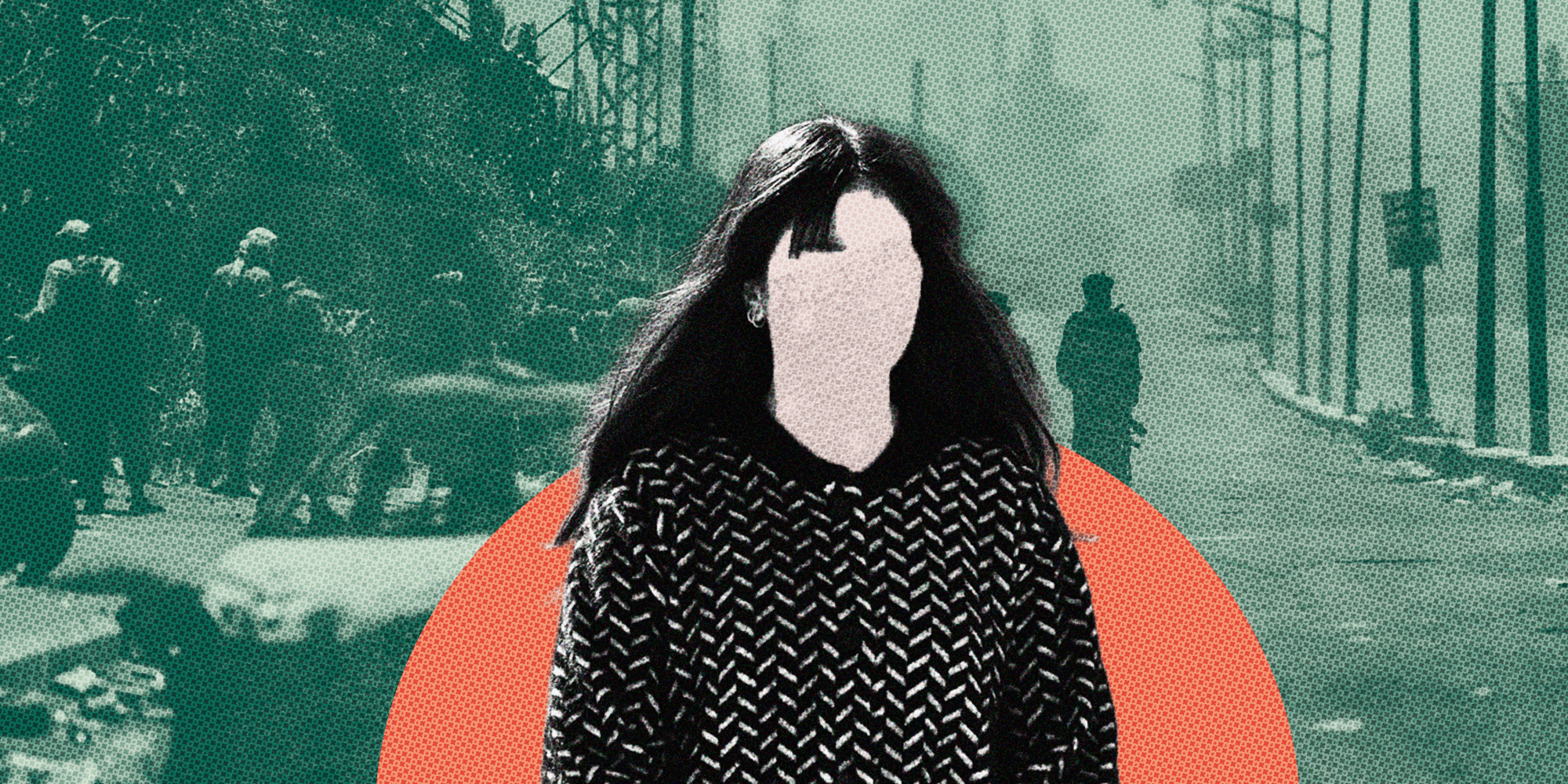
In a land convulsed by sectarian tempests, the horizon remains shrouded in mist. Yet one truth gleams with cruel clarity: women—especially those from minority communities—bear the heaviest burden. They are called to silence, compelled to bend their bodies and choices beneath a multitude of pretexts, chief among them the preservation of civil peace.
I met Maria Georges in a café whose windows open onto Lovers’ Street in Homs. She sat across from me, exhaling slow ribbons of argileh smoke between sentences, then leaned forward with a sardonic smile. “Who would have imagined,” she asked, “that even the water pipe could become dangerous in Syria—especially here on Lovers’ Street?”
Once lined with shops and cafés, this thoroughfare used to draw young people from all backgrounds. It was a haven where women could enjoy the outdoors, shop, or simply breathe. Now, after dusk, their footsteps are rare. The cafés stand half-empty, their regular patrons gone; security forces patrol the street like sentinels of a harsh new order.
Since the fall of Bashar al-Assad and the rise of religiously driven powers in Damascus, Syria has entered a new theatre of conflict. The struggle is no longer waged solely with weapons—it is fought upon bodies, minds, and the very fabric of public space. Following its self-dissolution, Hayat Tahrir al-Sham proposed a so-called transitional government. What followed was a swift campaign to reshape society according to the austere religious model that once prevailed in Idlib under Nusra rule—the same ideological lineage now in ascendancy.
In this new phase, women have been reduced to instruments: showcased for official narratives or punished as warnings. Beyond the sectarian massacres on the coast and in Suweida, there have been abductions, intimidation, coerced confessions, and other crimes steeped in sectarian animosity. Meanwhile, campaigns promote modesty and the wearing of the niqab—as though women’s bodies had become the central battlefield, and violence intensified against any deviation from the image of the pious woman now propagated across the land.
This raises the question: how do women from religious minorities navigate life in cities whose faces and rhythms have been transformed beyond recognition? How do they negotiate, daily, with authorities that impose restrictions on every gesture and decision?
I attempt to answer through the stories of three women—each resisting the new constraints in her own way, each carving out fragile yet defiant spaces in which to live.
Life on One’s Own Terms
Maria, 22, from a Christian family in rural Homs, sees the regulation of appearance as a new form of violence imposed by the authorities on women. Torn between the desire to remain true to herself and the fear of confronting power, she lives in a daily battle between survival and self-sovereignty.
“Even the simplest choices—what to wear, where to walk—have become a minefield. One misstep can cost you dearly,” she says.
Homs has long been a conservative, predominantly Sunni city, though displacement during the war altered its demographic make-up. With the regime’s fall, many of the displaced returned—now forming the majority—while state-affiliated groups increasingly advocate for the Islamisation of public life. For minority women, venturing into Sunni-majority or devout districts with uncovered hair or deemed immodest clothing is risky and often invites harassment.
“It started,” Maria recalls, “with the abduction of an Alawite girl. Two days later, whispers about ‘modest dress’ began circulating in our neighbourhood—even though most of us are Christians and Alawites who’ve always dressed freely. It was as if the abduction were her fault, not the abductor’s.”
Despite avoiding overtly religious districts, Maria has endured repeated verbal assaults. A man once spat at her for wearing a crop top, demanding she cover herself. She fired back: “Lower your gaze a second time!”
Since 8 December, Homs has seen a spate of sectarian kidnappings and killings, claiming men, women, and children—primarily Alawites. The latest victim was young teacher Reham Hammoudeh, killed when unidentified gunmen threw a grenade into her home.
“Even home is no longer safe,” Maria says. “I feel we have no place left in this country. For the first time, I’m seriously thinking of leaving.”
Her family has since imposed restrictions on her movement and clothing. Yet she refuses to fully relinquish her former life. Through the curling smoke of the argileh, her face is lit with determination: “We live only once. I’ll keep trying to live as I did before—because I owe that to my youth.”
Most young women from minority backgrounds in Homs are less daring. They have withdrawn from cafés, from shopping alone, from unnecessary outings. Even a university commute is now planned with caution. Maria insists the burden should not fall on women to hide or adapt—but on authorities to protect difference and dignity.
The Road from Damascus to Suweida: Paved with Fear
Over the phone, Rita’s voice—here using a pseudonym—was unrecognisable. We had met many times, yet only the Mountain’s distinct accent remained. Following last summer’s massacres in Suweida—where more than a thousand were killed, including at the hands of pro-Damascus militias—Rita’s world has been upended.
“We think only of survival now, one day at a time,” she said when I asked about the situation. “There is fear, no security, people are exhausted and suffocating.”
Life has resumed in parts, but movement—especially for women—remains fraught with necessity and fear, whether within Suweida or along the vital road linking it to Damascus. “My father now accompanies me to the capital,” she says. “Other women travel only with male relatives. Very few go alone.”
After the massacre, family and society have tightened control over women, under the guise of protection. For the first time, Rita’s father forced her to wear a hijab when travelling. She recounts the moment with pain: “I wept. I didn’t even know how to wear it. That moment broke something inside me.”
Though the massacre ended and a ceasefire was declared, violence persists—especially on the Suweida–Damascus road. “However dangerous, I must go to Damascus; I have commitments. I’ll keep wearing the hijab if it might help me pass unnoticed.”
The massacres have deepened rifts between social and cultural communities. In Damascus, Rita conceals her accent and avoids wearing her usual clothes. “Whenever I meet new people or attend training, I worry about their assumptions—that a Druze woman from Suweida is a traitor or separatist.”
Fear governs her movements. She deletes traces of her identity and journalistic work from her phone, avoids political conversation, and refrains from publishing her opinions. Yet she persists—working in secret, determined to carry her city’s voice forward.
A New Lens on Reality
In Latakia’s old covered market, on Syria’s coastal edge, Sally Mansour stands quietly with her camera, capturing moments others overlook. A 30-year-old Alawite, she eschews viral images in favour of honest depictions: daily rituals, worn faces, and the stubborn resilience of life.
Sally took up photography seriously after the Assad regime’s collapse. “I saw everything around me changing and realised this transitional chapter had to be documented—not just for its politics, but for its deep social reverberations.”
Life in Alawite-majority Latakia has changed—especially for women. Following the abduction of at least 33 Alawite women, according to Reuters, most now go out only with male relatives and rush home before nightfall.
The city once deemed open has seen striking shifts in female attire. A new anxiety shadows women’s sense of their own bodies. “My body feels like a burden now,” Sally says. “I’m always afraid something might be showing without me noticing. I feel constantly watched, constantly targeted.”
She channels this fear into her art, documenting what mainstream media miss: ancient buildings, the texture of everyday life, and above all, coastal women. “I want to create a beautiful yet truthful portrait of these women—who were long stigmatised under the old regime.”
Asked to capture her current experience in a single image, she imagines herself seated on the pavement, camera turned inward, firing off shots. Each frame, she says with a wistful smile, would capture a different expression, a different emotion: “You could call it loss, and the splintering of identity.”
Sally believes Syria’s true visual identity lies not in state propaganda, but in a young man selling parsley on the kerb, in a woman trading her winter stores to feed her children, in Alawite girls sweltering in long sleeves to avoid harassment.
Despite the risks, Sally has avoided harassment so far—perhaps because the camera inspires trust. Still, she chooses her locations carefully: districts with fewer patrols and a more tolerant mood.
Between the Personal, the Feminine, and the Political
What Maria, Rita, and Sally endure is not isolated misfortune but part of a broader reconfiguration of everyday life for Syria’s minority women. In a period labelled “transitional”—when security and justice are promised—they find their bodies policed, their movements restricted, their roles rewritten. The authority of family and community, often bolstered by the state, tightens its hold.
Yet their stories reveal that resistance does not always need to shout. Sometimes, it lies in the quiet act of sitting in a café, filing a report, or raising a camera lens in a hostile street. In this context, small acts of living become political assertions—a woman’s right to appear, to move, to tell her story.
In a land tormented by sectarian storms, the horizon may remain dim. Yet amid the darkness, one cruel truth shines: women—especially those of minority faiths—carry the greatest weight. They are pressed to silence, told to bow to custom and control, all in the name of peace.
But in their defiance, however modest or fleeting, lies the essence of this Syrian moment: women writing their own stories, guarding what little space remains in a country that has never stopped trying to take it from them.
This article was translated and edited by The Syrian Observer. The Syrian Observer has not verified the content of this story. Responsibility for the information and views set out in this article lies entirely with the author.