
Four months separate Syria’s participation in the previous Munich Conference—held in Al-Ula, Saudi Arabia, in early October—from its presence at this month’s gathering in Germany. Those four months proved decisive. They witnessed political and field developments that consolidated Syria’s renewed visibility on regional and international stages, particularly within American policy circles.
In major international forums such as the Munich Security Conference, the question of presence—its form, its symbolism, and its political weight—inevitably arises. This question becomes even more pertinent when Syria arrives having resolved some of the most complex sovereignty files intertwined with regional and international dynamics.
Presence, however, is not limited to what appears in official communiqués. It includes what cameras capture but statements omit, the deliberate or inadvertent messages embedded in remarks, and the impressions conveyed through gestures and representation. It also reflects the quality of participation and the influence derived from political and field developments—and, ultimately, what various states are counting on.
This year, Syria’s presence unfolded along two tracks: the official delegation headed by Foreign Minister Asaad al-Shaibani, and a parallel track on the margins involving SDF Commander Mazloum Abdi and Ilham Ahmed, who appeared within the official Syrian delegation. Observers immediately noted the implications of this arrangement, reading it as a joint Syrian-American message reinforced by U.S. Special Envoy Tom Barrack’s remark about “new beginnings” and “a picture worth a thousand words.”
Two Scenes: Political and Economic
Analysts argue that Syria’s participation in Munich produced two intertwined scenes—one political, the other economic.
Politically, the inclusion of Mazloum Abdi and Ilham Ahmed within the Syrian delegation signals that the SDF has now been incorporated as a Syrian component. This effectively neutralizes any external project and opens the door for future transformation into a political entity, whether as a party, bloc, or forum. Their presence in Munich represents a form of “appeasement,” according to analysts who say the conference once again revealed a firm American orientation toward strengthening Syrian state institutions. This was evident in U.S. Secretary of State Marco Rubio’s remarks during his meeting with al-Shaibani.
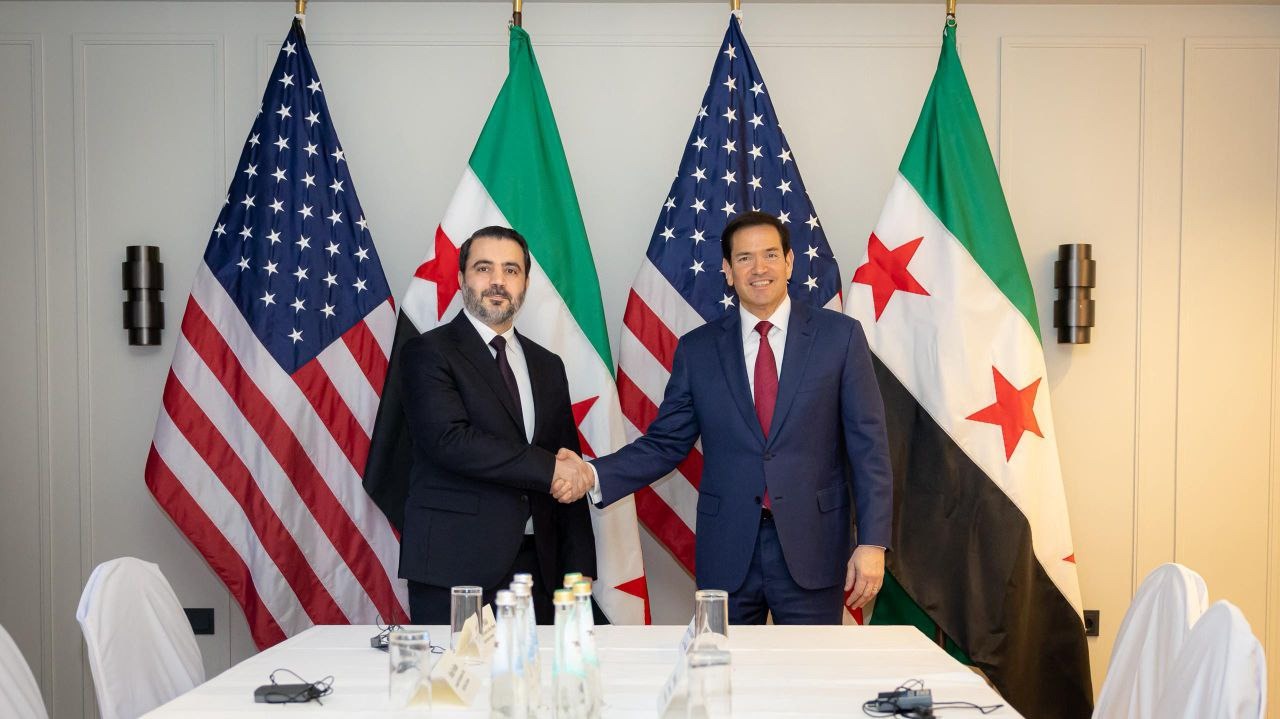
The meeting between al-Shaibani and Rubio on Friday evening went far beyond a routine bilateral encounter on the sidelines of a conference. It came as implementation advances on the January 30 agreement between the Syrian government and the SDF—an agreement receiving close support and follow-up from senior U.S. officials, including Rubio and Envoy Barrack.
Within this context of “strict support” falls President Donald Trump’s new statement on Saturday, in which he told journalists that President Al-Sharaa is doing “a great job for the Syrian people and working to unify the country.” Asked about Syria’s situation, Trump said: “Syria’s president is doing a very good job, and we are satisfied with the work he is doing.”
President Al-Sharaa had received an extended phone call from Trump on January 27, during which they discussed developments in the transitional phase, efforts to enhance security and stability, and prospects for bilateral cooperation. Al-Sharaa affirmed Syria’s full commitment to territorial unity, national sovereignty, and the preservation of state institutions.
Economically, this political support for unifying Syria and strengthening state foundations naturally aligns with shared economic objectives. The United States is a principal actor in reconstruction, while the Syrian state accelerates stability to launch rebuilding on solid foundations.
Intensive Meetings and American Patronage
The Syrian delegation, which arrived in Munich on Friday, immediately entered a series of intensive meetings with American and European officials. Discussions focused on the future of the political process, the integration agreement with the SDF, counterterrorism, and regional stability.
The meeting between al-Shaibani and Rubio—attended by Mazloum Abdi—stood out. According to a Syrian Foreign Ministry statement, a separate meeting between the two ministers addressed key local and regional developments, emphasizing Syria’s unity, sovereignty, and territorial integrity. The American side affirmed U.S. support for the government, the integration agreement, and Syrian efforts to combat ISIS, while also discussing avenues for bilateral cooperation.
Parallel statements by al-Shaibani indicated that Washington seeks a strong Syrian state with functioning institutions and a unified army capable of protecting all citizens. Reuters quoted a Western official expressing U.S. satisfaction with progress on the integration agreement.
Al-Shaibani added that Washington had given the government significant opportunity and support, noting Rubio’s affirmation of U.S. backing for Syria’s unity and economic development. He stressed Damascus’s commitment to unifying the country and addressing the consequences of war and fragmentation.
He confirmed that integrating SDF forces into state institutions is progressing well on the ground, reflected in joint Syrian meetings in Munich. He emphasized that the Kurdish community is an integral part of the national fabric and that Decree No. 13 on civil and cultural rights addresses issues unresolved for decades.
Following his meeting with al-Shaibani and Rubio, Abdi confirmed that his participation in Munich was within the official Syrian delegation. In a post on X, he said the meeting reviewed progress on the integration agreement and thanked the United States for facilitating the process. He added that the SDF delegation’s participation came “representing the Syrian state within its comprehensive national framework.”
A Pivotal Moment in Time and Place
Political analyst Abdullah Al-Hamad told Al-Thawra that the Munich Conference represents a pivotal moment for Syria—both in timing and significance. It is a major global forum where security decisions are shaped, and at this historic juncture, the meeting between al-Shaibani and Rubio carries a clear message: legitimate engagement with Syria now occurs exclusively through Damascus and its official institutions.
For this reason, Al-Hamad argues, Mazloum Abdi and Ilham Ahmed’s participation occurred within the Syrian delegation. Syria attended with one unified delegation, not two as in previous years. There is no longer space for parallel entities or alternative projects. All actors are welcome within a national framework, but representation abroad is unified.
Al-Hamad sees Abdi and Ahmed’s participation as part of reassurance messages Washington wishes to send to certain political forces, affirming that U.S. allies have not been abandoned. Yet America’s ultimate objective, he says, is a single, strong Syrian state that includes all components—including its own allies—to achieve stability, prosperity, and a new political landscape built on cooperation between central governments and partners.
The Munich Security Conference remains the world’s most prominent platform for policy and security dialogue, drawing more than 60 world leaders and around 100 foreign and defense ministers each year.
Al-Hamad also referenced last Friday’s UN Security Council session on Syria, questioning how the UN might adopt a comprehensive support track for the integration agreement. He noted that the agreement extends far beyond Syria, involving regional powers such as Turkey, Iraq, and Gulf states, as well as international actors including France and the United States. The agreement with the SDF—and Decree No. 13 granting Kurds their historic rights as a national component—constitutes a historic moment in Syria’s political, security, and military landscape.
Al-Hamad believes developments are moving in a remarkably positive direction, but international support is essential to nurture the agreement toward broader regional projects. Syria’s status as the 90th member of the U.S.-led international coalition against ISIS means the state is open to cooperation with coalition countries, including intelligence and military coordination. This partnership will inevitably shape regional and international dynamics. Syria, he concludes, needs international and UN support through memoranda of understanding and agreements sponsored by the United Nations.
Capability and Effectiveness
According to Al-Hamad, one of the most important messages preceding the Munich Conference concerned the Syrian state’s demonstrated capability to reach an agreement with the SDF and ensure its success—whether through military decisiveness or negotiation—ultimately integrating the organization into state institutions. Although implementation was delayed for ten months, the state proved its effectiveness throughout the process.
The initial agreement between the government and the SDF was signed on March 10, 2025, yet it stalled due to SDF field violations and its support for separatist and extremist armed groups. After the situation was resolved in Aleppo’s Sheikh Maqsoud and Ashrafieh neighborhoods, the SDF was given a second chance through a new agreement on January 18. That attempt also faltered, prompting a comprehensive military operation that restored state sovereignty over the Jazira provinces—nearly 30 percent of Syrian territory previously under SDF control. This paved the way for the final, decisive agreement on January 30, whose implementation phases began immediately and are set to conclude by the end of February.
Al-Hamad adds that another crucial message conveyed before Munich was Syria’s accession to the international counterterrorism coalition through genuine field engagement. The most important message, he argues, is that Damascus remains the gateway to regional stability. The world has witnessed how regional conditions deteriorated over the past fourteen years, how separatist and extremist organizations emerged, and how their influence spilled into neighboring countries. Today, Syria enters the Munich Conference with significant political momentum and leverage through the SDF agreement and other domestic files, including transitional justice, government formation, and parliamentary elections. Syria presents itself as a partner and principal actor, extending its hand to all in pursuit of regional and global stability.
American Commitment to Supporting the Syrian State
Researcher and political analyst Mustafa Al-Nuaimi told Al-Thawra that the Munich meetings—whether the bilateral encounter between al-Shaibani and Rubio or the trilateral meeting that included Mazloum Abdi—serve to reinforce civil peace through a purely national will. He notes a genuine desire to build sustainable peace based on national commonalities under American patronage, which underscores the importance of these meetings in aligning perspectives and establishing stability across Syrian territory.
According to Al-Nuaimi, the United States is keen to support the Syrian state and to demonstrate this support clearly—a message directed not only to Damascus but also to parallel entities such as the SDF. The message concerns Syria’s place within the region and the broader Arab and international system, which Washington seeks to shape.
Al-Nuaimi explains that the Syrian-American context surrounding these meetings is rooted in successive transformations within Syria and its regional environment. With the SDF losing territorial control, it also lost its ability to maneuver and reached the certainty that U.S. support would not continue indefinitely. This compelled it to turn toward Damascus for understandings, effectively neutralizing any threat it once posed and strengthening civil peace as the defining feature of the next phase.
He adds that the sweeping transformations in Syria and the region have demonstrated Damascus’s competence across all levels—political, security, field, and military—removing all the cards the SDF previously relied upon. He believes this dynamic will extend to other files of similar nature, most notably the Suwayda file in the coming period.
This article was translated and edited by The Syrian Observer. The Syrian Observer has not verified the content of this story. Responsibility for the information and views set out in this article lies entirely with the author.