
March has unfolded as one of the most volatile months in Syria’s recent security landscape, marked by a sharp rise in armed attacks and coordinated breaches across multiple regions. While several operations bear the unmistakable imprint of Islamic State cells, others remain cloaked in anonymity. The latest strike, carried out last night in Safira in Aleppo’s eastern countryside, reinforces the persistent fragility of the national security environment and heightens concerns over the organization’s ongoing transformation. No longer a territorial entity, the Islamic State has reconstituted itself as a mobile insurgency—lean, clandestine, and increasingly lethal.
The Safira Assault
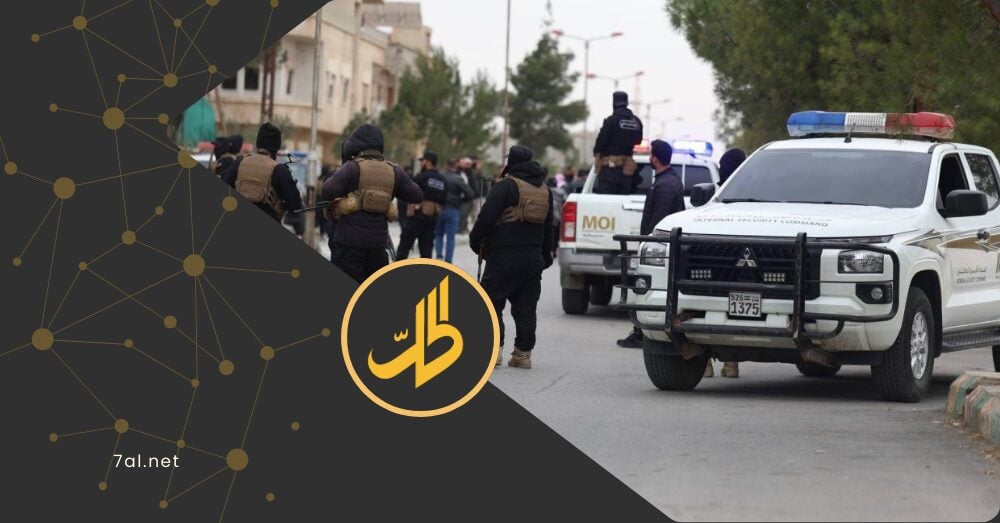
On Tuesday evening, two officers from the Syrian Customs Directorate were killed and two others wounded in a violent ambush near Safira. Security intelligence indicates that an Islamic State cell orchestrated the attack, initiating a firefight with responding forces.
During the pursuit, one militant detonated a suicide vest to avoid capture, killing himself instantly. The Ministry of Interior, operating under the Transitional Government, confirmed that broad manhunts are underway to track down the remaining fugitives.
This incident ranks among the most consequential escalations of the month, part of a broader pattern of strikes targeting Ministry of Defense personnel. It underscores the organization’s enduring ability to wage asymmetric warfare despite the collapse of its territorial caliphate.
A Month Defined by Volatility
The rhythm of violence in March has been relentless. In the first week alone, two internal security outposts in eastern Deir ez-Zor came under coordinated attack. Local sources in Al-Shuhail reported that unidentified gunmen on motorcycles opened fire on the Al-Attal checkpoint with automatic weapons, injuring two civilians—a woman and a young man—caught in the crossfire.
That same day, another group of assailants targeted a security installation near Al-Busayra using heavy machine guns. Although the attack caused significant material damage, no casualties were reported. In response, internal security forces imposed a strict cordon around both towns, launching sweeping search and forensic operations.
Meanwhile, the Islamic State claimed responsibility for a deadly ambush in northern Aleppo. Through its Amaq agency, the group detailed an attack on the Aleppo–Al-Bab road near A‘bad, where operatives used automatic weapons to kill two Syrian Army soldiers—an incident later confirmed by the Ministry of Defense.
The Strategic Evolution of 2026
Since the beginning of 2026, the Islamic State has executed dozens of localized strikes, concentrated primarily in the Badia (Syrian Desert) and along the eastern Euphrates. These operations have spanned the governorates of Deir ez-Zor, Aleppo, Raqqa, Idlib, and Hasakah, targeting Ministry of Defense units, internal security detachments, and fortified military positions.
The group’s evolving methodology reveals a deliberate shift toward high-mobility, low-visibility tactics. Exploiting the vast, porous terrain of the desert, small cells conduct rapid, precise attacks before disappearing into the wilderness. This strategy of “persistent irritation” enables the organization to maintain both psychological and operational presence, complicating the efforts of security forces and exploiting the inherent challenges of policing such rugged geography.
Systemic Fragility and the Shadow of Infiltration
These developments unfold amid growing anxiety over the resurgence of extremist activity in the Badia and along key military demarcation lines. The rising tempo of both claimed and unclaimed attacks casts a long shadow over the capacity of the new Syrian authorities to stabilize the country.
Under Transitional President Ahmad al-Sharaa, the government faces the monumental task of securing a fractured state. The difficulty of controlling the desert corridors is compounded by quiet but persistent concerns about potential infiltration of the New Syrian Army by extremist elements. Any breach within the ranks would grant insurgents invaluable intelligence—precisely the kind of insight reflected in the precision and lethality of recent operations.
This article was translated and edited by The Syrian Observer. The Syrian Observer has not verified the content of this story. Responsibility for the information and views set out in this article lies entirely with the author.