
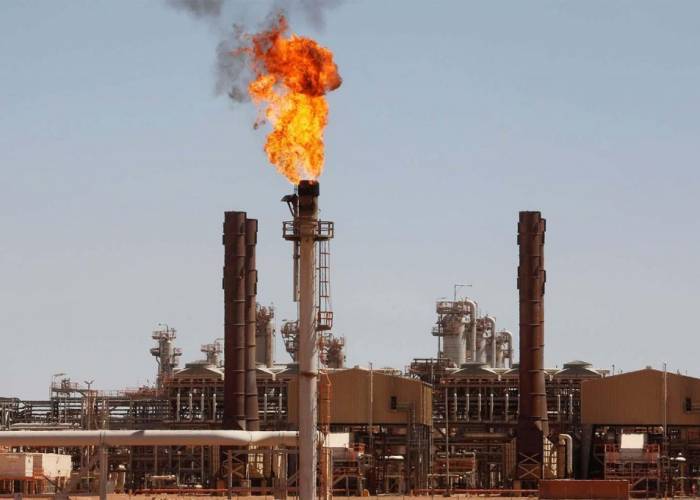
A general review of the proposal submitted by businessman Ayman Al-Asfari for investment in Syrian gas fields—according to documents obtained by the “Syrian Shadow Government – Zaman Al-Wasl”—reveals elements of coercion embedded within the offer. This pressure appears tied, on one hand, to the fragile internal political and security climate in the country, and on the other, to Al-Asfari’s assertion that international companies are unlikely to return under current conditions. As a result, he presents his offer as “the best option the Syrian government can hope for” in the prevailing circumstances.
Details of the Proposal
According to the documents, Asfari proposes a 25-year investment framework for Syrian gas, pledging to inject $5 billion over the duration—$1.5 billion of which would be committed within the first three years. The objective is to reach a daily output of 15 million cubic metres of gas.
The 25-year term is far from arbitrary, especially coming from someone with long-standing expertise in Syria’s oil and gas sectors. Asfari states in the proposal that he has been active in Syria’s energy industry since 1986. This context underscores his awareness that Syria’s gas reserves are estimated at 2.5 billion cubic metres—enough to sustain extraction for around 25 years in the absence of new discoveries. Essentially, the proposal seeks to exploit Syria’s entire current gas reserve.
Key Observations
One critical point, often overlooked by the average Syrian, is that most of the major gas fields are already under government control—aside from some fields in Deir ez-Zor and Hassakeg, which are of limited economic viability, particularly those in Hassakeh. Asfari’s proposal primarily targets investment in state-held fields in the central region, while also accounting for specific fields in Deir ez-Zor, including the Al-Omar oil field, which is presently under the control of the Syrian Democratic Forces (SDF). This field is anticipated to return to government control in the coming months, especially as the SDF is not currently exploiting it.
Another point of concern lies in Syria’s gas production figures from the past year. Official reports place daily output at between 11 and 12 million cubic metres. Of this, 9 million cubic metres were directed to power generation, 600,000 to a fertiliser plant formerly under Russian control, and around 1.5 million for domestic, industrial, and commercial use. This suggests that Al-Asfari’s proposal would raise output by only 3 to 4 million cubic metres per day within three years.
For historical context, prior to 2010, Syria’s gas production peaked at 23 million cubic metres per day—yet this still fell short of national demand. At that time, approximately 6 million cubic metres were imported daily from Egypt via the Arab Gas Pipeline to meet the energy needs of power stations, which required over 20 million cubic metres daily.
Strategic Framing of the Proposal
The proposal bears the hallmarks of a seasoned Syrian merchant adept at marketing his offer. Asfari provides exhaustive detail about the asset, emphasising its unique qualities compared to alternative opportunities—clearly aiming to corner and fully persuade the government.
This approach is evident throughout the proposal. He showcases his intimate understanding of Syria’s energy geography, his connections with international experts and firms he claims he can bring to Syria, and his willingness to invest tens of millions of dollars in equipping and upgrading infrastructure.
On paper, the offer is undoubtedly attractive—particularly in light of Syria’s acute energy shortages and its ambitions to construct new power plants. Asfari’s proposal thus emerges as a potential “lifeline” for the government in this context.
Concerns and Implications
While the technical aspects of the proposal may require expert evaluation beyond the scope of this analysis, it is reasonable to expect the Ministry of Energy to consult relevant professionals.
However, the central concern lies not in the technical feasibility of the proposal, but in the motivations behind its possible acceptance. There is growing apprehension that the government’s decision may be driven less by national economic interest and more by political calculation or external pressure.
In other words, there is a palpable fear that segments of the ruling authority may consider bartering political capital for economic concessions. The implications of such a transaction—where strategic resources are leveraged under duress—are both significant and self-evident.
This article was translated and edited by The Syrian Observer. The Syrian Observer has not verified the content of this story. Responsibility for the information and views set out in this article lies entirely with the author.