
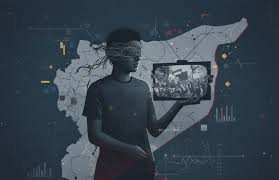
Despite the clear political trajectory toward stabilizing Syria and reaffirming the unity of its territory, certain actors continue to manufacture tension by generating chaos in the digital sphere and attempting to project it onto the ground. Their aim is to impose a distorted reality and erode trust between Syrian society and the new Syrian state. Yet these attempts have repeatedly failed; their impact rarely lasts more than a few hours and is built on misleading narratives designed for internal political exploitation.
These campaigns typically exploit sectarian and ethnic sensitivities, misleading certain communities into believing that international sentiment is shifting in their favor. This comes at a time when the agendas of some groups have been exposed and their popular support has eroded due to their practices and violations in areas under their control. Their strategy relies on spreading fabricated news to confuse the public and generate high engagement on social media, ultimately fueling hate speech among the components of Syrian society.
This pattern has been evident in several recent campaigns led by entities operating outside the law. The latest example was the exaggerated portrayal of an informal session held in the U.S. Congress, which was falsely promoted as an “official session” dedicated to discussing the situation in Suweida. In reality, the meeting had no legislative status and was merely an informal briefing.
The same tactic has been used in relation to developments in the Jazeera region and the recent agreement between the Syrian government and the SDF. Official and unofficial statements are distorted to plunge the public into uncertainty about the implementation of the agreement and the future of the region.
Inflated Narratives of a U.S. Congress Session
Last Wednesday, an informal briefing was held in the Capitol building in Washington, D.C., addressing issues related to the protection of Druze, Christians, and other minorities in Syria. The event was organized by small lobbying groups and research organizations with no official standing. Despite its limited nature, it was amplified across social media to create the illusion of a major shift in U.S. policy toward Syria.
False claims circulated that the session recognized a “massacre against the Druze,” granted “self-determination,” or incorporated the Druze into a “project to protect the Kurds.” In reality, the session was neither legislative nor official, nor was it convened by the Senate Foreign Relations Committee.
The event — organized by groups such as “Druze Nexus” and the “Worldwide Druze Public Affairs Committee,” in cooperation with activist Tim Ballard — received only symbolic sponsorship from Congresswoman Marilyn Stutzman. It carried no legal or political weight.
A similar scenario unfolded during the February 10 hearing of the House Foreign Affairs Committee titled “Syria at a Crossroads: Challenges for U.S. Policy Post-Assad.” The hearing was analytical in nature and concluded with clear messages supporting the unity of Syrian territory, commending the integration of military structures into the Ministry of Defense, and emphasizing regional partnerships, economic recovery, and reconstruction.
Media amplification has not been limited to U.S. events. It has extended to internal developments in Suweida and the Jazeera region, particularly regarding the implementation of the recent agreement between the Syrian government and the SDF. The goal is to deepen divisions among Syrians, especially in areas where militias rejecting the agreement continue to operate outside the law.
What Is the Goal of This Amplification?
These disinformation campaigns aim to create political illusions — convincing certain groups that they enjoy special international backing. This confusion destabilizes the Syrian landscape, fuels political tension, and undermines trust in the new Syrian state.
The mechanism is well-known:
- Thousands of coordinated social media accounts publish the same misleading content in different formats.
- Media outlets affiliated with the same actors republish the content, citing “private sources” or attributing it to officials or agencies to give it credibility.
- Advocacy campaigns then escalate sectarian and ethnic rhetoric, provoking counter-reactions and widening social fractures.
Journalist and expert in professional safety and publication ethics, Khaled Al-Qudah, explains that “media disinformation has a political function.”
He notes that political actors lacking a convincing discourse or genuine popular support resort to disinformation when they fail to influence public opinion through truthful information and logical arguments.
Al-Qudah told Al-Thawra:
“Disinformation attempts to divert people from their compass, cast doubt on every achievement, undermine competence, frighten people about the future, and spread fragmented or unrealistic stories.”
Its purpose, he said, is to undermine trust and prevent the creation of a positive environment that could empower genuine state-building forces.
Investigative journalist Hazem Al-Mazouni agrees, noting that political disinformation is a globally recognized tool capable of mobilizing populations, sparking revolutions, or concealing atrocities.
He explained that its goal is to distort public consciousness and replace truth with alternative narratives, ultimately influencing political attitudes or voting behavior.
Who Benefits?
This amplification and distortion of facts serve actors seeking to entrench the current fait accompli in Suweida and the Jazeera region. By creating the illusion of imminent international support, they attempt to strengthen their political position.
Linking the Suweida file with the Jazeera region also aligns with regional interests that seek to keep Syria in a state of fragmentation and division — a return to security chaos that would inevitably impact both stability and economic conditions.
This article was translated and edited by The Syrian Observer. The Syrian Observer has not verified the content of this story. Responsibility for the information and views set out in this article lies entirely with the author.