
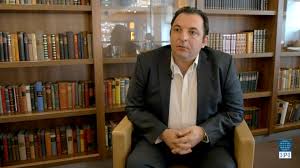
In the months following the fall of the Syrian regime, few figures have been as central to the country’s search for justice as Mazen Darwish, the president of the Syrian Center for Media and Freedom of Expression. For more than a decade, Darwish has been one of the most persistent advocates for accountability, documenting violations, supporting victims, and pursuing perpetrators across borders. Today, as Syria attempts to rebuild its institutions, he finds himself navigating a landscape filled with both opportunity and peril.
On Transitional Justice
Darwish begins with a blunt assessment: Syria still has no national plan for transitional justice. “This plan should have been drafted the moment the National Dialogue failed to form a committee to prepare it,” he says. Instead, the country has been moving through scattered steps, without a governmental strategy or an independent one. The trials on the coast, the arrests, the public investigations — all of them, he argues, are reactive measures rather than components of a coherent process. Even the appearance of figures like Atef Najib before investigative judges, or the coastal trials themselves, remain isolated actions that should be integrated into a broader transitional justice framework. “The events on the coast are part of the wider context of the conflict,” he insists.
Despite the absence of a national plan, Darwish and his colleagues have been far from idle. For high-ranking fugitives, the Center has built a network of cooperation with international authorities. “We have obtained more than twenty international arrest warrants issued by the French judiciary,” he explains. Working with investigative judges, the public prosecutor, the French war crimes police, and the Center, they formed a joint unit to track wanted individuals. Requests for cooperation have been sent to Lebanon and several Gulf states, where additional suspects are believed to be hiding.
For Darwish, accountability must ultimately be Syrian, but he is clear-eyed about the practical realities. Many perpetrators are outside the country, and the case files are complex. “We must combine Syrian trials with universal jurisdiction courts in France, Germany, the Netherlands, and Sweden, and cooperate with the International Criminal Court when necessary.”
His critique of the Transitional Justice Committee is measured but firm. The structure, he says, lacked strategic vision from the beginning. He does not blame the committee members themselves; their room for action is limited. What Syria needs now is the long-delayed Transitional Justice Law, which would address the legislative vacuum created by the constitutional declaration. Hundreds of laws require amendment or replacement, and even the criminal code does not include war crimes or crimes against humanity. “The root of the problem began with the National Dialogue and continued through the constitutional declaration,” he says. “The committee now bears this legacy while facing intense public pressure to issue a law.”
Darwish notes that post-conflict states typically need around two years to build legal structures, courts, and training programs. But the rush that followed the fall of the regime produced unrealistic promises: massive salary increases, uninterrupted electricity, trials for all perpetrators, compensation for all victims. “These promises were not helpful,” he says.
Yet there have been breakthroughs. After years of work, the Center helped secure the recovery of assets belonging to Rifaat al-Assad. The French government is preparing to transfer thirty-two million euros to the Syrian government, with more to follow. “We worked on this file for many years, and we are pleased to see tangible results,” Darwish says. Confiscations are expected to expand beyond eighty million euros, including new properties in France. Protocols have been signed between the two governments, and the Syrian government is expected to specify spending priorities before the funds are transferred.
He hopes the money will be used for justice processes, the search for the missing, and compensation for victims. “To our knowledge, France has not imposed conditions,” he says.
For Darwish, the work is deeply personal. “Before anything else, I am a Syrian citizen and one of the victims,” he says quietly. He and his family, including his parents, were subjected to arrest, disappearance, and violations. “This work touches us directly.” In the coming days, he and Syrian partners will file a case in Denmark against a Danish company that supplied fuel to Russian aircraft between 2015 and 2017, seeking compensation for victims and for the Syrian state.
The pursuit of Rifaat al-Assad’s assets continues in Britain, Spain, and elsewhere. Darwish is confident. “One of the lessons of recent years is that no path is closed to victims determined to claim their rights,” he says. He recalls the moment in 2023 when an arrest warrant was issued for Bashar al-Assad while he was still president. “Many believed it impossible, but persistence proved otherwise.”
Coastal Violations and Judicial Proceedings
The coastal killings, one of the most painful chapters of the conflict, remain a test of Syria’s new judicial landscape. Darwish’s report described acknowledgment as “the highest form of moral courage,” and he stands by that view. The formation of an official committee is, in his eyes, a significant step. Acknowledging the unlawful killing of around fifteen hundred civilians is positive, even if the committee’s report differs from his own in key respects. It avoided naming actors linked to the government and classified the killings differently. Still, he sees value in the process: interviewing victims, documenting the killings, naming suspects, even when they are tied to networks of the former regime. “We had hoped the full report would be published in the interest of transparency,” he says.
Justice, he insists, cannot be separated from social and political realities. The coastal crimes should be integrated into the broader framework of transitional justice. And the victims are not only civilians. Two hundred eighty-five security and defense personnel were killed in ambushes, and their families also deserve acknowledgment and accountability. “Justice must consider the rights of all,” he says.
Procedurally, he has concerns. It is unclear why investigations were conducted before military judges while trials are held before civilian criminal judges. It is also unclear whether defendants had lawyers during the investigation. The indications suggest they did not. In the first session, the judge appointed public defenders for defendants who had none, implying they may not have had representation earlier. Transparency is limited: sessions were announced only a day or two in advance, and the investigation process remains opaque. “Legal and procedural soundness must be accompanied by transparency and communication with the public,” he says.
On Corruption, Asset Recovery, and the Sovereign Fund
Corruption and asset recovery form another pillar of Darwish’s work. Inside Syria, the Center supports the Transitional Justice Committee, the Missing Persons Committee, and the Ministry of Justice. With the fall of the regime, institutional roles must be redefined. Previously, no government body assumed these responsibilities, forcing civil society to act as both public prosecutor and Ministry of Justice. “We do not want this situation to continue,” he says. The Center’s role now is to step back and support official institutions, while insisting that reconstruction must not come at the expense of victims’ rights.
Corruption under the former regime was structural, not a series of isolated cases. Preventing the reproduction of corruption and patronage networks in the new economy is essential. Recovering Syrian assets is a priority, yet Darwish notes that settlements and asset recovery through the sovereign fund and other bodies lack transparency. The mechanism is fast, which is positive, but without details, it cannot be evaluated.
On Accountability for Violations by All Parties
Finally, Darwish turns to the question of accountability for violations committed by all parties, including Hayat Tahrir al-Sham and other factions. He believes it is possible. Over the past six months, he says, the presidency has affirmed that the committee’s work must include all violations and all victims. The committee itself has confirmed this. The path will not be easy, and expectations must be managed. No international example exists in which every perpetrator faced criminal accountability. But strategic and balanced litigation that protects victims’ rights remains essential.
He ends on a note of sober determination. “I have many observations about the current tracks,” he says, “but the fall of the regime is an opportunity that must be seized.”
Then he adds a line that feels like a thesis for Syria’s future. “We have all found ourselves in the same boat. Either we survive together or we sink together. Justice, the missing, and accountability are not luxuries. They are part of Syria’s future. Failure is not an option.”
This article was translated and edited by The Syrian Observer. The Syrian Observer has not verified the content of this story. Responsibility for the information and views set out in this article lies entirely with the author.