
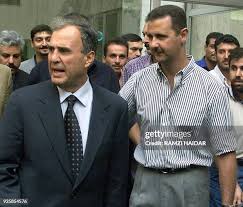
A man of riddles—his expression revealed little, his presence etched in ritual. Handsome, meticulous in his manner, Ghazi Kanaan greeted guests with a commanding handshake, a poised smile, the soft haze of a cigar, and always a leather-bound notebook in hand—ready to annotate each encounter. His gaze, incisive and unwavering, gave the impression of seeing not just the speaker, but the shadows that trailed behind.
Such was the man whose name emerged in a terse communiqué from Syria’s Ministry of Interior on a morning in October 2005:
“Major General Ghazi Kanaan has taken his own life in his office at the Ministry of Interior this morning.”
A curt sentence that consigned to silence one of the Syrian regime’s most enigmatic and powerful figures—yet failed to stifle the questions that still echo.
In a realm where high-ranking officials are rarely driven to suicide unless cast from power’s ledger, Kanaan’s death felt less like an act of despair and more like a coded message shrouded in deliberate ambiguity.
A suicide—perhaps. But what truly happened that day?
The forensic report cited a single gunshot to the mouth.
At Damascus’s Shami Hospital—mockingly referred to by political circles as the “sanctuary of silent assassinations”—his son reportedly struck the walls in anguish, shouting: “They murdered him!”
Before the lifeless form of a man whose footsteps once commanded fear, the scene resembled the closing chapter of a book too dangerous to read aloud.
The Sealed Envelope
Prior to this supposed “suicide”—or “execution,” as some murmur in the margins—Kanaan, according to sources who spoke to Al-Modon, received in his office a sealed envelope, hand-delivered on behalf of the “deposed President” himself.
It contained classified documents: communications and records of secret meetings outlining a coup Kanaan had allegedly plotted against President Bashar al-Assad. The conspiracy was reportedly coordinated with a senior American intelligence officer stationed in Cairo at the time, in collaboration with Lieutenant General Hikmat al-Shihabi, former Chief of Staff of the Syrian Army, and Abdel Halim Khaddam, the former Vice President who would later defect.
Shortly after, Assef Shawkat—the President’s brother-in-law and head of Military Intelligence—arrived at the Ministry of Interior, according to eyewitnesses within the compound.
Immediately following this meeting, Kanaan placed his final phone call to Lebanon’s Voice of Lebanon radio. His words: “This may be my last statement.” Then, calmly: “I wanted to affirm that the accusations against me are baseless… This is for history.”
A Cloaked Exit
No thorough investigation followed. No official medical report. No formal conclusions. In Syria, silence often speaks louder than facts. In Lebanon, where Kanaan’s name once echoed with authority, questions faded—suppressed by fear or resignation.
Months later, the first edition of the Mehlis Report was published, naming Kanaan among those “possibly aware of orders from the highest levels” in the assassination of former Lebanese Prime Minister Rafik Hariri. But the man who might have clarified everything was already dead.
A security guard at the Ministry reportedly told a neighbour the following morning: “We heard only one shot.”
One bullet to silence two decades of secrets, alliances and intelligence operations spanning Anjar, Damascus and Beirut. But it could not silence the thirst for truth.
Who killed Ghazi Kanaan? Did he take his life in despair, or was he eliminated by a regime that could no longer tolerate his reach? The mystery may never be conclusively resolved.
Yet Al-Modon has uncovered a critical revelation: Kanaan’s body bore seven bullet wounds—not one. His killing, sources assert, was ordered personally by the President, and executed by a trusted lieutenant who was subsequently rewarded with vast financial and political power.
The scene was meticulously crafted to appear as a single gunshot suicide, with silencers used to conceal the true extent of the violence.
An alternate version suggests he was pressured into suicide following a final confrontation in his office.
Despite differing accounts, both converge on one certainty: Kanaan’s death marked the end of an era—an era in which Damascus ruled Beirut from the shadows, with Kanaan as its face.
Aftermath of Elimination
Suspicion did not end with Kanaan’s death. Weeks later, his brother was declared dead in a train accident.
But confidential sources informed Al-Modon that the event was no accident—it was an orchestrated purge. His brother had reportedly been asked to surrender confidential files Kanaan had kept at home as a “historical trust”.
Syrian intelligence allegedly raided the house searching for the documents. Soon after, his brother disappeared, only to be found dead on the railway tracks.
Simultaneously, the Kanaan family—his widow in particular—was ordered to refrain from speaking to the media. Warnings were issued to his children, particularly one son studying and residing in the United States.
The Assad family assured the Kanaan household that their lives, wealth and property would be untouched—in exchange for permanent silence. Thus, the book was closed, never to be reopened.
From Bahramra to Beirut
Ghazi Kanaan was born in 1942 in Bahramra, a village under Latakia’s jurisdiction, into a modest Alawite farming family. He graduated from the Homs Military Academy as an infantry officer in 1965, fighting in both the 1967 and 1973 wars. He became one of the rising officers loyal to Hafez al-Assad, who seized power in the 1970 coup.
In the early 1980s, following the Israeli invasion of Lebanon in 1982, Assad sought a trusted overseer for Syria’s portfolio in Lebanon—someone to manage militias, politics and security in a fractured landscape.
He chose the young Major General Ghazi Kanaan, appointing him head of the Syrian Military Intelligence branch in Lebanon. From then on, Kanaan’s name became synonymous with Syrian dominance in Beirut. For two decades, he presided over Lebanon’s affairs, enforcing Syria’s will through the so-called “security coordination” between Syrian and Lebanese agencies.
His lieutenants infiltrated ministries, selected Lebanese Army commanders and shaped electoral lists. Anyone seeking Damascus’s approval had to pass through his office in Anjar, in the Bekaa Valley.
There, inside a drab compound flanked by tanks and barbed wire, Kanaan orchestrated elections, exiles and more. He was a diplomat in his own right—measured, well-informed, and unlike his successor Rustum Ghazaleh, not prone to open brutality.
Anecdotes abound of his meetings with Lebanese politicians—always with a polite smile behind a veil of cigar smoke, as if signing pacts in the air. But his smile offered no immunity.
Those who defied Damascus’s line often found themselves exiled, imprisoned or buried.
Throughout the 1990s, Kanaan served as Syria’s security envoy in Lebanon, sitting at the same tables as Rafik Hariri, Emile Lahoud and Walid Jumblatt—arbitrating their rivalries with clinical detachment and subtle manipulation.
One Lebanese political figure who worked closely with him later said: “Kanaan knew everything—who slept with whom, who funded what, who planned what for tomorrow. He didn’t need a dossier… he was the dossier.”
The Final Descent
In 2002, Kanaan was summoned back to Damascus. Some say Bashar al-Assad could no longer tolerate his sprawling influence in Lebanon, which had begun to outstrip the mandate he was given.
Others suggest it was the fulfilment of a long-standing promise by Hafez al-Assad to elevate him to the regime’s inner circle—and that Bashar was merely honouring that pledge.
Either way, his return signalled decline. He was removed from foreign intelligence and assigned to lead Political Security—a position that lacked the clout of his previous role in Beirut.
In October 2004, he was appointed Minister of the Interior, replacing Ali Hammoud.
The timing was fraught: Israel had withdrawn from southern Lebanon, Syria’s grip on Beirut was loosening, and Lebanese calls for independence were growing louder.
Kanaan attempted to recast himself as a civilian reformer within Damascus. But the tides in Lebanon shifted too rapidly—and against a man whose authority had always rested in the shadows.
Here is the refined version of the final section of your article, edited according to British journalism standards and the editorial brief you provided:
The Fall of the Fortress
On 14 February 2005, a cataclysmic explosion tore through central Beirut, claiming the life of Lebanese Prime Minister Rafik al-Hariri.
Within weeks, suspicion turned sharply towards Damascus, prompting the formation of a United Nations investigative commission led by German judge Detlev Mehlis. Ghazi Kanaan’s name topped the list of those summoned for questioning.
He travelled to Vienna that September, enduring hours of interrogation before the panel. Leaks that followed painted a portrait of a man unsettled and guarded—walking a precarious line between loyalty to the regime and fear of being cast as a sacrificial offering.
Upon his return to Damascus, rival intelligence services reportedly intensified their scrutiny, monitoring his every move. In the corridors of power, his name was now uttered in hushed tones, tainted by suspicion. The man who once ruled Lebanon in Damascus’s name was now seen as a thread barely holding, liable to snap at a moment’s notice.
Weeks later, the regime announced he had “died from a self-inflicted gunshot wound to the mouth.” Yet few in Damascus or Beirut accepted the account.
In a system where defenestrations outnumber natural deaths, the suicide narrative seemed a convenient mask for a political purge. His demise coincided with the impending release of Mehlis’s first report, reinforcing widespread belief that he was silenced before he could speak.
Lebanese media branded the incident a “suicide by decree”, while Western outlets decried it as “death by scripted design”. The Syrian regime, true to its traditions—often accused of devouring its own—offered only silence.
Testimony from the Shadows
A Western journalist later wrote: “Every structure built on shadows eventually consumes its final silhouette.”
Ghazi Kanaan had long personified Hafez al-Assad’s shadow in Beirut—the embodiment of Syrian hegemony during Lebanon’s most fragile chapter. But when the political winds shifted, he became a liability that had to be removed. He was neither the first nor the last to meet such a fate.
Accounts from defectors and former regime officials later suggested Kanaan had safeguarded documents of immense sensitivity—records detailing Syria’s financial entanglements in Lebanon and intricate intelligence relationships that few wished to see unearthed.
His close ties to Abdel Halim Khaddam—the former Vice President who would later defect and publicly denounce the regime—only deepened the cloud of mistrust surrounding him, giving his Damascus adversaries all the ammunition they needed for his exclusion.
A Legacy of Dread
Rustum Ghazaleh inherited Kanaan’s mantle in Lebanon, but lacked both his gravitas and political acumen. And perhaps—as some familiar with the regime’s inner workings would whisper—he inherited his fate as well.
In the quarters of Beirut once accustomed to the rumble of Kanaan’s motorcade, Syrian influence began to retreat, culminating in the army’s withdrawal in April 2005—months before Kanaan’s death. His disappearance marked more than the end of a man; it signalled the collapse of an entire chapter in Syrian-Lebanese relations.
Yet his presence lingered: the memory of a gaunt officer, softly spoken, seated in the chambers of Lebanese ministers like a headmaster grading compliant pupils.
The “suicide” of Major General Ghazi Kanaan now joins a long line of mysterious deaths that have punctuated modern Syrian political history.
Among them: the 1969 suicide of Abdel Karim al-Jundi—Hafez al-Assad’s fierce rival and the most formidable obstacle to his eventual seizure of power in 1970.
Then, in May 2000, Prime Minister Mahmoud al-Zoubi took his own life in the twilight of Hafez al-Assad’s reign, clearing the path for the rise of his son Bashar.
Thus, the death of Ghazi Kanaan appears less as an aberration and more as a continuation of a distinctly Syrian ritual: when a regime loyalist becomes too large, too exposed, or too inconvenient, he is made to immolate himself—precisely when it suits the regime.
This article was translated and edited by The Syrian Observer. The Syrian Observer has not verified the content of this story. Responsibility for the information and views set out in this article lies entirely with the author.