
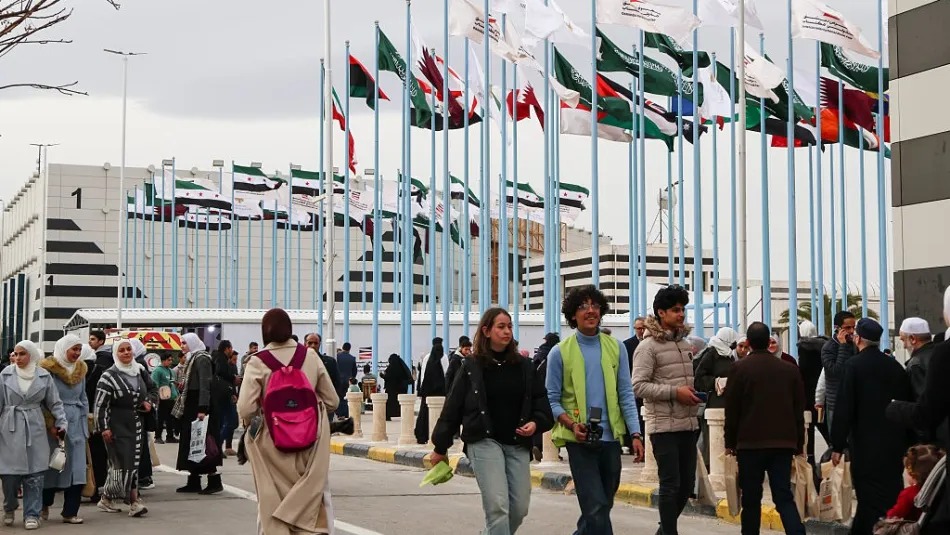
When I asked the man seated beside me in the gardens of Damascus’s Fairgrounds why such a human tide had descended upon the Book Fair, his wife answered before he could speak. “We were suffocating,” she said, with an intensity that suggested a sentiment long pent up since the fall of the Assad regime. He added that the matter extended beyond books. Had the event been a food or industrial exhibition, he believed the turnout would have been the same. According to the organisers, nearly fifty thousand visitors streamed in during the first three hours alone.
Buses, microbuses, and taxis arrived in a steady procession, delivering families and young men and women to this distant site near the airport. The Book Fair seemed almost a pretext, a respectable excuse for people to pour out in waves. One sensed a public thirsting for any occasion of celebration, an opportunity to step away from homes and workplaces, to gather in shared delight and affirm their own capacity for communal joy.
The previous evening, we had missed the official opening ceremony. We were detained at the border for nearly three hours because arrest warrants issued during the Assad era remained in force against three Lebanese writer and journalist friends travelling with us. By the time we reached the fairgrounds, the festivities had ended. Mohammed and I stood by the motorway, fully aware that finding a taxi back to central Damascus at that hour would be futile. A police officer approached and offered to call a friend who drove a taxi, persuading him to leave his home and collect us.
The police have returned to Damascus in force. “Before the regime fell, my salary was twelve dollars a month,” the officer told us as he offered me a cigarette, while Mohammed questioned him with his usual relentless curiosity. “We were close to starving. I started selling cigarettes in the wholesale market. Now I earn two hundred dollars. It is not enough, of course, though things are improving.”
The battered Iranian-made taxis that rattle through the streets remain a visible relic of the so-called era of resistance, with its economy and its technology. They continue to spew thick pollution into the air of Damascus, even as the city embarks upon a broad campaign to clean its walls and pavements. Dust and soot, layered over perhaps a quarter of a century, have lent the capital a muted antiquity, obscuring the elegance of its urban design and the faded grandeur of its architecture.
We had no wish to sleep on our first night back in Damascus. Near midnight we found ourselves at Abu George’s bar. As ever, chance encounters unfolded one after another with friends and acquaintances, some long resident, others newly returned from exile. For a year now, Damascus has been reclaiming its people, those driven abroad by force. It has also been reclaiming its devoted visitors. There was Khaled al-Nasiri, genial and warm, surrounded by a circle of young poets and novelists. Khaled, founder of Dar al-Mutawassit, once banned along with his publications from “Assad’s Syria,” seemed to regard the Book Fair as the setting for a personal and cultural vindication. “In Damascus, and nowhere else, we meet,” he said, raising his glass in celebration of the embraces unfolding around us between those long separated.
Suddenly two young men in their early twenties approached and embraced me. “Do you remember us?” they asked. “We were among the children you taught in Beirut how to write our stories, in the photography and writing workshop organised by Dar al-Musawwir with UNICEF.” One had come from Mexico, the other from Canada. They now work together producing documentary films. A shiver ran through me. Two children expelled from Syria by Assad, transformed into refugees in Lebanon, now stood in the heart of Damascus, brimming with vitality and promise. An invisible victory, perhaps, though decisive in shaping the image of another Syria.
On the cold Friday morning, the city slept. Markets were shuttered for the holiday. Only cats, pigeons, balconies, and layered shop signs dating from the 1960s to the present kept silent watch. From al-Salihiyah to al-Hamra and al-Shaalan, through a labyrinth of streets and markets, we walked toward Sabaa Bahrat and the Central Bank, which many Syrians now regard as more consequential than any other institution. After decades of impoverishment, plunder, and criminalised authority, no voice rises above that of the economy.
Yet the voice of the new economy inspires unease as well. What will market liberalisation, privatisation, foreign investment, and vast real-estate projects bring? A middle class already battered by severe impoverishment feels apprehensive. Workers, minor officials, small traders, craftsmen, and a large proportion of the population sense the peril of being swept aside by this promised prosperity. The first sign came in an electricity bill equivalent to a quarter of a government employee’s salary.
We headed toward Hijaz Station. The thousands of homeless people and beggars I had seen a year earlier were gone. The photographs of the disappeared that once covered every wall had vanished as well, and the improvised pavement stalls had thinned. One cannot help wondering whether a deliberate erasure is under way, an attempt to conceal the painful traces of the past and the abject poverty that drove women and children to beg in the streets.
Rebuilding the City, Recasting the Nation
Beside the historic station, a construction site gleamed in blinding white: a mall, a hotel, luxury apartments and restaurants gathered into a single complex, reminiscent of those that rise across Gulf cities. I recalled the dazzling technical displays of both the Saudi and Qatari pavilions at the Book Fair. It was as though these two states were not merely supporting Syria’s new rulers, but, through their economic power and their declared zeal to “restore Syria to the Arab fold” and efface the legacy of Iranian influence – in its constructions and destructions, its culture, politics and economy – were actively participating in the remaking of Syria’s urban, cultural and economic fabric.
Such a transformation will inevitably provoke contention, rivalry and struggle over the identity of the city and society, over patterns of living and their expression, and over the re-engineering of the economy and Syria’s regional role. The new political leadership has repeatedly invoked the “Singapore model,” though its translation may well assume a distinctly Gulf inflection. This extends beyond reconstruction or investment in urban real estate and alterations to architectural style. It will likely permeate educational and professional spheres, reshape the social order and its class arrangements, and redefine the distribution of wealth and influence. Syria may be approaching a moment comparable to that experienced by Eastern European states after the collapse of communism: a vast workshop dedicated to rebuilding both people and stone in radical fashion. Such a shift reaches deeper than any formal political transition.
These reflections occupied me as we arrived at Souq al-Hamidiyah. I found myself imagining a process of “investment” and redevelopment that might cast its current occupants into uncertainty, erase its historic contours and replace them with boutiques bearing the names Chanel, Dolce & Gabbana and Boss, echoing the fate of central Beirut and its markets – a city stripped of its inhabitants, catering to a phantom elite and nouveaux riches deserving little more than irony. One could even envision the venerable al-Nawfara café transformed into yet another branch of Starbucks.
We threaded our way through the narrow alleys toward the intimate quarters of al-Qaymariyah, with its lanes, houses and small shops. A magic fashioned slowly over centuries, from Byzantine and Umayyad times through the Mamluk and Ottoman eras. I neither smelled jasmine nor sought it. Here lay Old Damascus: homes converted into restaurants or heritage hotels with folkloric charm. There was elegance and order, alongside modesty and even shabbiness, in a curious harmony where distinctions between wealth and poverty blurred. Past and present seemed to converse quietly with one another, as residents, stone, houses, mosques and churches shared the same textured space.
We were to meet Stefan, a German Arabist revisiting Damascus, where he had once studied Arabic. “We shall go to my teacher Jamal Shuhayd’s house,” he said. We walked along unpaved ground near Bab Touma and reached an old building that appeared almost tilted, gently undulating. The door stood open, and from within came Jamal’s voice in a deep Damascene accent: “Welcome.”
It was a house of books upon books, papers and further stacks of volumes, furniture without any clearly definable age, clean, beautiful and intensely personal. A Damascene intellectual’s home that carried me back to the late 1980s and mid-1990s, when we visited the houses of Saeed Hourani, Shawqi Baghdadi and Muhammad al-Maghout. Homes filled with shelves of memory and personal taste, things that cannot be purchased from furniture stores nor assembled by interior designers. Jamal Shuhayd embodies a wounded yet pure romanticism characteristic of Syrian intellectuals who endured without succumbing to the moral compromises that ensnared others, remaining in their city without clamour or complaint. Now he stands alone, dignified in age after the death of his wife a few months ago. In his home, I glimpsed what might serve as a cinematic scene of a twentieth-century Syrian intellectual, one who witnessed all the upheavals of his country and persisted in his devotion to reading and translation. What faith sustained such men and guided their perseverance?
Together we went on to the Book Fair, which appeared above all as a political and promotional occasion, part of the new authorities’ effort to shape alternative impressions of themselves beyond the dominant military and security image. More significantly, it sought to display a civilian and cultural face of the state, softening its Islamist character.
The “new opponents” of President Ahmad al-Sharaa’s rule comprise a wide and heterogeneous spectrum. Some emerge from the Syrian revolution itself, steadfast in their commitment to democratic principles, civic governance and respect for pluralism, and remain critical of political Islam in any guise. Others regard the new leadership as a project of sectarian predominance that suppresses minorities, recalling events in the coast and in Suwayda. There are also sympathisers of the Kurds who feel they have forfeited their autonomy and distinctive entity, perceiving their integration into the Syrian state as submission to an “Arab” authority that diminishes their national and cultural rights and economic resources. Alongside them stand the wary, the anxious and the deeply cautious, motivated by reasons that carry their own legitimacy: concern for public and personal freedoms, apprehension about religious hardening, and unease over the concentration of power, politics and wealth in the hands of a now-dominant group.
At the same time, one discerns a palpable fear among Alawites and a retreat of their presence from the public sphere. The intertwining of “Assadism” with sectarian identity renders the removal of a bureaucratic bloc loyal to the former regime and entrenched within the machinery of the state susceptible to interpretation as sectarian cleansing and the persecution of a minority. This anxiety has been intensified by the absence thus far of a clear Alawite political expression that decisively breaks with Assadism. Meanwhile, the new authorities have struggled to articulate a reassuring discourse or to contain the sectarian tensions that persist in the coastal regions and in Homs. Mechanisms of accountability and transitional justice have yet to begin in earnest, leaving uncertainty to fill the void.
Silence, Shrinking Space, and the Urgency of Politics
Those Christians I spoke with in Damascus conveyed what might be called a form of political abstention. They cling to silence. Such restraint is troubling, for it gestures toward a broader Syrian malaise: the absence of a political life capable of articulating the interests of communities, social strata and the country’s many “components.”
Equally disquieting, compared to the Damascus I knew twenty years ago, is the diminished presence of women in public space. A hesitancy surrounds their appearance in the streets. A guardedness and physical withdrawal mark their movement and bearing in shared spaces. Cities that fail to grant women ease of presence are consumed by melancholy and hardened by severity. Political liberty cannot take root where individual freedom, especially that of women, is constrained.
Upon reaching the Book Fair, we encountered Suhair al-Atassi and Burhan Ghalioun. To shake their hands on the soil of Damascus would have seemed surreal before 8 December 2024. More surreal still was the prospect of a Damascene audience attending a lecture by Ghalioun. I recalled the first “Damascus Spring,” and the destinies of Riad Seif, Michel Kilo and their companions, scattered between prison, death and exile. This lecture felt like a resurrection of a possibility once suffocated by Assadism, which denied Syria a historic opportunity for democratic reform and instead steered it toward massacre and devastation.
Outside the hall, Salafis distributed their pamphlets free of charge. They had secured numerous stands at the fair, part of a fierce, if largely unspoken, contest with other Islamic currents, particularly those close to the new authorities. Inside, Burhan Ghalioun spoke of the intellectuals’ error in setting secularism in opposition to religion, and of the primacy of preserving the unity of the state in its identity and geography. He addressed democracy, sectarianism and tribalism at length. Most striking was his insistence on the urgent need to revive political, trade union and party life. His words sounded like an appeal to residents and returnees alike to engage actively in public life, to work within society, to organise political expression and craft a new language of politics capable of reflecting divergent interests and ideas. Implicit in his remarks was a critique of those who lament the identity of the new authority and the absence of political representation while refraining from returning to Syria or from organising and speaking openly despite residing within it.
When asked whether he would found a political current himself, Ghalioun deferred to the younger generation. “I am ready to support and encourage them,” he said. “That is all.”
The Minister of Information, Hamza al-Mustafa, who had been seated among the audience, later gathered us for a private conversation lasting nearly two hours: Ghalioun, Mohammed, Hossam Darwish, Stefan and myself. In effect, the minister volunteered to face a barrage of questions, particularly as Hossam Darwish seemed charged with ideas ready to detonate. The minister’s central message was clear: all must contribute to the building of the Syrian state; the media is open; public space is available to all.
The themes Ghalioun articulated found an echo in a young Damascene taxi driver who, upon learning we were Lebanese journalists, launched into his story. “I spent twenty-four months in Assad’s prisons. My father sold our family home and our two plots of land to save me from death. Now, because we protested the electricity bill, the cheerleaders descended on us and accused us of being remnants of the old regime. Those arriving from Idlib each think himself Saladin. That is a problem. We will protest, gather and demand our rights. We made a revolution and sacrificed dearly in order not to remain silent. We have the right to practise politics.”
This pride, displayed by Syrians across identities and inclinations, whether critical of the new leadership, newly opposed, supportive or silent, may be among the most significant recoveries since liberation from Assadism.
We leave Damascus and Syria to their people, hoping that the taxi driver’s words, Burhan Ghalioun’s ideas, the minister’s assurances, the intellectuals’ questions and even the poor policeman’s complaint will converge into a serious summons to political engagement, and to the labour of building a new Syria free of fear and grievance.
This article was translated and edited by The Syrian Observer. The Syrian Observer has not verified the content of this story. Responsibility for the information and views set out in this article lies entirely with the author.