
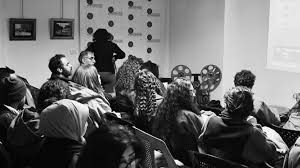
In a country where the very act of gathering can still feel like provocation, a stubborn constellation of private cinema clubs has emerged as one of Syria’s most eloquent forms of resistance. Not through slogans or barricades, but through flickering projectors, borrowed chairs, and the murmured debates that follow the closing credits. These are not grand institutions, but living rooms, shuttered cafés, abandoned halls and rooftop terraces where young Syrians insist on watching, discussing—and, most radically—staying.
In Jaramana, the sprawling, multi-confessional suburb southeast of Damascus that once absorbed waves of Iraqi refugees and displaced Syrians from across the country, Nasser Munzer founded the “Jaramana Cinema Club” to challenge the capital’s cultural monopoly. “We are here,” he says, “to prove that culture does not belong only to the centre.” Each week, Sunnis, Alawites, Christians, Druze and Iraqi Shi‘a sit side by side, debating films many of them have never seen on a big screen before. Following the recent massacres in Suwayda and unrest in Jaramana itself, post-screening discussions have grown raw—sometimes furious. Munzer does not flinch. “That is the entire point,” he insists. “If we cannot speak here, where the screen has just shown us someone else’s pain, then where can we speak at all?”
A few months after the fall of the Assad regime, Munzer launched the “Cinema of Freedom” series: 23 banned films documenting the revolution, the prisons, the chemical attacks, the disappearances. One evening they screened Ehab Tarabieh’s The Taste of Apples Is Red, shot clandestinely in an occupied Druze village in the Golan before the regime’s collapse. The film’s quiet dread—caught between Israeli occupation and the distant thunder of the Syrian uprising—struck the mixed audience like a slap. “For two hours,” Munzer recalls, “Druze viewers saw their own fear reflected, and everyone else finally understood it.”
Four hundred kilometres to the west, on the Mediterranean coast—where blood was again spilled just last March—Mohammad al-Youssef has kept the Latakia Cinema Club alive for eight years on little more than sheer resolve and his own salary. Since 2017 he has rented projectors, paid café owners out of pocket, and shifted venues weekly to evade harassment. After the regime’s fall, he paused for just one week—“the week the coast burned,” he says. Then, the young audience demanded to return. “Coming to the screening became their way of saying: we are still alive.” In a city that lost all four of its commercial cinemas during the war, and where entire generations of youth have emigrated, these gatherings have become a ritual of collective endurance. “Cinema,” al-Youssef says, “is how we treat fear.”
In the capital, the story is more bittersweet. Feras Mohammad’s “Beit al-Cinema” (House of Cinema) was once the beating heart of independent film culture, screening world classics in the historic al-Kindi theatre, with proper projection and surround sound—an almost forgotten luxury. It was a space where debate was fierce but protected, where long-banned films could finally breathe. After the regime fell, Feras hoped the Ministry of Culture would return the keys. Instead, al-Kindi remains closed—another casualty of bureaucratic inertia and evaporated political will. “We lost the best cinema hall in Damascus,” he says, his voice hollow. “Yielding to that closure feels like yielding to silence itself.”
Yet even in the rubble of that loss, new seeds are taking root. In the ancient alleys of Old Damascus, young director Raghd Bash has opened “Cinema Café,” deliberately after the fall of the regime. “This is not just a place to watch films,” she explains. “It’s a platform to prove that Syrians can still speak to one another without hating one another.” The café’s door is open to any filmmaker who wants to screen their work, no matter how rough. “Social media has become a sewer of resentment,” she adds. “Here, at least, we look each other in the eye.”
Rasha Milhem, whose new film On the Edge premieres next month at the American University in Kuwait, still remembers her first screening at a club outside the capital. Living in a vast dormitory suburb that had never known a cinema, the experience struck her like revelation: strangers debating passionately about framing, subtext and life—without mentioning sect or militia. “Those evenings,” she says, “taught me things about my own films I had never seen.”
Across the country, Munzer is quietly compiling what he calls a “map of community cinema spaces”—non-profit, unofficial venues where films are screened anywhere: a café in Aleppo, a study room in Homs, a tent in a displacement camp, even a street corner. In partnership with the Aflamna foundation, every pin on the map represents an act of faith that cinema can still stitch a torn society back together.
These young Syrians are not waiting for the state to rebuild cinemas that may never return. They are not waiting for perfect security or generous funding. They are borrowing projectors, passing the hat, moving chairs in the dark—and week after week, refusing to let Syria become a country that only knows how to mourn.
In a land where public gatherings have so often ended in gunfire, the simple act of sitting together, watching a film, and arguing about its meaning has become one of the bravest political statements left.
As Mohammad al-Youssef puts it, eyes gleaming with exhaustion and defiance: “If they force us out of the cafés, we’ll screen in our living rooms. If they take our living rooms, we’ll screen in the street. This is no longer just cinema. This is cultural resistance—and we are not going to lose twice.”
This article was translated and edited by The Syrian Observer. The Syrian Observer has not verified the content of this story. Responsibility for the information and views set out in this article lies entirely with the author.