
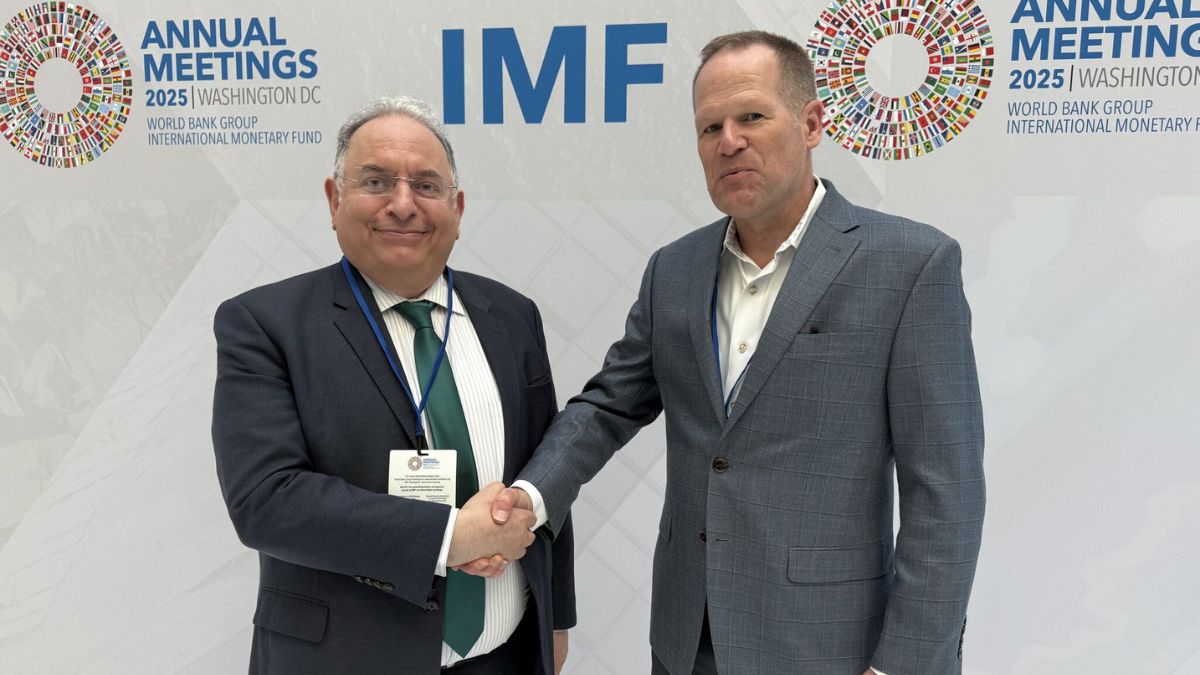
Syria is pursuing a $1 billion grant package from the World Bank, marking a significant step in its reintegration into the global financial system. For the first time in over a decade, Syria participated in the annual meetings of the International Monetary Fund (IMF) and World Bank in Washington, D.C., led by Finance Minister Mohammed Barnieh and Central Bank of Syria Governor Abdul Qader al-Husariya. The delegation’s presence reflects growing international interest in re-engaging Syria economically.
In a LinkedIn post on Saturday, October 18, Finance Minister Barnieh, following a meeting with Akihiko Nishio, World Bank Vice President for Development Finance, stated that Syria aims to secure approximately $1 billion in grants over the next three years. While the number of grants was not specified, discussions centered on the components of potential funding and associated conditions. Barnieh noted that Syria has “clear options” moving forward.
In a separate meeting with Charles North, Deputy CEO of the Global Partnership for Education (GPE), Barnieh emphasized Syria’s intent to access all available grants. The talks focused on securing financial support for Syria’s education sector, particularly technical education, building on prior discussions in Damascus between the Ministries of Education and Finance.
Reconstruction and Risk Mitigation
Syria also attended the periodic meeting of Arab states’ finance ministers and central bank governors (Arab Coordination Group) with World Bank Group President Ajay Banga. Barnieh reported that Banga directed the Bank to address Syria’s support needs. The minister expressed hope that the World Bank would mobilize resources for reconstruction projects, attract private capital, and leverage the International Finance Corporation (IFC) and the Multilateral Investment Guarantee Agency (MIGA) to provide guarantees that mitigate investment risks in Syria.
Syria is a founding member of five institutions within the Arab Coordination Group, which comprises ten entities: the Islamic Development Bank Group, the Arab Fund for Economic and Social Development, the Arab Monetary Fund, the Kuwait Fund for Arab Economic Development, the Abu Dhabi Fund for Development, the Qatar Fund for Development, the OPEC Fund, the Arab Bank for Economic Development in Africa, the Arab Authority for Food Security, and the Arab Gulf Programme for Development (AGFUND). The group has provided over $300 billion in financing for approximately 13,000 projects across 160 countries. Syria has benefited from most of these institutions in past decades.
AGFUND: Increased Investment in Syria
Prince Abdul Aziz bin Talal bin Abdul Aziz Al Saud, Chairman of AGFUND, confirmed during a meeting with Barnieh a renewed focus on Syria, emphasizing investments in microfinance and higher education. Barnieh noted that Syria is receiving “unprecedented attention and welcome” wherever it engages.
Financial Discussions with the U.S. Treasury
Barnieh also met with Eric Meyer, U.S. Treasury Deputy Assistant Secretary for the Middle East, to discuss support for Syrian financial reforms and capacity-building in public finance and the financial sector. Barnieh highlighted significant progress in Syrian-U.S. financial cooperation.
In meetings with World Bank officials, Barnieh stressed that the Bank is mobilizing technical support for Syria and laying the groundwork for comprehensive strategic cooperation across all its institutions and sectors in the country. These discussions focused on planned World Bank programs in Syria, including:
- Collaboration with Bank experts on public finance, financial management, and enhancing economic and financial forecasting and modeling.
- Human development, encompassing health, education, social protection, and poverty reduction.
- Financial and banking sector support, including payment systems and financial infrastructure development.
- Infrastructure cooperation in energy, transportation, housing, and mortgage financing.
- Digital transformation and support for the digital economy.
- Sustainable development, environmental support, water management, and reforestation.
- Private sector support and improving the investment climate.
Barnieh confirmed that a comprehensive framework document with clear objectives and timelines will be developed for these areas. He added that World Bank expert teams will work with Syrian ministries and institutions, coordinated by the Ministry of Foreign Affairs and Expatriates’ international cooperation team.
Additionally, a Syrian financial meeting with the IMF’s policy director agreed on key priorities for the coming phase:
- Supporting disciplined fiscal policies.
- Reducing rising debt levels.
- Strengthening central bank independence.
- Promoting digital transformation while monitoring systemic risks.
- Continuing structural reforms to improve the investment climate and combat corruption.
- Reinforcing the global financial safety net.
This article was translated and edited by The Syrian Observer. The Syrian Observer has not verified the content of this story. Responsibility for the information and views set out in this article lies entirely with the author.