
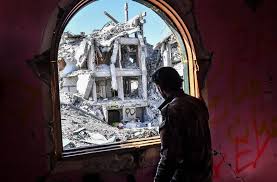
Fourteen years of war have left Syrian cities scarred and hollowed out. As the guns fall largely silent, the promise of reconstruction confronts harsh economic realities, legal uncertainty and lingering security concerns. Officials speak of new funding and foreign openness; economists warn that the gulf between need and capacity remains immense.
Lives in Limbo
For many displaced families, the notion of “return” remains a slogan rather than a concrete plan. Jahida Qartoumah, 65, fled Jobar during relentless bombardment and now moves between rented rooms with the help of charity. When a neighbour showed her a video of her old neighbourhood after the regime’s fall, she could not recognise her own building. “They erased everything,” she said, describing the moment as reliving “an entire life on fast-forward—then rubble.”
In Eastern Ghouta, Raed Taameh, 45, watched an airstrike hit his house in Hazzeh before fleeing to Idlib in 2018. Returning this year, he found only the shell of a home, requiring more than $5,000 in basic repairs — money he does not have. “No one called about reconstruction,” he said. “Only a few blankets and mattresses from the Red Crescent.”
From Harasta, Ahmad al-Tayer returned to find his building flattened. Rents in Rural Damascus now exceed those near Aleppo, utilities are unreliable, and services are sparse. “We’re forgotten,” he said. “The first real investment should be bringing the displaced home.”
The Price Tag—and the Clock
Exact nationwide damage assessments are elusive, but widely cited estimates place Syria’s reconstruction cost between $250 billion and $400 billion, with some reaching as high as $800 billion. A 2021 World Bank estimate clustered around $400 billion for core infrastructure and private sector recovery, while a 2023 UN assessment suggested around $180 billion for priority housing and essential services. Since then, political shifts and renewed destruction have raised both expectations and costs.
The social baseline is stark: more than 16 million people in need of assistance within Syria, and nearly 90% of the population living below the poverty line, according to UN data.
Economic forecasts remain muted. The World Bank projects a modest 1% GDP growth in 2025, following a 1.5% contraction in 2024. Recovery remains hampered by ongoing security frictions, frozen foreign assets and limited access to global banking systems. A January brief from ESCWA outlined a theoretical 13% annual growth from 2024 to 2030 — yet even under that scenario, Syria’s total output would only reach around 80% of pre-war levels by the end of the decade, and GDP per capita just half of 2010. A full return to pre-war GDP could require another six years at 5% growth, pushing benchmarks into the mid-2030s.
Law, Governance, and Donor Red Lines
Despite a warmer international climate and the partial easing of sanctions, legal and political headwinds persist. Economists continue to highlight Law No. 10 (2018) — which grants the state sweeping powers over urban redevelopment — as a major source of concern for both citizens and investors regarding property rights.
Donor conditions focusing on transparency, anti-corruption, and rights protections remain critical. UN and IMF experts routinely identify governance weaknesses as the greatest obstacle to effective rebuilding.
Current government plans aim to reform judicial and oversight institutions, embedding accountability measures in public procurement. A 2019 Carnegie analysis emphasised three pillars for sustainable recovery:
- Inclusive political transition
- Checks on entrenched power
- Socioeconomic uplift for vulnerable populations
In the absence of these, experts warn, the risk of exclusion and relapse remains high.
Local Money, Local Limits
With sovereign borrowing unavailable and large-scale grants uncertain, the government is leaning on domestic fundraising campaigns and a new national fund:
- “Wednesday of Homs” (13 August): $13 million pledged for energy, health and cultural heritage projects, including Tadmor Hospital.
- “Abshiri Horan” (Daraa) (launched 25 August): Targeted $32.74 million; surpassed $44 million in two weeks.
- Syrian Development Fund (4 September): Flagship initiative with over $82 million in donations and subscriptions, designed to coordinate efforts across state institutions, private sector, civil society and diaspora.
- “Deir al-‘Izz” (Deir ez-Zor) (11 September): Over $26 million raised within hours.
- “Rifna Bistahel” (Rural Damascus) (20 September): More than $70 million pledged within the first few hours, aimed at devastated suburbs such as Eastern Ghouta, Daraya, Madaya, Zabadani and Jobar.
Together, these campaigns have pledged approximately $230 million in recent weeks — significant in domestic terms, but dwarfed by overall reconstruction needs. Daraa Governorate alone estimates $60 billion for comprehensive rehabilitation. Local economist Abdulrahman Mohammed described the drives as “a sign of social vitality,” but cautioned that without rigorous transparency and execution, their impact would remain limited to small and medium-scale projects.
International Signals: Easing, but Not a Windfall
- European Union: In June, the EU announced €175 million for socio-economic recovery programmes (energy, health, education, agriculture, livelihoods), part of a broader €5.8 billion commitment to Syria and host countries. Earlier in February, Brussels eased sectoral sanctions (energy, transport, banking) to facilitate reconstruction, while maintaining restrictions on former regime figures and calling for the use of frozen assets for justice and reparations.
- UN Engagement: Former UN envoy Geir Pedersen reiterated that meaningful political reform remains essential for sustainable peace and rebuilding. A May UN update cited over 1.5 million refugee and IDP returns since Assad’s fall, and called for a significant scale-up in international financing.
- Financial Re-entry: In April, Saudi Arabia and Qatar paid Syria’s $15 million arrears to the World Bank, clearing the path for renewed development finance. In June, the Bank approved a $146 million Syria Electricity Emergency Project (SEEP) to restore key grid components and provide technical support.
Competing Playbooks for Recovery
Regional priorities focus on basic infrastructure, home repairs and labour market absorption to support refugee return, ease demographic pressure and reopen trade routes.
Western priorities demand legal predictability, reliable project pipelines and functioning financial systems. That means accessible ports and airports, viable banking channels, wage levels that support imports, and stable regulatory environments.
Syria-focused strategies advocate a phased, localised recovery model: community-funded projects, incremental infrastructure improvements, domestic private investment, wage recovery, tax reform and competitive regional development zones. The goal is to rebuild from within and earn international reintegration over time.
The Road Ahead
Ultimately, Syria’s reconstruction rests on three intertwined factors: funding, governance, and legitimacy.
- Funding: Domestic efforts and initial multilateral windows are promising but insufficient.
- Governance: Effective oversight, honest procurement, and timely delivery will determine whether early wins can generate sustained progress.
- Legitimacy: Inclusive politics and clear property protections — especially around laws like No. 10 — are essential to attract diaspora capital and foreign investment at scale.
“Reconstruction is not a construction site — it’s a social contract,” said economist Mohammad al-Saloum, arguing that if corruption is confronted and partnerships fostered, a decades-long rebuild could become a transformative decade.
For Jahida, Raed and Ahmad, transformation is measured more simply: a functioning light switch, a sealed roof, and a door that locks. Until then, “rebuilding” remains a promise deferred — and a dream not yet realised.
This article was translated and edited by The Syrian Observer. The Syrian Observer has not verified the content of this story. Responsibility for the information and views set out in this article lies entirely with the author.